EN
 Español
A 0.3 kWh/kg target is a line-level outcome, not a single machine specification. It becomes realistic only when high output, efficient cooling, a matched screw-and-die combination, and disciplined auxiliary load management operate together. On a low-output mono-layer line, the same target is usually not a fair comparison. This article breaks down where the energy goes, what 0.3 kWh/kg actually demands, and how buyers should read energy claims before a purchase decision.
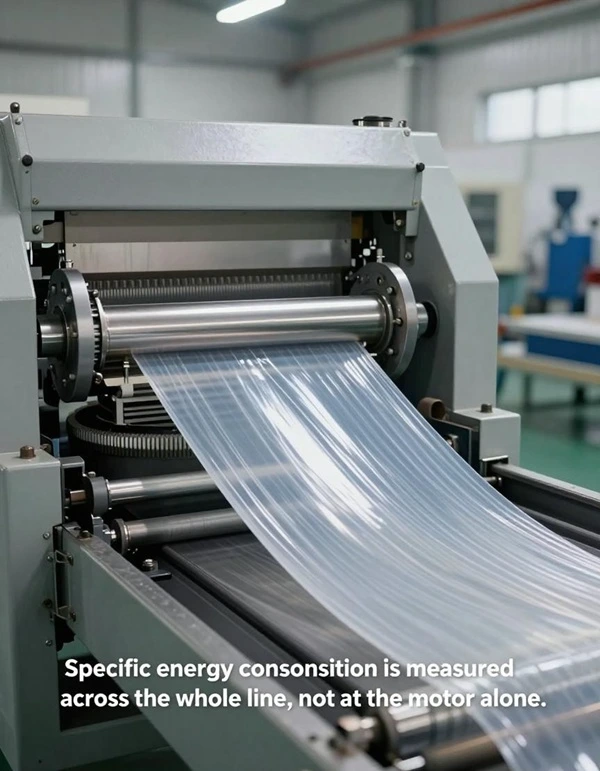
Why kWh/kg is a system number, not a motor number
Specific energy consumption on a blown film line is total electrical demand divided by output: kilowatt-hours consumed per kilogram of film produced. That definition sounds simple, but it immediately exposes the core issue. A line with a 55 kW main motor does not have a fixed kWh/kg value. The same motor, running at a higher output with better cooling and lower auxiliary losses, can deliver a materially lower kWh/kg than an identical motor on a line that is output-limited by cooling or haul-off.
This is why comparing kWh/kg figures without the corresponding output, material, thickness, and line configuration is unreliable. A figure measured at 1,000 kg/h on a high-output multi-layer line is not transferable to a 80–90 kg/h mono-layer operation. The metric is useful, but only when it travels with its operating context.
Where the energy actually goes
Published extrusion energy breakdowns consistently show that the main drive is the largest single consumer, but not the majority of total line demand. A commonly cited breakdown puts the main drive at roughly 50–52% of electricity, barrel heaters at about 26%, cooling pumps and fans around 9%, haul-off and winder about 8%, and vacuum/compressed air around 5%. Yongbang's own technical article on VFD retrofits uses a slightly different split—main motor around 30%, barrel heating 25–35%, air ring blower 5–10%, haul-off about 5%, winder 3–5%—and explicitly notes that percentages vary significantly by line configuration, material, and operating conditions.
The exact split matters less than the implication: kWh/kg is influenced by every major subsystem. A motor-side improvement that reduces main drive consumption by 20% does not reduce line-level kWh/kg by 20%. If the main drive is roughly half of total demand, the line-level effect is closer to 10%, and only if output and other loads remain unchanged. Conversely, a cooling constraint that caps output forces the motor and heaters to run at a less favorable point, raising kWh/kg even though no individual component has “failed.”
| Energy consumer | Approximate share of line demand (varies by configuration) | Directly addressed by motor efficiency? | Primary lever for kWh/kg |
|---|---|---|---|
| Extruder main drive | ~30–52% | Partially | Screw design, drive efficiency, output matching |
| Barrel heating | ~25–35% | No | Screw design, insulation, heater control |
| Air ring / IBC blower | ~5–10% | Often yes (variable speed) | Cooling efficiency, blower control |
| Haul-off / nip | ~5–8% | Sometimes | Mechanical efficiency |
| Winder | ~3–5% | Sometimes | Tension control |
| Auxiliary (chiller, compressor, vacuum) | Variable | No | System-level load management |
Ranges reflect published extrusion energy studies and Yongbang's technical notes; actual shares depend on material, line size, and operating point.
What 0.3 kWh/kg actually requires
A 0.3 kWh/kg result is reported in the industry, but it is typically associated with high-output, well-integrated lines rather than small mono-layer machines. One recent high-capacity five-layer example is cited at 1,000 kg/h with 0.3 kWh/kg, and another high-performance system is described at 0.37 kWh/kg with a 300 mm die, compared against a stated industry average around 0.5 kWh/kg. A technical guide for ABA configurations describes 0.30–0.35 kWh/kg at 120–150 kg/h with a 200 mm die and IBC cage, but explicitly ties that range to a specific steady-state condition.
These references do not contradict each other. They illustrate that 0.3 kWh/kg is not a universal benchmark. It is a value that appears when several conditions align:
1. Output must be high enough for fixed loads to be diluted. Heaters, blowers, and auxiliary systems draw power whether the line runs at 80 kg/h or 300 kg/h. At low output, fixed and semi-fixed loads dominate the per-kilogram figure. At higher output, the same kW draw is spread over more kilograms. This is the single most misunderstood point about kWh/kg claims: the denominator matters as much as the numerator.
2. Cooling must not be the bottleneck. If the air ring or IBC system cannot remove heat fast enough, the line’s output ceiling is set by cooling, not by the extruder. Running the extruder below its efficient output range while heaters and blowers continue to draw power pushes kWh/kg upward. IBC and high-efficiency air ring designs expand the output envelope by accelerating frost line formation and supporting higher extrusion rates. The energy benefit is indirect but real: more kilograms per hour through the same installed kW.
3. The screw, die, and drive must be matched to the material and output target. Screw design has a measurable influence on specific energy. Barrier screws, mixing sections, and compression ratio choices change the balance between mechanical shear heat and pressure build, and therefore the motor load required per kilogram. Yongbang’s material-specific screw configurations—for example, a 3.5:1 compression ratio and 28:1 L/D for HDPE, and a lower 2.8:1 ratio and 25:1 L/D for LDPE—are examples of matching the plasticating unit to the polymer rather than applying a single geometry across materials. A line optimized for one material and output range will not automatically reproduce the same kWh/kg when switched to a different resin or a much lower output.
4. Auxiliary loads must be managed, not ignored. Chillers, compressed air, vacuum, and over-sized blowers can add load that never appears on the extruder nameplate. Variable-frequency control on blowers and pumps is one lever; replacing throttling with speed control is another. But the buyer’s first step is to ask for a line-level load schedule, not just a main motor kW figure.
Mono-layer lines: why 0.3 is usually the wrong comparison
A mono-layer line producing 80–90 kg/h with an 11–18.5 kW main motor operates in a different economic and technical regime from a 1,000 kg/h five-layer line. At lower output, the fixed and semi-fixed portions of the load—heaters, blowers, haul-off, winder—represent a larger share of total kWh. Even a perfectly efficient extruder cannot dilute those loads to the same degree as a high-output line.
This does not mean mono-layer lines are inefficient. It means kWh/kg comparisons must be made within the same output class and product type. A mono-layer line making T-shirt bags or protective film at 80–90 kg/h should be evaluated against its own output band, material, and thickness, not against a high-output multi-layer benchmark. Buyers who apply a 0.3 kWh/kg target indiscriminately to a small mono-layer project may reject a technically appropriate configuration for failing to meet a number that was never designed for that scale.
How to evaluate an energy claim before you buy
Checklist for a kWh/kg claim review
- Ask for the output at which the figure was measured. A kWh/kg value without kg/h is not actionable.
- Confirm the material and thickness. LDPE, HDPE, LLDPE, and biodegradable blends have different specific energy profiles.
- Ask whether the figure is steady-state or includes start-up, purging, and shutdown. Start-up losses are real operating costs but are often excluded from headline numbers.
- Request the boundary of measurement. Is it the extruder only, the complete line including chiller and compressor, or the line plus downstream? Each boundary gives a different number.
- Check whether the test was on a specific die and air ring configuration. Die diameter, die gap, and cooling design affect output and therefore kWh/kg.
- Ask how auxiliary loads are metered. If the chiller and compressed air are excluded, the figure understates plant-level energy per kilogram.
- Verify the drive type and control. A fixed-speed drive with throttling and a modern VFD with sensorless vector control can produce different results on the same mechanical hardware.
A supplier who can answer these questions with measurement conditions is more useful than one who quotes a single kWh/kg number without context. The same discipline applies when reviewing any energy-related specification: the number is only as good as the conditions attached to it.
FAQ
Does a lower kWh/kg always mean a better line?
No. A lower kWh/kg can reflect a genuinely efficient line, or it can reflect a measurement taken at a high output point that is not representative of the buyer’s production mix. The relevant question is whether the line achieves a competitive kWh/kg at the output, material, and product mix the buyer actually intends to run.
Can a mono-layer line reach 0.3 kWh/kg?
Published figures around 0.3 kWh/kg are typically associated with high-output, integrated lines. A mono-layer line in the 80–90 kg/h class operates with a different fixed-load-to-output ratio, and its appropriate kWh/kg target should be established within that class. Buyers should discuss the expected output band and product specification with the supplier rather than importing a benchmark from a different scale.
How much does IBC cooling change kWh/kg?
IBC improves cooling capacity and can support higher output through the same die and extruder. The kWh/kg effect is largely indirect: more kilograms per hour through the installed load lowers the per-kilogram figure. The exact change depends on material, die design, and how close the original line was to its cooling limit, and should be confirmed through line testing.
Is barrel heating or the main motor the bigger lever for kWh/kg?
Both matter, but in different ways. The main drive is usually the largest single load, while barrel heating is a substantial secondary load. Motor-side measures such as VFD retrofits address only the motor portion; heater optimization, insulation, and screw design affect the thermal side. A line-level assessment is needed to avoid optimizing one subsystem while another remains the binding constraint.
Can I compare kWh/kg across different film products?
Only with caution. Film thickness, material density, additive package, and downstream converting requirements all influence the energy required per kilogram. A thin HDPE film and a thicker LDPE film are not directly comparable even on the same line. Comparisons should be made within the same product family and thickness range.
Conclusion
A 0.3 kWh/kg target is best understood as a conditional outcome: it tells you what a line can achieve when output, cooling, screw design, and auxiliary load management are aligned. It is not a label that can be attached to any blown film machine regardless of scale. Before using kWh/kg as a purchase criterion, confirm the output and material conditions behind the number, ask for the measurement boundary, and compare within the same production class. If you are evaluating configurations for a specific output range and film structure, reviewing the available blown film machine configurations and the mono-layer line options is a practical next step—and a technical discussion of your output, material, and product mix will produce a more useful energy estimate than any standalone benchmark.
 Brochure Download
 FAQ