How does YONGBANG's IBC cooling system achieve a thickness deviation of ≤±3% in film blowing machines?
Our IBC (Internal Bubble Cooling) system uses a closed-loop control loop with high-precision sensors to monitor the bubble profile in real-time. It automatically adjusts the cooling airflow volume and pressure around the bubble, ensuring uniform heat dissipation. This eliminates “thin spots” and “thick rings,” guaranteeing consistent film thickness critical for high-quality printing and bag making. This technology is a core patent of YONGBANG.
What is the actual output per hour of your 33:1 L/D ratio alloy screw for LDPE film production?
For a standard 80mm screw processing LDPE, our 33:1 alloy screw can achieve outputs between 180-220 kg/h, which is 25-30% higher than conventional 30:1 screws. The increased length provides better plasticizing, mixing, and stability, especially when using recycled materials. You can request a material-specific output test report based on your raw material formula.
How much can I save on energy costs with a YONGBANG variable frequency drive (VFD) film blowing line?
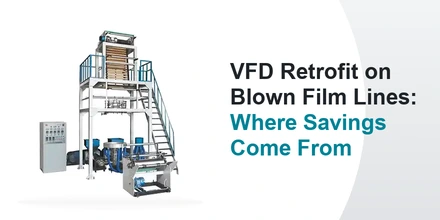
Our integrated VFD system optimizes motor speed based on real-time load, reducing idle energy waste. On average, clients report energy savings of 15-20% annually. For a line running 24/7, this can translate to tens of thousands of dollars saved over 3-5 years, giving you a rapid ROI beyond the initial machine price.
Can your multi-layer coextrusion film blowing machine process a core layer with 50% calcium carbonate (CaCO3) filler?
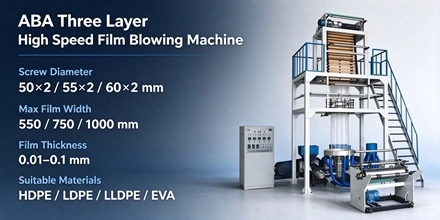
Absolutely. Our specialized screw and die design for A/B/A structures are engineered for high-filling ratios. We have successfully configured lines where the B-layer contains 40-50% CaCO3, significantly reducing raw material costs while maintaining film strength and printability on the virgin surface layers. We provide process parameter support from our database of 2000+ materials.
Is a 5-layer coextrusion film blowing machine worth the investment over a 3-layer model for high-barrier packaging?
It depends on your product requirements. A 5-layer machine (e.g., A/B/C/B/A) allows you to use a dedicated thin layer of EVOH or PA for ultra-high barrier properties at a lower overall cost than a 3-layer structure with a thicker barrier layer. For medium barriers, a 3-layer may suffice. We offer a free technical consultation to analyze your needs and recommend the most cost-effective structure for your target shelf life and budget.
How many operators are needed to run a complete YONGBANG high-speed film blowing and bag making line?
With our fully integrated and automated lines, one primary operator can oversee the entire process from pellet feeding to finished bag stacking, especially with automated winding and conveying systems. This modular “smart factory” design drastically reduces labor costs and human error, a key advantage we highlight against semi-automatic setups.
What is the expected service life of the bimetallic barrel in your film blowing machines under continuous operation?
Our bimetallic barrel, lined with a tungsten carbide-based alloy, has a wear resistance 3 times greater than ordinary steel barrels. Under normal HDPE/LLDPE processing, it supports over 10 years of continuous operation before significant wear affects output. This translates to lower maintenance costs and sustained production quality over the machine’s lifetime.
What kind of after-sales support and spare parts availability does YONGBANG offer globally?
We provide 24/7 remote technical support and maintain a 500+ standardized spare parts inventory for immediate dispatch. With agents in over 40 countries, we ensure localized service. Every machine comes with a comprehensive digital manual and video guide. Our goal is to guarantee your uptime with response within 12 hours for critical issues.
Can you customize the electrical system of the film blowing machine to match our existing factory's Siemens PLC standard?
Yes, flexible electrical configuration is our strength. You can choose from Siemens, Mitsubishi, or other brand PLC systems. We ensure seamless integration with your existing control environment, reducing operator retraining time and maintenance complexity. This is part of our “deep customization of core parts” philosophy.
Do you have reference projects for film blowing machines producing compostable PLA/PBAT films?
Yes. We have successfully delivered multiple turnkey lines for compostable film production in Europe and North America. These projects involved precise temperature profile control and screw design modifications for PLA/PBAT blends. We can arrange virtual tours or provide confidential case studies (with client permission) to demonstrate our proven capability in this growing niche.
What are the key advantages of your film blowing machines?
Our machines are renowned for three key advantages: 1) Robust Construction for long-term stability and reliability; 2) Intelligent Control Systems for ease of use and superior product quality; and 3) Customization Flexibility to tailor the machine to your exact film production needs, not just a one-size-fits-all solution.
What materials are compatible with your blown film machines?
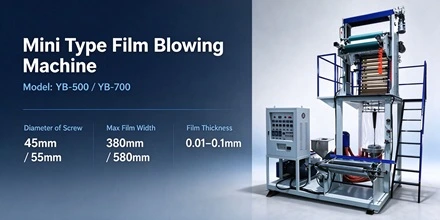
Our machines are engineered to process a broad spectrum of thermoplastic materials, including HDPE, LDPE, LLDPE, and EVA. We also support the processing of biodegradable materials, making our equipment adaptable to sustainable production needs.
Are your film blowing lines energy-efficient?
Absolutely. Energy efficiency is a core design principle. Our machines feature high-efficiency AC motors, optimized screw designs for lower torque, and advanced IBC (Internal Bubble Cooling) systems that significantly reduce cooling time and overall energy consumption, providing you with a lower cost of operation.

 EN
EN Español