EN
 Español
Direct answer: In a co-extruded silage wrap film, UV stabilization belongs in the outer layer because that is the surface exposed to sunlight. Placing UV stabilizers in the core wastes additive where it cannot intercept radiation, and can compromise the core’s puncture and tensile function. The practical question is not whether to use a co-extrusion line, but how to assign UV and tack functions to the correct layer, and how to specify layer ratio and thickness so the outer layer performs reliably across the intended storage period.
Why “just add UV masterbatch” is not a layer strategy
A monolayer silage wrap line can technically incorporate UV stabilizers into the single melt stream. But that approach forces every performance requirement into one formulation: the same layer must carry UV protection, tack, puncture resistance, tensile strength, and oxygen barrier. In practice, these requirements pull in different directions. Tack additives belong at the surface where film-to-film contact occurs; UV stabilizers need to be at the surface where solar radiation strikes; puncture resistance and tensile strength are best served by a core layer rich in LLDPE or mLLDPE. When all of these are compounded into one layer, the formulator is forced into compromises that show up as either reduced tack, reduced mechanical strength, or higher additive consumption than necessary.
Co-extrusion changes the problem from “one formulation must do everything” to “each layer does what it is best positioned to do.” That is the structural reason why silage wrap films are commonly produced on multilayer co-extrusion lines rather than monolayer lines.
The layer-function logic of a silage wrap film
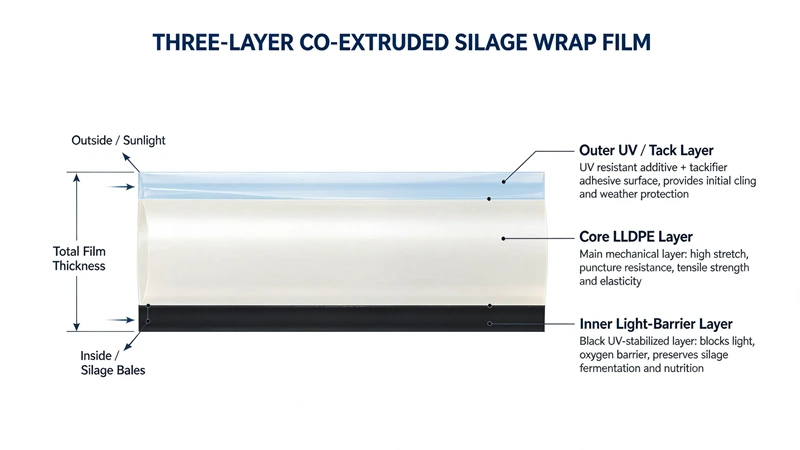
A functional silage wrap structure can be understood through three roles, regardless of whether the line has two, three, or more extruders.
Outer layer: UV protection and surface tack. The outer surface is the first barrier against solar radiation and the surface that contacts adjacent film layers during wrapping. UV stabilizers in this layer can intercept radiation before it reaches the core. Tack additives in this layer can create the film-to-film adhesion that expels air and supports anaerobic conditions. Industry descriptions of silage stretch film manufacturing consistently place UV stabilizers and high-tack additives in the outer layers for precisely these reasons.
Core layer: mechanical integrity and puncture resistance. The core layer is typically the thickest portion of the film. LLDPE and mLLDPE in the core provide the puncture resistance and tensile strength needed to withstand sharp forage stalks and wrapping tension. If UV stabilizers or tack additives are loaded into the core instead of the outer layers, they consume core volume that could otherwise be used for mechanical performance.
Inner layer (where present): sealing and adhesion. In a three-layer or higher structure, the inner surface may carry additional tack or sealing functionality. But the UV function remains an outer-layer responsibility.
What ABA and ABC structures mean for this layer logic
The ABA and ABC designations describe how extruders are assigned to layers, not a fixed formulation. Both can produce a functional silage wrap film, but they differ in how much independent control the processor has over each layer.
| Structural consideration | ABA (symmetric three-layer, A/B/A) | ABC (asymmetric three-layer, A/B/C) |
| Extruder count | Two extruders feed three layers; the two A layers share a melt stream | Three independent extruders, one per layer |
| Outer-layer independence | Both outer layers are identical by design; UV and tack in the A layer apply to both surfaces | Outer layers can be formulated independently; one surface can be optimized for UV/tack while the other serves a different function |
| Core formulation freedom | Core can carry recycled or lower-cost material while outer A layers preserve surface properties | Core and each outer layer can be tuned separately |
| Typical fit for silage wrap | Practical when both surfaces need similar UV/tack behavior and cost control is a priority | Relevant when one surface requires a different functional emphasis, or when layer ratio precision across three distinct melts is required |
For silage wrap specifically, ABA is a workable structure when the film is wrapped with both surfaces contacting the previous layer and both surfaces need comparable UV and tack performance. ABC becomes relevant when the production plan includes surface-differentiated films, or when the processor wants independent layer-ratio control across three distinct polymer streams. Yongbang’s application guidance recommends ABA three-layer machines for agricultural films generally, citing UV resistance and cost-effectiveness through layer-specific material combination; the ABC series is positioned for asymmetric functional layer design where each layer serves a distinct role.
The key point for a buyer is this: the structure name does not guarantee UV performance. What matters is whether the line can hold the intended layer ratio at the intended total thickness, and whether the outer-layer extruder is configured to handle the UV masterbatch and tack additive without dispersion problems.
Why layer ratio and total thickness are the specification variables that decide UV life
UV protection in silage wrap is not a single “additive percentage.” It is a function of three interacting variables:
- UV stabilizer concentration in the outer layer. This is the formulation variable, typically confirmed through masterbatch loading and dispersion quality. The outer layer must be thick enough to carry the required additive loading without becoming mechanically fragile.
- Outer-layer thickness as a share of total film thickness. If the total film is 25 μm and the outer layer is 10% of that, the UV-bearing layer is 2.5 μm. That may be sufficient for a short storage period but marginal for longer exposure. If the outer layer share is increased, UV-bearing volume increases, but the core share decreases, which can affect puncture resistance. Layer ratio is therefore a trade-off decision, not a “higher is better” setting.
- Total film thickness and stretch ratio in the field. Silage wrap is applied under stretch. A film specified at 25 μm before stretching becomes thinner after elongation. The outer layer’s effective UV-bearing thickness after stretch is what matters at the bale surface. Buyers should confirm the intended stretch ratio and the corresponding pre-stretch thickness, not only the nominal gauge on the roll.
There is no universal “correct” layer ratio or UV loading that applies to every climate and storage duration. These values should be confirmed against the intended storage period, solar exposure conditions, and the mechanical performance required for the forage being wrapped. A line supplier can support the layer-ratio and thickness configuration, but the formulation targets should be validated through film testing under representative conditions.
What to specify before committing to a blown film line for silage wrap
The following checklist is organized around the decisions that affect whether the outer UV layer actually performs as intended.
Checklist: silage wrap outer-layer UV specification
- Confirm the functional layer map. Decide which surface carries UV, which carries tack, and which layer carries the mechanical load. Document this before discussing extruder configuration.
- Confirm UV masterbatch carrier compatibility. The outer-layer extruder must handle the carrier resin and loading level without screw slip, dispersion defects, or excessive pressure fluctuation.
- Confirm layer-ratio control method. Ask how the line controls the outer-layer share: metering pump, screw speed, or both. The accuracy of this control directly affects UV-bearing thickness consistency.
- Confirm achievable outer-layer thickness range. State the target total thickness and target outer-layer percentage; ask for the minimum and maximum outer-layer thickness the line can hold stably.
- Confirm tack additive placement. If tack is also an outer-layer function, confirm whether the same extruder handles both UV and tack masterbatches, or whether a separate layer is needed.
- Confirm die and air-ring capability for the intended output. Layer uniformity at the die exit and bubble stability affect whether the outer layer remains uniformly thick around the circumference.
- Confirm the validation plan. Agree on film testing for UV-related performance under representative conditions before accepting the line specification.
For buyers evaluating the ABA route, the relevant configuration questions center on whether the shared A-layer melt stream can carry the required UV and tack loading while maintaining the target outer-layer thickness. For the ABC route, the questions center on independent layer-ratio precision across three extruders and the flexibility to differentiate outer-layer formulations if needed. Reviewing the available ABA configurations and ABC layer-control capabilities side by side is a practical way to match the structure to the film specification rather than the other way around.
A note on “UV resistance” claims
“UV resistant” is not a standardized single value. Different suppliers and standards use different exposure conditions, test durations, and pass/fail criteria. Some silage wrap products reference UV durability tested under ISO 4892-2 xenon-arc conditions, while commercial guarantees may state a storage duration under defined stretch and climate assumptions. When comparing line specifications or film formulations, buyers should ask what test method supports the UV claim and under what stretch ratio and climate assumptions it was established. A line that holds layer ratio precisely gives a formulator a better starting point, but the UV performance claim itself depends on the film formulation and the agreed test protocol, not on the machine alone.
FAQ
Does the UV stabilizer have to be in the outer layer, or can it be in all layers?
UV stabilizers can be placed in more than one layer, but the functional minimum is the outer layer exposed to solar radiation. Placing UV stabilizers in the core does not intercept radiation at the surface and consumes core volume that could serve mechanical performance. A multilayer structure allows the UV loading to be concentrated where it is functionally needed.
Can an ABA line produce a silage wrap with different UV levels on the two outer surfaces?
ABA is a symmetric structure: both A layers share the same melt stream. If both surfaces require the same UV and tack performance, ABA can be appropriate. If one surface needs a different UV level or a different surface function, an ABC structure with independent outer-layer extruders provides that flexibility.
What layer ratio is typical for the UV-bearing outer layer in silage wrap?
There is no universal ratio. The outer-layer share depends on the intended UV loading, the total film thickness, the stretch ratio used in the field, and the storage duration. A ratio that works for a short-season climate may be insufficient for longer exposure. The ratio should be confirmed through film testing under representative conditions, not copied from a generic table.
Does a thicker outer layer always mean better UV protection?
Not necessarily. A thicker outer layer carries more UV-bearing volume, but it also reduces the core share, which can affect puncture resistance and tensile strength. The goal is a balanced structure where the outer layer is thick enough to carry the required UV function and the core remains thick enough for mechanical performance.
How does stretch ratio affect the UV layer’s effective thickness?
Silage wrap is applied under stretch, so the film thins after elongation. A film with a given pre-stretch outer-layer thickness will have a lower effective UV-bearing thickness at the bale surface. Buyers should specify the intended stretch ratio and confirm the pre-stretch thickness and layer ratio that correspond to that application condition.
Conclusion
The outer layer does the UV work in silage wrap because it is the surface that meets solar radiation and the surface that must also manage film-to-film contact. The specification question is therefore not “which machine has UV protection,” but “which structure and layer-ratio control let the outer layer carry UV and tack reliably at the intended total thickness and stretch ratio.” ABA offers a practical symmetric route when both surfaces need comparable performance; ABC offers independent outer-layer control when the film design requires surface differentiation. Before committing to a line, confirm the functional layer map, the outer-layer thickness range the line can hold, and the validation protocol for UV-related film performance. The agricultural film application overview provides context on how ABA and ABC structures are positioned for these requirements, and the ABA and ABC sections allow a direct comparison of the layer-control capabilities relevant to silage wrap specification.
 Brochure Download
 FAQ