EN
 Español
Both ABA and ABC lines produce three-layer film. That is where the similarity that matters most to buyers ends. The practical difference is not the number of layers on the specification sheet—it is how many extruders feed the die. ABA uses two extruders to create a symmetric A/B/A structure. ABC uses three independently controlled extruders to create an asymmetric A/B/C structure. If two identical outer surfaces and a cost-optimized core meet your film requirements, ABA is usually the appropriate configuration. If the outer and inner surfaces must perform different functions—such as high sealability on one side and abrasion or barrier resistance on the other—ABC’s third extruder is the deciding factor.
This article provides a decision sequence based on extruder count, not layer count, so that buyers can match the configuration to the film’s functional requirements rather than to the marketing shorthand “3-layer.”
The source of confusion: same layer count, different architecture
A three-layer film simply means that three molten polymer streams converge in the die and exit as a single bubble with three identifiable strata. It does not specify how many extruders are connected to that die, whether the outer layers share the same resin, or whether each layer can be independently optimized.
An ABA line connects two extruders to a die with three flow channels. The “A” extruder feeds both outer layers, and the “B” extruder feeds the core. The resulting film is symmetric: the surface that touches the inside of the bag and the surface that faces outward have the same resin composition.
An ABC line connects three separate extruders to a three-channel die. Each of the A, B, and C layers can receive a different resin, a different formulation, or a different additive package. The film can be asymmetric—the outer skin and the inner sealant layer no longer need to be identical.
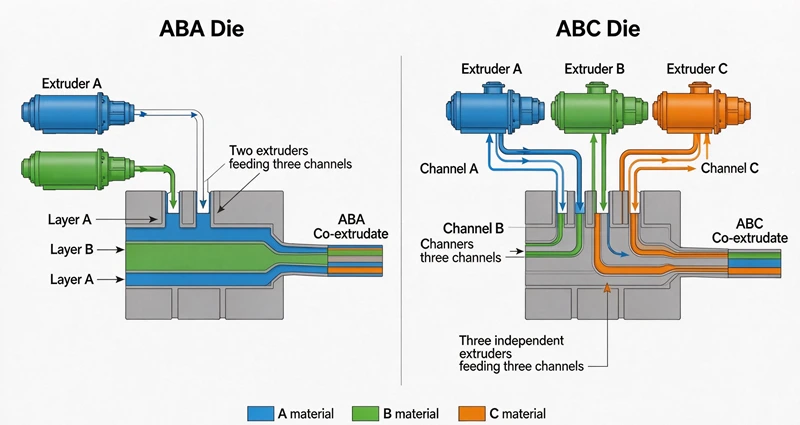
The table below summarizes the differences that affect selection.
| Decision variable | ABA (2 extruders, 3 layers) | ABC (3 extruders, 3 layers) |
|---|---|---|
| Extruder count | 2 | 3 |
| Layer structure | A/B/A — symmetric | A/B/C — asymmetric possible |
| Outer surfaces | Identical resin composition | Each skin can use a different resin |
| Core layer | Can carry recycled or cost-saving material | Can carry recycled or functional material |
| Independent functional design | Limited to two material streams | Three independent material streams |
| Typical film behaviour | Balanced stiffness, consistent both sides, reduced curl tendency | Can combine distinct seal, barrier, and strength functions in one structure |
| Setup and control complexity | Lower—two extruder profiles to balance | Higher—three extruder profiles to balance and maintain |
Step 1: Determine whether the two outer surfaces must be different
The first question is not “do I need three layers?” but “do the outside and inside of the film need to do different jobs?”
Many packaging films do not require differentiated surfaces. Shopping bags, garbage bags, express bags, and general industrial packaging films often need consistent stiffness, tensile strength, and a clean surface on both sides. An ABA structure is designed for these cases: the same A-layer resin provides a uniform outer and inner surface, while the B-core can carry recycled or lower-cost material without changing the film’s exterior performance.
If the inner surface must heat-seal at a lower temperature while the outer surface must resist abrasion, blocking, or printing defects, the two surfaces need different resins. This is the point at which a third independent extruder becomes relevant. ABC configurations allow the seal layer, the strength or bulk layer, and the outer functional layer to be formulated separately.
Step 2: Check whether the core is purely a cost lever or also a functional layer
In many ABA lines, the B-layer exists primarily to displace expensive virgin resin with recycled or lower-cost material. The A-layers carry the surface quality, and the B-layer carries volume. This is a cost-driven architecture, and it is appropriate when the core does not need to deliver a separate barrier, stiffness, or adhesion function.
In an ABC structure, the B-layer can still be a cost or bulk layer, but it can also be a functional layer—for example, a barrier layer or a stiffness modifier—while the A and C skins independently handle sealing and surface performance. If the product concept requires three chemically distinct roles (seal, barrier, strength/stiffness), two extruders cannot deliver that separation.
A practical test: list the required functions of the film. If the functions can be reduced to (1) surface performance and (2) core economics, ABA is sufficient. If three functions cannot be combined without compromise—such as low-temperature sealing, oxygen or moisture barrier, and mechanical toughness—the third extruder on an ABC line becomes a technical requirement rather than an upgrade.
Step 3: Match the configuration to the application, not to the “layer” label
The following application-oriented comparison is intended as a starting point. Final selection should be confirmed against the actual resin system, film thickness, and performance specification.
| Production scenario | Initial configuration indication | Reason |
|---|---|---|
| Shopping bags, vest bags, garbage bags, express bags | ABA | Symmetric surfaces and cost-saving core are usually sufficient; curl tendency is reduced by balanced A-layers |
| General industrial packaging film | ABA | Consistent surface and stiffness on both sides; core can absorb recycled content |
| Film requiring a dedicated low-temperature seal layer plus a distinct outer surface | ABC | Seal function and outer function require independent resin streams |
| Packaging with an oxygen or moisture barrier requirement | ABC (functional layer confirmation needed) | Barrier resin can be confined to one layer; outer and seal layers remain independently optimized |
| Agricultural or protective film with UV or anti-fog additive only on one surface | ABC | Additive placement in a single functional layer reduces total additive usage |
| Project with limited budget and no asymmetric functional requirement | ABA | Lower extruder count and simpler setup; avoids paying for capability that the film does not use |
Step 4: Validate barrier or functional claims with a test method, not a brochure label
When the decision moves toward ABC because of a barrier or functional requirement, the next step is to agree on how the film’s performance will be verified. For oxygen transmission rate (OTR), ASTM D3985 is a widely referenced test method using a coulometric sensor. For water vapor transmission rate (MVTR), ASTM F-1249 is commonly cited. These standards describe the measurement method, not a guaranteed film performance level. The actual OTR or MVTR depends on the barrier resin, layer thickness ratio, and total film structure.
Buyers should ask for the test method, the test conditions (temperature, relative humidity, sample thickness), and whether the reported value is a typical or a guaranteed specification. A supplier that provides this context is easier to compare than one that offers a single number without a method reference.
Step 5: Account for operating complexity before finalizing the extruder count
A common mistake in three-layer selection is to treat the third extruder as a “free” capability upgrade. In practice, each additional extruder adds another melt profile to balance, another temperature zone set to tune, and another potential source of layer thickness variation. ABA lines are simpler to start up and maintain because the two A-layers share a resin stream; the operator has fewer independent variables to stabilize during gauge control and bubble control.
ABC lines offer greater formulation freedom, but that freedom requires process discipline. Layer thickness ratios must be set and held, and the interaction among three melt streams can affect bubble stability and interlayer adhesion. Buyers should confirm whether the supplier provides proven starting parameters for the intended resin combination, and whether remote or on-site process support is available during commissioning. Yongbang’s ABA and ABC series both include optional PLC monitoring and process databases, but the appropriate level of automation should be matched to the in-house technical capability of the buyer’s team.
Decision checklist
Use the following checklist before requesting a quotation for either configuration:
- The film’s outer and inner surfaces can use the same resin without compromising seal, print, or handling performance → ABA candidate.
- The inner surface requires a dedicated seal layer and the outer surface requires a different functional resin → ABC candidate.
- The core layer’s only role is cost reduction or recycled-content absorption → ABA candidate.
- The core layer must also provide barrier, stiffness, or adhesion that cannot be combined into the skins → ABC candidate.
- The required functions can be mapped to two material streams → ABA is likely sufficient.
- The required functions need three independent material streams → ABC is the appropriate architecture.
- The buyer can maintain three extruder profiles and layer-ratio control → ABC operating complexity is manageable.
- The buyer prefers simpler startup and fewer process variables → ABA should be evaluated first.
- Barrier or functional claims will be verified by a recognized test method with stated conditions → include the method in the technical agreement.
What ABA does well — and when it is the rational choice
ABA’s design logic is cost-performance balance through symmetry. By feeding both outer layers from one extruder, the line eliminates the need for a third resin stream while still allowing the core to use recycled or lower-cost material. The symmetric structure also helps reduce film curl, because both surfaces respond to cooling and tension in a similar way. For bag makers and general packaging converters whose film requirements are primarily mechanical—stiffness, tensile strength, and a clean surface—this architecture is often sufficient.
The ABA product line at Yongbang is built around this use case, with models configured for HDPE, LDPE, LLDPE, and EVA, and output ranges that vary by screw diameter and film width. Buyers who want to review the available ABA configurations can compare the model range on the ABA three-layer blown film equipment overview.
What ABC adds — and when the third extruder is justified
ABC’s value is not “one more layer.” It is one more independent decision. The third extruder allows the inner sealant layer, the core, and the outer skin to be formulated against different requirements. This is useful when a single resin cannot simultaneously deliver low seal initiation temperature, adequate hot-tack, and the surface toughness needed for the outer layer, or when a barrier resin must be isolated in a specific layer to protect it from moisture or to avoid wasting expensive material in layers where it provides no benefit.
For projects that move toward ABC, buyers should confirm the intended layer ratio, the resin compatibility between adjacent layers, and the availability of process parameters for the specific combination. The ABC three-layer co-extrusion line range provides a starting point for model and configuration review.
The internal link between selection and the wider line
The extruder-count decision is rarely isolated from the rest of the production line. Film width, winding configuration, and downstream bag-making or printing equipment all influence the practical value of a given extruder configuration. If the film will feed an in-house bag line, the film’s slip and seal behaviour must be matched to the bag machine’s requirements. Reviewing the film blowing and downstream equipment integration options can help buyers avoid selecting a film structure that performs well in isolation but creates changeover or sealing issues downstream.
FAQ
Are ABA and ABC both three-layer films?
Yes. Both configurations produce a film with three identifiable layers. The difference is the extruder count: ABA uses two extruders feeding a three-channel die, while ABC uses three independent extruders. The layer count is the same; the number of independently controllable material streams is not.
Can ABA produce a film with a functional core layer?
ABA can place a recycled or lower-cost material in the core, and the core can be adjusted for stiffness or bulk to some extent. However, because the two outer layers share the same A-extruder, ABA cannot independently formulate the inner and outer surfaces. If the core must deliver a distinct barrier or adhesion function while both skins also need independent formulations, ABC is the more suitable architecture.
Is ABC always better because it has three extruders?
No. ABC provides more formulation freedom, but that freedom is only valuable when the film actually requires three independent functional layers. For symmetric films where the outer surfaces can share a resin and the core is primarily a cost lever, ABA can meet the requirement with simpler setup and fewer process variables. The appropriate configuration is the one that matches the film’s function, not the one with the highest extruder count.
How can I verify whether an ABC film meets a barrier specification?
Agree on the test method before production. For oxygen transmission rate, ASTM D3985 is a commonly referenced method; for water vapor transmission rate, ASTM F-1249 is commonly cited. Ask for the test conditions (temperature, relative humidity, sample thickness) and whether the reported value is typical or guaranteed. The test method and conditions should be part of the technical confirmation, not assumed from a product brochure.
What is the most common mistake when choosing between ABA and ABC?
Selecting based on “3-layer” as a label rather than mapping the film’s functions to extruder streams. A buyer may request a three-layer line assuming that any three-layer configuration can deliver three independent functions, only to find that the chosen architecture shares one extruder across two layers. Starting with the question “how many independent material streams does my film require?” avoids this mismatch.
Do I need ABC if I only want to add a color layer?
Not necessarily. If the color can be carried in one of the existing streams without affecting the other functions, a two-extruder ABA configuration may be adequate. A third extruder is justified when the color layer must be isolated from both the seal layer and the structural layer, or when the colorant would interfere with the performance of either surface.
Conclusion
The decision between ABA and ABC should begin with extruder count, not layer count. Ask how many independent material streams the film actually requires. If two streams can deliver the needed surface performance and core economics, ABA is the rational starting point: it uses two extruders, produces a symmetric A/B/A structure, and avoids the setup and control burden of a third melt profile. If the inner seal, the core, and the outer skin each need a different formulation to meet the product specification, the third extruder on an ABC line is the appropriate technical choice.
Before finalizing the configuration, confirm three things: the functional requirement of each layer, the resin compatibility and layer ratio that will be used, and the test method that will verify any barrier or performance claim. Buyers who want to review the specific model ranges can start with the ABA blown film line configurations and the ABC co-extrusion configurations, and then discuss the film structure and downstream requirements with the technical team through the contact page.
 Brochure Download
 FAQ