English
 Español
Imagine trying to protect a bag of premium coffee beans. You need a layer to keep oxygen out, another to seal in the aroma, and a third to provide the toughness to survive shipping. Using a single-material film is like trying to build a fortress with only bricks—no mortar, no insulation, no roof. This is exactly the problem that co-extrusion technology was born to solve.
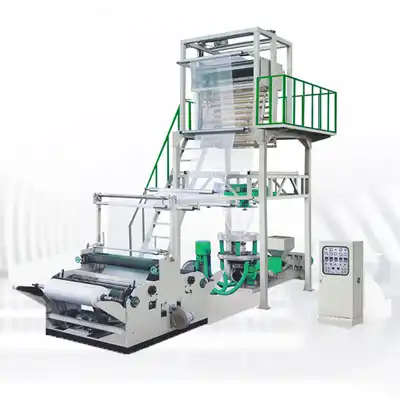
Instead of relying on a single-material blown film line, manufacturers now turn to co-extrusion systems to combine multiple polymers into one superior film. Based on industry feedback from packaging engineers and recent efficiency studies, here are the five most impactful applications of this versatile technology.
1. High-Barrier Food Packaging: Extending Shelf Life Without Preservatives
The global food industry loses billions annually to spoilage. The primary culprit? Oxygen and moisture. A standard monolayer film allows gas molecules to pass through slowly, turning fresh pasta dry or crispy snacks stale.
Co-extrusion solves this by integrating an EVOH (ethylene vinyl alcohol) or PA (polyamide) layer—a premium oxygen barrier—sandwiched between outer layers of polyethylene (PE) for strength and moisture resistance.
Real-world impact: A major meat processor reported extending the shelf life of their vacuum-packed beef from 14 to 28 days simply by switching to a 5-layer co-extruded shrink bag. The film did not become thicker; it became smarter. The different layers work in harmony: the outer layer resists abrasion during transport, the core blocks gas, and the inner layer provides a strong seal.
For operations that demand precise layer thickness control to minimize expensive EVOH usage, professionals often consult technical specifications for multi-layer die designs to optimize material distribution.
2. Agricultural & Silage Stretch Films: Farm Economics in a Roll
On a farm, time is harvest, and waste is lost profit. When wrapping hay bales into silage, the goal is to create a perfect anaerobic environment. A tiny pinhole or inconsistent thickness can let in air, ruining tons of fodder.
Multi-layer stretch films have revolutionized this field. A common design uses a tough, tear-resistant outer layer (usually LLDPE), a very sticky inner layer to cling to the bale surface, and a UV-resistant core layer for outdoor durability.
Why monolayers fail: Single-layer films cannot balance "cling" and "toughness." If you increase cling, the film becomes soft and tears. Co-extrusion breaks this trade-off. The outer layer handles the mechanical stress, while the sticky layer does its job independently.
Farm managers looking to reduce film breakage and plastic usage have found that exploring case studies on agricultural film solutions provides a clear return-on-investment calculation.
3. Liquid Packaging: The Hidden Complexity in Your Milk Bag
It seems simple: a bag of milk. But consider the journey. It must survive a fill line moving at 60 bags per minute, resist leaking when dropped, block light to prevent vitamin degradation, and finally, be easy to tear open by a consumer.
A co-extruded structure for liquid packaging typically requires 3 to 7 layers. The white pigmented layer blocks UV light. The black layer (if present) blocks all light for ultra-sensitive liquids. The virgin PE inner layer ensures food safety and seal integrity, while the recycled or filler layer in the middle reduces material cost.
According to ISO 22000 packaging guidelines, the seal strength of these films must be precise—too strong, and the consumer can't open it; too weak, and it bursts in the retail crate. This balance is only achievable with multi-layer die technology.
4. Heavy-Duty Shipping Sacks: Replacing Woven PP with Silent, Durable Film
Traditional heavy-duty sacks for cement, chemicals, or pet food were woven polypropylene (PP). They are strong but loud, dusty, and offer poor moisture protection. Co-extruded heavy-duty films are rapidly replacing them.
These sacks use a blown film line configured for high molecular weight HDPE (HMWHDPE) in the outer layers for stiffness and puncture resistance, combined with a LLDPE inner layer for tear propagation resistance. Some advanced versions include a "foamed" layer in the middle to reduce density and lower material cost without sacrificing stiffness.
The logistics advantage: A warehouse manager recently noted that switching to co-extruded sacks reduced pallet wrap usage by 15%. Why? The uniform surface friction of multi-layer film stacks more stably than woven bags, requiring less containment force.
For engineers calculating cost-per-thousand bags, accessing technical datasheets on heavy-duty film lines is a standard step before retrofitting a production hall.
5. Shrink Films for Multi-Packing: The "Can Collar" Revolution
Think of the plastic rings holding a 6-pack of soda cans together. That is a specialty shrink film. However, the industry is moving away from simple monolayer LDPE to engineered co-extruded films.
Why the change? Two reasons: sustainability and performance. To reduce plastic usage, films must become thinner. But thinner monolayer films tear easily. A co-extruded solution uses a central core layer of recycled PCR (post-consumer resin) and thin, high-strength virgin outer layers. This maintains the tear resistance of a thick film while using 30% less virgin plastic.
Furthermore, these films incorporate specific "slip" additives only in the outer layer to ensure they glide over high-speed packaging equipment without sticking, a common frustration with single-layer recycled content films.
Making the Right Choice for Your Production Line
Selecting the right co-extrusion configuration isn't about buying the most expensive machine. It is about matching the layer structure to your target market. Do you need 3 layers for basic agricultural film? Or 7 layers for high-barrier medical packaging?
The industry standard has shifted toward modular configurations that allow processors to start with 3 layers and upgrade to 5 or 7 as their business grows. This flexibility protects your initial capital investment while leaving the door open for future complex products.
If you are currently evaluating how to integrate multi-layer technology into your facility or want to see how modular upgrades work in practice, review the engineering options available from YongBang's team. They specialize in helping packaging producers transition from monolayer to high-efficiency co-extrusion without production downtime.
Final Thought: The future of flexible packaging is not in finding one perfect material. It is in learning how to combine imperfect materials into a perfect structure. That is the real power of co-extrusion.
 Brochure Download
 FAQ
FAQ