English
 Español
Let‘s cut straight to what you actually need to know. When someone asks about calculating output per hour for a film extrusion line, they usually want one of two things: either to estimate how much product a new machine will push out daily, or to figure out why their current setup isn’t hitting the numbers the spec sheet promised. The short answer is that output (kg/h) = (film width × thickness × line speed × melt density) for flat configurations, while round products follow a slightly different formula involving cross-sectional area. But here‘s the reality—that neat little equation only works if you actually know your material’s melt density (not the pellet density, which is higher and will throw your numbers way off).
Most operators I've worked with over the years obsess about screw diameter or motor horsepower, then wonder why their actual production falls 15–20 percent short of the theoretical maximum. The truth is, a handful of overlooked variables usually eat up that gap before the film even reaches the winder.

How the Standard Throughput Formula Actually Works in Practice
The extrusion industry has a go-to calculation that decent process engineers rely on: Q = Qd – Qp – Ql, where Qd represents drag flow (the forward movement driven by the screw), Qp is pressure flow pulling backward, and Ql accounts for leakage losses. If you‘re not deep into rheology, that公式 probably looks like a headache. That’s fair. Most plant managers I‘ve spoken with prefer working directly with dimensional inputs anyway.
The simpler and more practical method goes like this: For film and sheet extrusion, your mass flow rate depends on three measurable things: thickness, width, and line speed. Take those numbers, multiply by your polymer’s melt density in grams per cubic centimeter, then multiply by 60 to convert minutes into hours. That spits out your kilograms per hour estimate.
Here’s where people mess up consistently. Melt density is not the same as the solid pellet density sitting in your gaylord box. LDPE melts down to roughly 0.76–0.80 g/cm³, while HDPE sits around 0.74–0.78 g/cm³. PP runs a bit lower at 0.72–0.75 g/cm³. I‘ve walked into facilities where someone was using the room-temperature density in their calculation—their estimated output was overestimated by roughly 15 percent before a single kilogram of resin melted. Always, always pull the melt density from your resin supplier’s technical datasheet.
6 Critical Variables That Slash Your Real-World Production Rate
No machine runs at its theoretical max all day. Something always gets in the way. Let me walk you through the usual suspects that quietly kill your hourly output.
Screw diameter and L/D ratio are where it all starts. A larger screw pushes more melted resin per rotation—that‘s straightforward. But the length-to-diameter ratio matters just as much. Higher L/D ratios give the material more time to melt and homogenize, which actually allows you to push higher throughput without sacrificing quality.
Motor power seems obvious, but here’s the nuance: throwing a bigger motor at the problem doesn‘t automatically boost output if your cooling system can’t handle the extra heat. A more powerful drive lets you run higher screw speeds, but that generates more frictional heat. If your barrel cooling chokes, you‘ll end up backing off the speed anyway to prevent degradation.
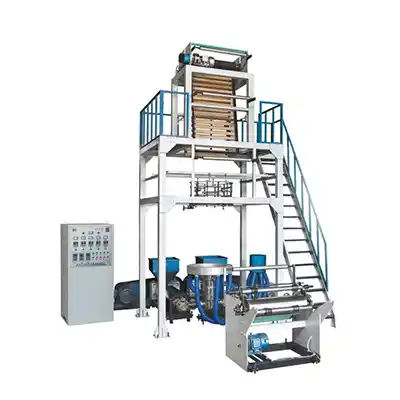
Cooling system efficiency is probably the biggest bottleneck I see on older lines. Air cooling works, but it’s fundamentally slower than the chilled rollers used in cast film extrusion. This creates a hard ceiling on line speed. Modern internal bubble cooling (IBC) systems help substantially—they stabilize the bubble and allow faster run speeds by precisely managing the temperature profile from the inside out.
Die design quality shows up in your gauge uniformity. A poorly designed die creates thick-and-thin spots. Your line speed then gets limited by the thickest section because you can‘t pull faster without tearing the thin areas. That’s a hidden output killer that doesn‘t show up in any spec sheet.
Resin properties vary wildly across material grades. Low-viscosity resins flow easily and allow higher throughput. High-viscosity materials create back pressure that limits screw speed regardless of motor size. Switching resin suppliers without recalculating your expected output is a fast way to miss your production targets.
Die head configuration changes the math entirely. A twin-head setup typically yields 30–50 percent more material than a single-head counterpart because two extrusions run simultaneously—essentially doubling throughput without doubling floor space. That said, twin-head systems demand more operator attention and about 35 percent more heating components. If your crew isn‘t well-trained or your uptime falls below 90 percent, those theoretical gains shrink fast.
Real-World Calculation Walkthrough: Turning Theory Into Numbers
Let’s run a concrete example so this isn‘t just abstract math. Suppose you‘re producing LDPE film at 50 microns thick with a layflat width of 1200 mm. Your line speed reads 45 meters per minute on the control panel—not the speed the manufacturer claims, but what your actual production monitor shows after accounting for stops and startups.
LDPE melt density lands around 0.78 g/cm³. Convert that thickness from microns to centimeters: 50 microns = 0.005 cm. Convert width to centimeters: 1200 mm = 120 cm.
Area per minute = thickness (cm) × width (cm) × line speed (cm/min)
That‘s 0.005 × 120 × 4500 = 2,700 cm² per minute.
Volume flow = area × line speed sounds redundant here because line speed already factored in. Let me clarify: The actual formula from Gauge Advisor’s calculator treats thickness and width as cross-sectional area, then multiplies by line speed and melt density.
Mass flow = area (cm²) × melt density (g/cm³) × line speed (cm/min) / 1000
= 2,700 × 0.78 × 45 = 94,770 grams per minute = 94.77 kilograms per hour.
That‘s your theoretical output. Real-world output typically runs 10–15 percent lower after accounting for dwell time on roll changes, edge trim waste, and the occasional bubble instability that forces you to slow down for thirty seconds. I’d budget for roughly 82–85 kg/h as a practical sustainable rate.
If you‘re running a twin-head configuration on this same material spec, your output jumps to somewhere between 123 and 142 kg/h at the same line speed. The trade-off? You’ll need more heating capacity and a sharper operator watching die alignment like a hawk.
Customization Changes the Output Equation—Here‘s How
Generic machines come with generic performance numbers. A plastic extrusion system designed around your specific resin blend, film width range, and target thickness tolerance will always outperform an off-the-shelf unit because the screw profile, cooling ring configuration, and die gap geometry get tuned for your actual operating window, not some theoretical average.
For example, a facility running mainly recycled LLDPE needs a different screw design than one processing virgin HDPE. Recycled material has broader molecular weight distribution and more contaminants. A custom screw with optimized compression ratio maintains consistent melt flow where a standard design would surge and cause gauge variation. That directly translates to running 5–8 percent faster without sacrificing quality—pure bottom-line gain.
Similarly, if your production mix includes both ultra-thin agricultural mulch at 12 microns and heavy-duty industrial sheeting at 120 microns, a one-size-fits-all die will force you to compromise somewhere. A modular die system with interchangeable internal components lets you swap configurations without days of downtime. I‘ve seen this cut changeover time from eight hours down to ninety minutes, which effectively adds two to three hours of production to every shift.
Blown Film vs. Cast Film: Where Does Each Process Shed Output?
You might notice that cast film lines often claim higher line speeds—up to 300 meters per minute in some cases, compared to roughly 30–60 m/min for typical blown film. That’s real. Cast film extrusion dumps molten polymer onto chilled rollers, quenching it instantly. Blown film relies on air cooling. Air is just slower at pulling heat out of the material.
But here‘s what the speed comparison doesn’t tell you. Cast film gives you superior flatness and optical clarity, and its thickness uniformity is excellent. The trade-off: cast machines cost more upfront. They‘re also less forgiving if your resin supply changes suddenly, and they generally don’t handle the same range of material types that a flexible blown film system can process.
Blown film‘s strength isn’t raw line speed—it‘s material versatility and lower capital entry. You can run LDPE, LLDPE, HDPE, PP, and even certain biodegradable resins through the same basic platform with screw swaps or configuration changes. Try doing that on a dedicated cast line designed specifically for polypropylene or PET. You’ll be buying new equipment.

From a total cost of ownership perspective, the slower line speed of a custom film extruder doesn‘t automatically make cast film the winner. You have to run the numbers on your specific product mix. If you’re making mostly plain garbage bags or agricultural film where absolute clarity doesn‘t matter, blown film’s lower equipment investment and maintenance costs typically win. If you‘re running high-end food packaging that demands crystal clarity and dead-nuts uniform gauge, cast film justifies its higher sticker price.
That’s why I always ask clients two questions before recommending anything: What‘s your primary resin, and what’s your acceptable scrap rate at start-up? The answers usually tell me which technology fits.
For manufacturers processing multiple resin families or running small-to-medium batch sizes where quick changeover matters more than top-line speed, a well-configured blown film line often delivers better net production over a 24-hour shift than a faster cast line that sits idle during lengthy material swaps.
The Bottom Line on Calculating Your True Hourly Output
Stop trusting manufacturer spec sheets at face value. Those numbers assume perfect conditions: ideal melt temperature, flawless cooling, zero operator breaks, and resin that behaves exactly like the lab sample. That‘s not your floor. Run the throughput formula using your actual melt density and real-world line speed—not the theoretical maximum painted on the machine brochure.
Then look at your biggest constraint. Is it cooling? Screw design? Die configuration? Find the bottleneck first. Upgrading motor power won’t help if your cooling air ring can‘t keep the bubble stable above 55 meters per minute.
If you’re evaluating multiple machine options, ask each supplier for output curves across your target thickness range, not just a single number at one operating point. The machine that hits 150 kg/h at 80 microns might drop to 60 kg/h when you switch to 20 microns. That matters more than the peak number they advertise.
 Brochure Download
 FAQ
FAQ