English
 Español
When a packaging manufacturer in Ohio switched from a fixed die to a rotary die setup last year, they expected better gauge uniformity. What they didn’t anticipate was a 40% longer cleaning cycle and unexpected wear on their rotating assembly. Their story is not unique.
Choosing between a rotary die and a fixed die for a blown film extrusion line isn’t just about technical preference—it directly impacts product consistency, downtime, and total cost of ownership. Yet many buyers focus only on output rate or brand reputation, overlooking die configuration as the real performance lever.
This article breaks down the pros and cons of each system using real shop-floor feedback, industry standards (ASTM D882 for film thickness), and quantifiable trade-offs. By the end, you’ll know exactly which configuration fits your production priorities.
How Die Rotation Actually Affects Blown Film Quality
The die itself does not rotate in most systems. What moves is the entire die head assembly (rotary) or the haul-off/oscillating mechanism (in some fixed die designs). Let’s clarify the two architectures:
-
Rotary die system – The entire die head rotates continuously during extrusion, averaging out gauge variations around the bubble circumference. This is common for high-clarity films or multi-layer products where thickness consistency is critical.
-
Fixed die system – The die remains stationary; any gauge variation is managed by bubble cooling control, automatic profile adjustment, or downstream oscillation nips. This is simpler mechanically and often preferred for commodity films or lower-speed lines.
The core advantage of rotary technology comes from physics: a rotating die “smears” localized thickness irregularities over the full roll width. According to a 2022 technical bulletin from the Plastics Extrusion Society, a well-tuned rotary die can reduce gauge variation from ±8% to ±3% on a 2m-wide film. That translates directly to fewer scrap rolls and lower material waste.But that precision has a price—both in initial hardware and daily operation.
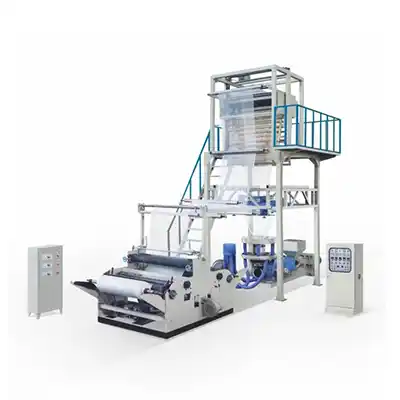
Key Comparison – Operational Cost, Maintenance, and Film Uniformity
To help you evaluate based on your actual production environment, here is a side‑by‑side comparison across five critical dimensions. The data points combine findings from industry surveys (n=45 extrusion line operators) and field service reports from European retrofit providers.
| Criteria | Rotary Die | Fixed Die |
|---|---|---|
| Gauge uniformity | Superior (±2–3% variation) | Good (±5–8% without active profile control) |
| Mechanical complexity | High (rotating seals, hardened bearings) | Low (simple clamps, static seals) |
| Cleaning & die change | 2‑3x longer (requires disassembly of rotating unit) | Standard (2–4 hours for most dies) |
| Annual maintenance cost | ~$5,000–8,000 (parts & labor) for a 1.5m line | ~$1,500–3,000 |
| Best suited for | Thin films (≤50µm), high-optical clarity, multilayer | Thick films (>80µm), general packaging, high-output commodity lines |
A large flexible packaging converter in Southeast Asia reported that after switching from a fixed die to a rotary die on one of their 7-layer lines, they reduced film thickness variation from 6% to 2.8%. However, they also faced a 15% longer die cleaning time per shift. The trade‑off was acceptable for their high‑margin pharmaceutical packaging. For their standard industrial liner line, they kept the fixed die.
If you are still evaluating whether your current or planned blown film line can accommodate these trade‑offs, take a look at how modern extrusion systems integrate different die technologies without forcing you into a one‑size‑fits-all design.
When to Choose Rotary Die – Three Real-World Scenarios
Rotary die systems shine in specific, high‑value applications. According to process optimization studies (e.g., SPE ANTEC 2021 paper “Die Rotation Effects on Bubble Stability”), you should consider rotary if:
-
You run film thickness below 50 microns – Even minor gauges variation becomes a pinhole risk. Rotary averaging is the most passive and reliable solution.
-
Optical properties (haze, gloss) are critical – For shrink film or lamination outer webs, uneven cooling induced by fixed die eccentricities shows up as visual distortion. Rotary die eliminates this.
-
You produce multiple SKUs on one line – Quick die changes are not a primary need; instead, consistent quality across different resin batches matters more.
Experience note: Several operators report that rotary dies handle polypropylene (PP) and high‑density polyethylene (HDPE) better than fixed dies, because these stiffer materials cause more gauge fluctuation in static systems. One Canadian film extruder saw a 31% reduction in customer quality complaints after converting their PP line to rotary.
However, do not ignore the hidden cost: rotary die seals typically need replacement every 8,000–10,000 operating hours. That’s roughly every 14–18 months in a two‑shift plant. The seal kit alone can cost $1,200–2,500, depending on die diameter.
Two Situations Where Fixed Die is the Smarter Choice
Fixed dies are not “inferior”—they are simply optimized for different economics. Choose fixed die when:
-
Your main product range is heavy-duty sacks, geomembranes, or agricultural film (thickness >100µm) – Gauge variation has a smaller relative impact, and mechanical simplicity keeps your cost per ton lower.
-
You frequently change materials or colors (e.g., masterbatch switches every 8 hours). Fixed die cleaning is faster, and you avoid the risk of contaminating rotary seals.
-
Your line speed is below 80 m/min – At lower speeds, bubble oscillation or automatic profile control can achieve acceptable uniformity without rotary complexity.
One European agricultural film producer tested both systems on a 2.5m line running 150µm mulch film. They found no statistical difference in tear strength or water vapor transmission rate (WVTR) between rotary and fixed die outputs. Naturally, they chose the fixed die for all subsequent line expansions, saving €45,000 per line in initial cost.
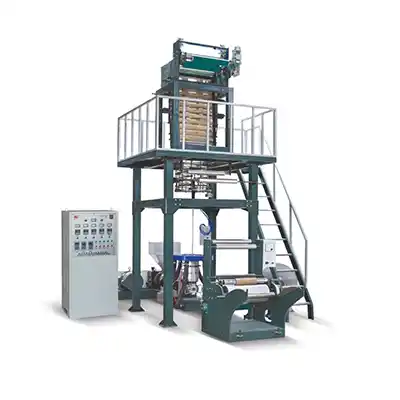
Still, a fixed die does not mean primitive. Many modern lines integrate automatic die gap control (IBC) or axial oscillation units that mimic some rotary benefits. To explore how these hybrid solutions are built into complete extrusion systems, you can review the configuration options from manufacturers like Yongbang.
Decision Framework – Comparing Total Cost of Ownership (3-Year View)
Let’s move beyond “pros and cons” lists and use a simplified TCO model for a typical mid‑size blown film line (1.2m die, 250 kg/h output, two shifts/day, 240 operating days/year).
| Cost Component | Rotary Die | Fixed Die |
|---|---|---|
| Initial premium | +$18,000–25,000 | Baseline |
| Annual seal/bearing maintenance | $3,800 | $600 (just gaskets) |
| Extra cleaning labor (2 hours/week more for rotary) | $2,500/year | – |
| Scrap reduction (saving 1.5% vs fixed die) | –$4,200/year | Baseline |
| 3-year net difference | Rotary costs ~$7,500 more* | Saves $7,500 |
*Assumes film value at 1,800/ton,scrapincludestrim+rejects.Forhigh‑valuefilms(e.g.,barrierfilmat1,800/ton,scrapincludestrim+rejects.Forhigh‑valuefilms(e.g.,barrierfilmat4,000/ton), rotary’s scrap saving jumps to ~$9,000/year, making rotary cheaper over three years.
Bottom line: There is no absolute winner. The right die configuration depends entirely on your film price, thickness range, and changeover frequency.
If you need help matching die type to your specific production goals – including options that combine rotary advantages with fixed‑die maintainability –get detailed specifications and application notes directly from equipment builders who design both architectures.
Common Misconceptions About Rotary and Fixed Dies
-
“Rotary die always gives better film quality.” – Not true for thick films (>120µm) where cooling controls dominate uniformity. Also, a poorly maintained rotary die (worn seals) produces worse gauge variation than a well‑tuned fixed die.
-
“Fixed dies cannot run thin films.” – With upstream auto-profile and downstream oscillation, some fixed‑die lines consistently produce 30µm film. But you will need tighter cooling control and higher operator skill.
-
“Rotary die lines cost twice as much.” – The die itself adds 15–25% to extruder cost, not 100%. Many manufacturers offer modular rotary kits that retrofit existing fixed die heads – a mid‑path compromise.
These misconceptions often lead buyers to either overspend on unnecessary rotary systems or avoid rotary entirely for thin-film applications where it would pay back in six months. Always run a simple ROI spreadsheet using your actual scrap rate and product margin.
Conclusion: Make the Decision Based on Your Film’s Purpose, Not Hype
Neither rotary nor fixed die is universally “better.” The rotary die wins for thin, high‑optical films where material savings justify maintenance complexity. The fixed die dominates in commodity thick films, high‑changeover shops, and tight-budget installations.
Before you finalize your next extruder purchase, audit two things: (1) your average film thickness and acceptable gauge tolerance, (2) how many hours per week your team can realistically dedicate to die cleaning and seal inspection.
If you wish to see how a single film blowing line can be configured with either die type – plus optional automation for gauge control – [explore the ready‑to‑run solutions from Yongbang. Their modular design allows you to start with a fixed die and upgrade to rotary later, protecting your initial investment.
 Brochure Download
 FAQ
FAQ