EN
 Español
The short answer: when PE film scrap is granulated, the cutting method matters less than the heat history the polymer experiences before and during cutting. Die-face cutting produces more uniform, near-spherical pellets because the melt is cut at a controlled die temperature, but it exposes the polymer to a fully molten state. Friction-based low-temperature granulation cuts and densifies the film below its full melting point, preserving molecular structure but producing denser, less spherical agglomerates. The right choice depends on the film’s contamination level, moisture, and the downstream process that will re-melt the pellets.
Why “cutting vs. heating” is the wrong question — and the right one
Buyers often frame the decision as “cutting” versus “heating,” as if a low-temperature granulator only cuts and a conventional pelletizer only heats. In practice, every granulation path involves both. A die-face pelletizer cuts molten polymer at the die, but the polymer has already been heated to a flowable melt. A friction disc agglomerator cuts and compacts film using mechanical shear, but the friction itself generates heat — typically in the range of 130–180 °C for PE film, softening the material without fully melting it.
The more useful question is: how much heat history does the polymer accumulate, and how does that history interact with the cutting geometry to affect the pellets that come out?
What die-face cutting does to pellet quality
In die-face cutting, molten polymer exits a die plate and is cut immediately at the face by rotating blades. The pellets form under controlled melt pressure and cutting speed, which tends to produce uniform, near-spherical granules with better flow and packing consistency than irregular strand-cut material. Hot-face and water-ring variants are common for PE and PP film because they avoid the strand breakage that plagues soft, thin film in a water bath.
The trade-off is thermal. PE film that passes through a melt extrusion step is exposed to temperatures that commonly fall in the 180–230 °C range for PE, depending on the grade and line configuration. Each additional melt pass increases the opportunity for chain scission and oxidative degradation. Polyethylene that has been extruded more than once can show a lower melt index relative to the base material because it has been exposed to heat and shear more than once. For a converter who needs pellets that behave predictably in a downstream blown film line, that shift in melt flow is not a cosmetic issue.
Die-face cutting also requires the polymer to be filterable and flowable. That usually means the film must be adequately dried, compacted, or pre-densified before extrusion, especially when dealing with low-bulk-density film that tends to bridge or surge in the feed section.
What friction-based low-temperature granulation actually produces
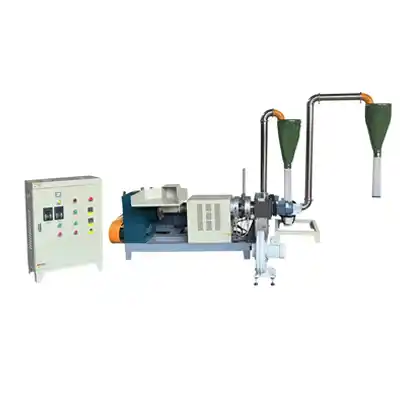
A friction disc agglomerator is not an extruder. It uses a high-speed rotating disc or blade set to generate frictional heat and shear, converting loose PE film into dense, free-flowing granules without full melting. The output is a densified agglomerate, typically 3–15 mm in size, with bulk density rising from loose film levels to roughly 300–500 kg/m³ depending on the material and settings. The composition and plasticizing properties of the raw material are not chemically changed in the same way they are during a full melt pass.
The pellet geometry is different. Because the material is softened and compacted rather than fully melted, the resulting granules are denser and less spherical than die-face pellets. They may have irregular surfaces and a broader size distribution. That shape difference has consequences: irregular granules can pack differently in downstream feeding, and fines generation depends heavily on blade condition, screen configuration, and the brittleness of the cooled agglomerate.
The low-temperature path is not a purification step. An agglomerator densifies; it does not filter out contamination or remove ink and residual moisture at the same level as a melt extrusion line with a screen pack. If the film scrap carries soil, paper fiber, or high moisture, those inputs remain part of the agglomerate and will affect the downstream melt anyway.
The quality dimensions that actually matter to buyers
Rather than asking which machine “makes better pellets,” buyers should evaluate granulation output against the specifications their downstream process can tolerate.
| Quality dimension | Die-face cutting (melt path) | Friction-based low-temperature granulation | What to verify |
|---|---|---|---|
| Pellet shape | Near-spherical, uniform size | Denser, irregular agglomerates, broader distribution | Feeding stability in the next extruder |
| Heat history | Full melt pass, typically 180–230 °C for PE | Softening range, roughly 130–180 °C, no full melt | Melt index shift after reprocessing |
| Moisture sensitivity | Requires dried/compacted feed; moisture becomes steam at the die | Less sensitive to surface moisture, but residual moisture remains trapped | Moisture target for the intended application (often ≤0.5–0.8% for high-grade recyclate) |
| Fines | Can be low with stable die-face cutting, but throughput pushing raises fines | Blade clearance and cooling determine fines; overcooled agglomerate can brittle-fracture | Screen analysis of as-received granules |
| Contamination handling | Screen pack can remove some solids if configured | No melt filtration; densifies what is fed | Feedstock washing and metal removal upstream |
| Bulk density | Consistent, typically higher | 300–500 kg/m³ depending on film and settings | Storage, conveying, and feeding behavior |
A practical moisture note: industry recyclate specifications frequently target moisture below 0.5% or 0.8%, depending on the end application, and measure it using methods such as ASTM D6980 or loss-in-weight at elevated temperature. Neither cutting method fixes moisture that is already in the film. The difference is where the moisture creates problems: at the die in a melt line, or trapped inside an agglomerate that will be re-melted later.
When the cutting method becomes a decision driver
Choose a melt-path, die-face or strand cutting configuration when the pellets must meet tight downstream extrusion specifications, the film scrap is relatively clean and dry, and consistent pellet geometry is more important than minimizing thermal exposure. This is typically the case for larger centralized recycling operations where filtration, drying, and quality control are part of the line.
Consider friction-based low-temperature granulation when the goal is in-plant densification of PE film scrap with a small footprint, no water treatment, and the ability to start and stop without a full preheating and purging cycle. A compact agglomerator in the 40–60 kg/h range is designed for this scenario, converting film trim or reject rolls into a feedable densified form close to the production line. The trade-off is that the agglomerate is a densified feedstock, not a fully purified, spec-grade pellet; if the downstream process demands tight melt index control or low gel content, secondary extrusion and filtration may still be necessary.
A buyer’s checklist before choosing a granulation path
- Feedstock condition: Is the film clean, dry, and consistent, or does it carry moisture, ink, or mixed polymers?
- Downstream process: Will the granules go directly into a blown film, bag-making, or injection process, or will they be re-compounded?
- Melt index tolerance: Does the end product allow a shift in melt flow after reprocessing, or is viscosity stability critical?
- Moisture target: What moisture level does the next melt step tolerate, and how will it be measured?
- Fines and feeding: Can the existing conveying and feeding system handle irregular granules without bridging or surging?
- Space and utilities: Is there room for a water treatment and drying line, or does the installation need to be water-free and compact?
- Throughput fit: Does the granulation capacity match the actual scrap generation rate, rather than a theoretical line maximum?
For buyers evaluating the compact, water-free route for in-plant film recovery, the available configurations and technical specifications can be reviewed on the film low-temperature granulator machine page. If the application requires a different capacity or material scope, the broader plastic film granulator range provides a starting point for comparison.
FAQ
Does die-face cutting always produce better-quality PE pellets than low-temperature granulation?
Not always. Die-face cutting produces more uniform, spherical pellets and allows melt filtration, but it requires a full melt pass and adequate feed preparation. Low-temperature granulation preserves molecular structure to a greater degree but produces denser, irregular agglomerates without filtration. “Better” depends on whether the downstream process prioritizes pellet geometry and purity or minimal heat history and compact installation.
Will low-temperature granulation change the melt index of PE film scrap?
Friction-based agglomeration softens the film without fully melting it, so the chemical composition and plasticizing properties are altered less than in a full melt extrusion pass. However, some thermal and shear exposure still occurs, and the actual melt index shift should be verified by testing the specific film scrap and granulator settings.
What causes fines in PE film granulation, and does the cutting method affect them?
Fines come from brittle fracture during cutting or handling. In die-face cutting, pushing throughput too hard can degrade melt quality and increase fines. In friction granulation, fines depend on blade clearance, cooling rate, and agglomerate brittleness. Both paths require a screen check on the as-received granules to quantify the fine fraction.
Can I use a low-temperature granulator for wet or washed PE film?
A friction disc agglomerator is generally more tolerant of surface moisture than a melt die-face line, because the material is not immediately exposed to a die at melt temperature. However, residual moisture remains in the agglomerate and will affect the next melt step. Moisture targets for higher-grade recyclate are commonly below 0.5–0.8%, and wet feedstock should be evaluated against the downstream process requirements.
When should a buyer choose a compact agglomerator instead of a full pelletizing line?
A compact agglomerator is a practical option when the goal is on-site densification of film trim or reject film, the available space is limited, and water treatment or a long drying line is not feasible. A full melt pelletizing line is more appropriate when the output must meet strict downstream extrusion specifications, requires filtration, or serves external customers with defined pellet quality criteria.
Does the cutting method affect the bulk density of the final granules?
Yes. Die-face pellets typically have a more consistent, flowable bulk density because of their uniform shape. Friction-agglomerated granules can reach 300–500 kg/m³, but the density depends on film type, disc speed, cooling, and blade condition. Buyers should confirm the expected bulk density for their specific film and verify it against conveying and storage requirements.
Conclusion
The cutting-versus-heating decision is ultimately a trade-off between pellet geometry and filtration capability on one side, and minimal heat history and compact, water-free operation on the other. Die-face cutting gives more uniform pellets and the option to filter contaminants, but demands a full melt pass and adequate feed preparation. Friction-based low-temperature granulation preserves more of the polymer’s original structure and fits into tight in-plant spaces, but produces a densified agglomerate rather than a purified, spec-grade pellet.
Before choosing, verify the feedstock condition, the moisture and melt index tolerance of the downstream process, and the actual fines and bulk density of the granules the machine will produce. If the application points toward compact, water-free recovery of PE film scrap, the film low-temperature granulator machine specifications and available configurations are the next logical reference; for a wider view of granulation options, compare the related models in the plastic film granulator category.
 Brochure Download
 FAQ