EN
EN Español
Quick Answer: Adding recycled content to blown film changes four main areas: melt behavior, film appearance, bubble stability, and thickness consistency. Recycled resin typically requires lower processing temperatures, more careful moisture control, and may produce more gels and higher haze. Multi-layer structures such as ABA or ABC configurations can isolate recycled material in the core layer to protect surface quality. The exact adjustments depend on recyclate quality, feed rate, and machine configuration, and should be confirmed through trial runs.
Why Recycled Resin Behaves Differently in a Blown Film Line
Recycled polyethylene resin is not simply a lower-cost substitute for virgin resin. Post-consumer and post-industrial recyclates carry a different thermal history, may contain mixed polymer fractions, and often exhibit higher variability in melt flow index (MFI), moisture content, and contamination levels.
These differences affect every stage of the blown film process — from how the resin melts in the extruder barrel to how the bubble cools and stabilizes above the die. Understanding these changes is the first step toward making informed adjustments rather than reacting to production problems as they appear.
What Changes in Processing Parameters
1. Melt Temperature and Barrel Zones
Recycled polymers generally require lower processing temperatures than virgin resin to prevent thermal degradation, which can accelerate gel formation and cause odor or discoloration. However, reducing temperature too aggressively risks incomplete melting and unmelted particles in the film.
For recycled LDPE compounds, some resin suppliers recommend a melt temperature range of 170–210°C, with the caveat that processing conditions should be optimized for each production line.
Practical starting point: Begin with barrel temperatures 5–10°C lower than your virgin resin settings and adjust upward only if you observe unmelted particles or excessive die pressure.
2. Screw Speed and Output Rate
Recycled resin often has a broader molecular weight distribution, which can affect how it conveys and pressurizes inside the extruder. Running the screw at the same RPM as virgin resin may produce inconsistent output.
Operators typically find that recycled content runs more stably at moderate screw speeds, with output adjusted based on observed melt pressure and film thickness readings rather than fixed RPM targets.
3. Cooling and Frost Line Height
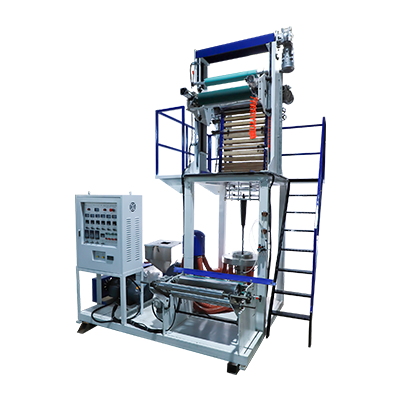
Recycled resin may have lower melt strength, which affects bubble stability and the position of the frost line. Adjusting air ring airflow and frost line height helps maintain a stable bubble and consistent film gauge.
A higher frost line can improve clarity but may reduce bubble stability. A lower frost line improves stability but can increase haze. The optimal setting depends on the specific recyclate batch.
4. Moisture Control and Drying
Moisture is one of the most common causes of film defects when processing recycled resin. Recycled flakes and pellets can absorb atmospheric moisture during storage and handling. If moisture is not controlled, it can cause lacing, fisheyes, porosity, and blow holes in the film.
Industry practice suggests drying PE fluff or pellets at 80–90°C for a minimum of 30 minutes up to 1 hour, targeting a moisture content of 0.15% or less when measured at 130°C by loss-in-weight method.
What Changes in Film Properties
Film Clarity and Haze
Recycled content almost always increases film haze. This is caused by contaminants, gels, and differences in crystallinity between virgin and recycled fractions. For applications where clarity is critical — such as food packaging or retail display bags — higher recycled content may require a multilayer structure that isolates recycled material in a core layer.
One case documented in supplier literature describes processing 70% recycled LDPE using modified feed zones and achieving film clarity approaching that of virgin material processing, measured by ASTM D1746 haze standards. Results vary by recyclate source and machine configuration.
Gel Formation
Gels are small visual defects or elevations in the film caused by isolated impurities, crosslinked material, or high-molecular-weight fractions in the recyclate. They appear as bumps or specks that affect print quality, seal integrity, and visual appearance.
Gel formation tends to increase with:
-
Higher recycled content percentage
-
Lower-quality recyclate input streams
-
Higher processing temperatures
-
Insufficient filtration in the recycling process
Some studies suggest that increased film and sealant layer thickness can partially compensate for gel-related quality loss.
Thickness Consistency
Recycled resin variability can make it more difficult to maintain consistent film gauge. Poor thickness control is one of the commonly reported challenges when using recycled polymers in blown film. Real-time thickness monitoring systems help identify drift early, and adjustments to haul-off speed and air ring airflow can bring gauge back into specification.
Mechanical Strength and Seal Performance
Recycled content may reduce tensile strength and tear resistance compared to virgin resin. The extent of the reduction depends on the recyclate source and the percentage used. In multilayer structures, placing recycled material in the core layer (as in ABA or ABC configurations) helps preserve the mechanical performance of the outer layers.
Seal performance also requires attention. Recycled material in the seal layer can produce weaker or inconsistent seals. Where seal integrity is critical, keeping seal layers virgin and placing recycled material in the core is a standard approach.
Does a Multi-Layer Structure Help with Recycled Content?
Yes — in many cases, a multi-layer structure is the most practical way to increase recycled content without sacrificing surface quality and mechanical performance.
| Structure | Recycled Content Placement | Key Advantage | Key Limitation |
| Mono-layer | Throughout the film | Simplest machine setup | Recycled defects affect both surfaces; clarity suffers |
| ABA (A/B/A) | Core (B) layer only, 50–70% of total thickness | Outer layers remain virgin; protects print and seal surfaces | Requires a co-extrusion die and two extruders |
| ABC (A/B/C) | Any layer can be independently optimized | Recycled in core, functional layers on each surface | Higher investment; more complex process control |
| AB (A/B) | One functional layer + one cost layer | Simpler than three-layer; good for dual-property films | Limited to two distinct material zones |
In ABA and ABC structures, the core layer can accept recycled pellets, calcium carbonate filler, or lower-grade resin while the outer layers maintain surface finish, printability, and mechanical performance. A typical ABA configuration places 50–70% of the total thickness in the core, which means the majority of the film can use recycled or cost-saving material.
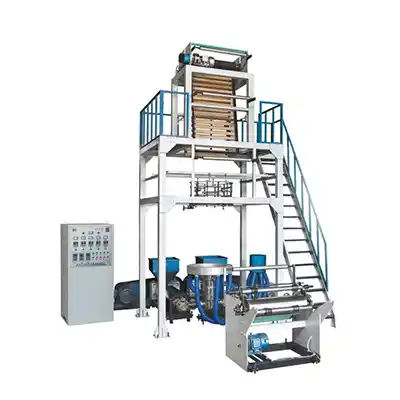
If you are evaluating whether a multi-layer configuration fits your production requirements, the film blowing machine product range includes mono-layer, AB, ABA, and ABC options that can be matched to different recycled content strategies.
[Image: Cross-section diagram of ABA vs. ABC film structure showing layer placement for recycled material]
Processing Checklist for Adding Recycled Content
Use this checklist when introducing or increasing recycled content on an existing blown film line:
Pre-production:
- Verify recyclate moisture content (target ≤ 0.15% for PE)
- Check recyclate MFI and compare to virgin resin baseline
- Inspect recyclate for visible contamination, color variation, and odor
- Confirm screen pack and filtration are adequate for the recyclate grade
Process setup:
- Reduce barrel temperatures by 5–10°C from virgin resin settings
- Adjust screw speed to match melt pressure to virgin baseline
- Set frost line height based on observed bubble stability
- Verify air ring airflow produces uniform bubble cooling
Quality monitoring:
- Measure film haze and compare to virgin baseline
- Check for gels using visual inspection or optical defect detection
- Record thickness variation across the film width
- Test seal strength and tensile properties at target recycled content
Production:
- Establish baseline data before increasing recycled content percentage
- Increase recycled content in 5–10% increments with quality checks at each step
- Document the recyclate source and batch for traceability
- Monitor die pressure and screen pack buildup over run time
FAQ
What is the maximum recycled content I can add to blown film?
There is no universal maximum. Practical limits depend on recyclate quality, film application, and machine configuration. Some operations run up to 100% recycled material in the core layer of ABA or ABC structures, while mono-layer films with high recycled content may struggle with clarity and gel defects. Testing is the only reliable way to determine the appropriate level for your specific application.
Why does my recycled blown film bubble keep breaking?
Low melt strength in recycled resin is a common cause of bubble instability and film breaks. Recycled LDPE and LLDPE often have lower melt strength than virgin material, which weakens the bubble during drawing. Reducing processing temperature, adjusting frost line height, and slowing take-off speed are starting points. In some cases, adding a melt strength enhancer or compatibilizer may be necessary.
Does recycled content affect film seal strength?
Yes, recycled material in the seal layer can reduce seal integrity. Gels and contamination in recyclate create weak points in the seal. Where seal strength is critical, keeping recycled material in the core layer while using virgin resin for the seal layer helps maintain consistent sealing performance.
Can I run recycled content on a mono-layer blown film machine?
Yes, but the results differ from multi-layer configurations. On a mono-layer line, recycled material is distributed throughout the entire film thickness, so surface defects, haze, and gels affect both sides of the film. Multi-layer structures offer more flexibility because recycled material can be isolated in an internal layer.
How do I know if my recyclate batch is causing quality problems?
Compare film quality metrics — haze, gel count, thickness variation, seal strength — against a baseline run with virgin resin. If quality drops after a recyclate batch change, isolate the recyclate as a variable. Checking moisture content, MFI, and visible contamination in the recyclate helps identify the cause.
Does adding recycled content require a different screw design?
In some cases, yes. Recycled material with high filler content or abrasive contaminants may require a bimetallic screw and barrel for wear resistance. A two-section screw design with a mixing section can improve homogeneity when processing recycled material blends. Whether a screw change is necessary depends on the recyclate type and the machine's current configuration.
Conclusion
Adding recycled content to blown film is not simply a material substitution — it changes how the resin melts, how the bubble cools, and how the finished film looks and performs. The most important adjustments involve lowering processing temperatures, controlling moisture, and accepting that film haze and gel count may increase unless a multilayer structure is used to isolate recycled material in the core layer.
The most common mistakes are:
-
Running recycled resin at the same temperature as virgin resin
-
Skipping moisture control for recycled feedstock
-
Increasing recycled content percentage too quickly without establishing quality baselines
-
Assuming mono-layer performance will match multi-layer performance at the same recycled content level
If your production requires high recycled content while maintaining surface quality and mechanical strength, a multilayer configuration — ABA or ABC — provides a practical path forward. The film blowing machine category page outlines the available structures and configurations. For application-specific guidance, the solutions page describes how Yongbang matches machine configuration to material and production requirements.
 Brochure Download
 FAQ
FAQ