EN
 Español
A 700 bags/min figure on a T-shirt bag machine almost always refers to the combined theoretical cycle rate of a two-lane configuration running at roughly 350 cycles per lane, under a specific bag size and film condition. Servo drive does not make that number possible by itself. It changes how quickly the film feed can accelerate and settle within each cycle, which in turn affects how close a machine can operate to its mechanical ceiling. The practical question for a buyer is not whether servo is faster in principle, but whether the conditions behind a speed claim match the bags you actually intend to run. This article breaks down the 700 claim from the cycle-time level, compares servo and clutch/brake behavior, and gives a verification checklist before you commit to a capacity target.
What “700 bags/min” is actually counting
A T-shirt bag machine does not produce a bag continuously. Each cycle contains a film-advance phase, a sealing or cutting dwell, and a return or reset motion. The number of cycles per minute is bounded by how fast the film can be indexed forward, stopped, sealed, and indexed again. On a single-lane machine, the bag rate equals the cycle rate. On a two-lane machine, two identical lanes run in parallel, so the total bag count is approximately double the per-lane cycle count.
That is the origin of the 700 figure: 350 cycles per lane per minute multiplied by two lanes. Industry descriptions of high-speed two-track T-shirt bag machines commonly place per-lane cycle rates in the 200–350 range, with total output reaching roughly 400–700 bags per minute when both lanes are counted. The number is arithmetically valid, but it is a rated or theoretical ceiling, not a promise of sustained production.
Two conditions must be stated alongside any 700 claim. First, the bag size and film thickness matter. A short, thin HDPE bag requires less film per cycle than a long, thick LDPE bag, and the draw length directly affects the time available for acceleration and deceleration. Second, the speed is typically established with unprinted film, stable tension, and a machine that has been optimally tuned. Printed film introduces registration corrections; thicker film reduces the safe acceleration window; and routine changeovers consume productive time that a pure cycle-rate number does not capture.
Why the drive system sets the practical ceiling
The film-advance motion is intermittent: the web accelerates from rest, reaches a peak velocity, decelerates to a stop for sealing, dwells, and then repeats. The limiting factor is not only the peak speed the motor can reach, but how much of each cycle is consumed by acceleration and deceleration rather than useful draw distance.
In a conventional clutch/brake system, the main motor runs continuously and a mechanical clutch engages the draw roll for the advance phase, while a brake stops it for sealing. The engagement and release of mechanical components introduce a response lag, and the acceleration profile is constrained by the torque characteristics of the clutch and the inertia of the drivetrain. The machine can run reliably, but the time lost to clutch engagement, brake reaction, and mechanical settling places a hard floor on cycle time. Patent literature comparing the two approaches has quantified the effect: replacing a conventional clutch/brake draw-roll system with a servo-driven draw roll improved output by tens of cycles per minute under otherwise comparable peak-velocity or acceleration limits, because the servo could complete the draw phase in a shorter window.
A servo-driven feed changes the constraint. The servo motor’s position, speed, and torque are controlled electronically, so the acceleration and deceleration profiles can be shaped rather than dictated by mechanical engagement. The motor can accelerate rapidly to a commanded peak, decelerate with a controlled curve, and settle at the seal position without the compliance and lag of a clutch. Industry technical descriptions note that servo motors can accelerate and decelerate more rapidly than conventional drive arrangements, and that programmable motion profiles allow sealing parameters to be adjusted independently of line speed. On a dual-lane machine with independent servo axes, each lane can also maintain its own registration and cycle without a mechanical shaft tying the two lanes to a single compromise timing.
This is where the 700 figure becomes plausible on a servo platform. The servo does not change the number of lanes or the arithmetic of doubling. It compresses the non-productive portion of each cycle—the acceleration ramp, the deceleration approach, and the settling time—so that the same mechanical frame can complete more cycles in a minute before hitting its physical limits. Without that compression, a clutch/brake machine may be mechanically capable of the same peak film velocity but unable to return to the seal position quickly enough to reach the same cycle count.
Servo vs. clutch/brake: where the difference actually shows up
| Aspect | Conventional clutch/brake | Servo-driven feed |
|---|---|---|
| Motion control | Mechanical engagement and braking; acceleration shaped by clutch torque and inertia | Electronic position/speed/torque control; acceleration and deceleration profiles programmable |
| Cycle-time bottleneck | Clutch response, brake reaction, and mechanical settling add fixed time to each cycle | Servo response is faster, and the motion profile can be tuned to reduce settling time |
| Bag-length changeover | Mechanical adjustments and trial runs; changeover can take substantially longer | Length and motion parameters change through the control interface, often in minutes rather than hours |
| Wear pattern | Clutch and brake surfaces wear through repeated engagement; shock loads transmit to drivetrain | Smoother acceleration and deceleration reduce shock loading on bearings, belts, and guides |
| Speed claim basis | Rated speed reflects mechanical capability under specific setup | Rated speed reflects servo motion capability, but still depends on film, bag size, and registration conditions |
The table is not an argument that every servo machine automatically reaches 700 bags/min. A servo system can be specified poorly, tuned incorrectly, or paired with a sealing system that cannot keep pace. The drive is one link in the cycle. If the sealing dwell, the cutting action, or the stacking mechanism requires more time than the servo feed can save, the overall cycle rate will be limited by the slowest subsystem, not by the drive.
The gap between rated speed and sustained output
A rated speed is a test condition, not a production average. Industry guidance on high-speed T-shirt bag machines places realistic sustained output at roughly 70% to 85% of the rated figure once thicker film, printed rolls, changeovers, and minor jams are accounted for. Applying that range to a 700 bags/min theoretical ceiling gives a sustained output window in the approximate range of 490–595 bags/min, depending on the production mix. This is not a defect of servo technology. It is the normal difference between a lab-condition cycle rate and a line that must run commercial orders across a shift.
For a buyer, the implication is that the 700 number should be used to compare machine capability, not to calculate daily capacity. A machine rated at 700 theoretical and a machine rated at 600 theoretical may have overlapping sustained output ranges once real conditions are applied. The more useful comparison is the per-lane cycle rate under the bag size and film structure you actually run, and whether the drive and sealing systems have enough margin to hold that rate without constant intervention.
What to verify before accepting a speed claim
The following checklist is intended for use during supplier discussions. None of the items require a laboratory; they are questions that clarify the conditions behind a quoted figure.
-
Ask whether the speed is per lane or total. A “700 bags/min” statement on a two-lane machine should be traceable to a per-lane cycle rate. If the supplier cannot separate the two, the number is not verifiable.
-
Ask for the bag size and film thickness used in the speed rating. A speed established on a short, thin bag does not transfer directly to a long, thick bag. Request the specific draw length and micron range.
-
Ask whether the rating was established with printed or unprinted film. Printed film requires registration tracking, which can reduce achievable cycle rate unless the servo and sensor system are configured for it.
-
Ask what the sealing and cutting subsystem can sustain. Servo feed can index film quickly, but the seal bar still needs dwell time at temperature and pressure. If the sealing dwell is the limiting factor, increasing feed speed will not raise output.
-
Ask how the machine behaves during changeover. A drive system that saves seconds per cycle but requires hours of mechanical adjustment for a bag-size change may not deliver the expected effective capacity across a multi-SKU schedule.
-
Ask for a sustained-output reference under conditions close to your own. If the supplier has customers running similar bag specs, request the cycle rate those lines hold in routine production, not the peak figure from a commissioning test.
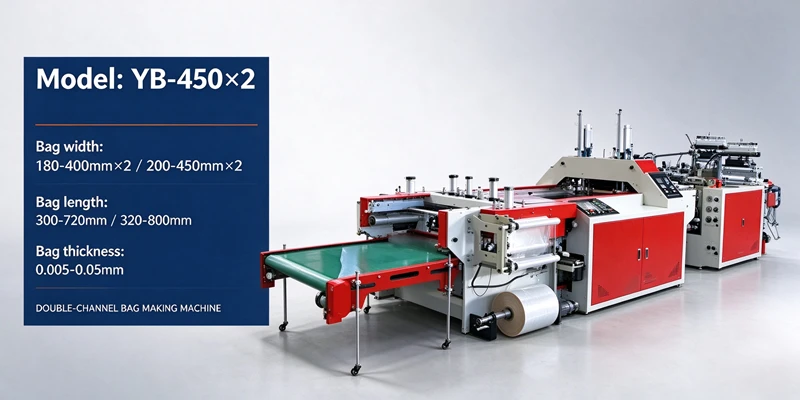
For readers who want to compare how a dual-lane servo platform is configured at the component level, the 450X2 double layer carry bag machine page lists the servo motor arrangement and lane-specific parameters. The broader plastic bag making machine range provides context for how T-shirt bag models fit alongside other bag formats and material handling requirements.
FAQ
Does a servo drive alone guarantee 700 bags/min on a T-shirt bag machine?
No. The 700 figure is a combined two-lane theoretical rate. Servo drive supports faster cycle times by improving acceleration and settling behavior, but actual output also depends on bag size, film thickness, sealing dwell, registration conditions, and changeover time.
Is a clutch/brake machine incapable of high speed?
No. Clutch/brake machines can run reliably at substantial cycle rates. The difference is that mechanical engagement and braking introduce response and settling constraints that tend to make the cycle-time floor higher than on a well-tuned servo system. The practical ceiling depends on the specific machine design, not on the drive category alone.
Why do some suppliers quote 700 bags/min while others quote 300 bags/min for a similar-looking machine?
The numbers may refer to different counting bases. A per-lane cycle rate of 300–350 multiplied by two lanes produces a total of 600–700 bags/min. A single-lane rating or a rating under a heavier bag specification will be lower. Always confirm whether the figure is per lane or total, and under what bag conditions.
What sustained output should I plan for if the rated speed is 700 bags/min?
Industry experience suggests planning at roughly 70% to 85% of the rated figure for routine production, which would place a 700-rated machine in the range of about 490–595 bags/min under typical conditions. Your specific range will depend on film, print, bag size, and shift-level changeover frequency.
Does servo drive reduce maintenance compared with clutch/brake?
Servo systems avoid the repeated engagement wear of clutch and brake surfaces and reduce shock loads on mechanical components, which can lower wear on bearings, belts, and guides. This does not mean maintenance-free operation; periodic inspection of the servo mechanics, belts, and sealing components remains necessary.
Can I verify a speed claim without running my own film?
Full verification requires running your film and bag specification. Before that stage, you can ask for the per-lane cycle rate, the bag size and micron range used in the rating, whether the test was printed or unprinted, and a sustained-output reference from a comparable production environment.
Conclusion
The 700 bags/min claim on a T-shirt bag machine is best understood as a two-lane theoretical ceiling: roughly 350 cycles per lane, combined. Servo drive matters because it compresses the acceleration, deceleration, and settling time within each cycle, allowing a machine to operate closer to its mechanical limit than a conventional clutch/brake feed typically can. But the number does not transfer automatically to a production floor running thicker film, printed rolls, and frequent size changes. The key judgment for a buyer is whether the per-lane cycle rate under your bag specification leaves enough margin for the sealing and handling subsystems to keep pace. If you are comparing configurations, review the dual-lane servo setup on the 450X2 carry bag machine and discuss your bag dimensions, film structure, and daily output target with the technical team before fixing a capacity figure.
 Brochure Download
 FAQ