EN
EN Español
Film waste is one of the largest hidden costs in blown film production. For many converters, material loss can account for 3–8% of total resin consumption—a significant expense that directly impacts profitability. The good news is that much of this waste is preventable through intelligent process control systems.
This article examines the primary sources of film waste in blown film extrusion, explains how smart control technologies address each source, and provides a practical framework for evaluating your current waste reduction approach.
What Causes Film Waste in Blown Film Production?
Film waste in blown film extrusion originates from multiple points across the production process. Understanding these sources is the first step toward effective reduction.
Startup waste occurs during line startup and grade changeovers. Each time the line starts, film must be run until stable bubble formation and consistent gauge are achieved. This material is typically scrapped.
Thickness variation waste results from inconsistent film gauge across the width or along the length. Film that falls outside specified thickness tolerances cannot be sold to customers with strict requirements and must be reprocessed or discarded.
Edge trim waste is generated when the blown film tube is flattened and the edges are trimmed to achieve the desired finished width. While some edge trim can be recycled, it still represents material that was processed but not sold.
Downtime waste occurs whenever the line stops unexpectedly—due to bubble breaks, screen clogging, or other disruptions—and must be restarted.
Quality defect waste includes film with gels, fisheyes, poor optical properties, or insufficient mechanical strength, all of which render the material unsuitable for its intended application.
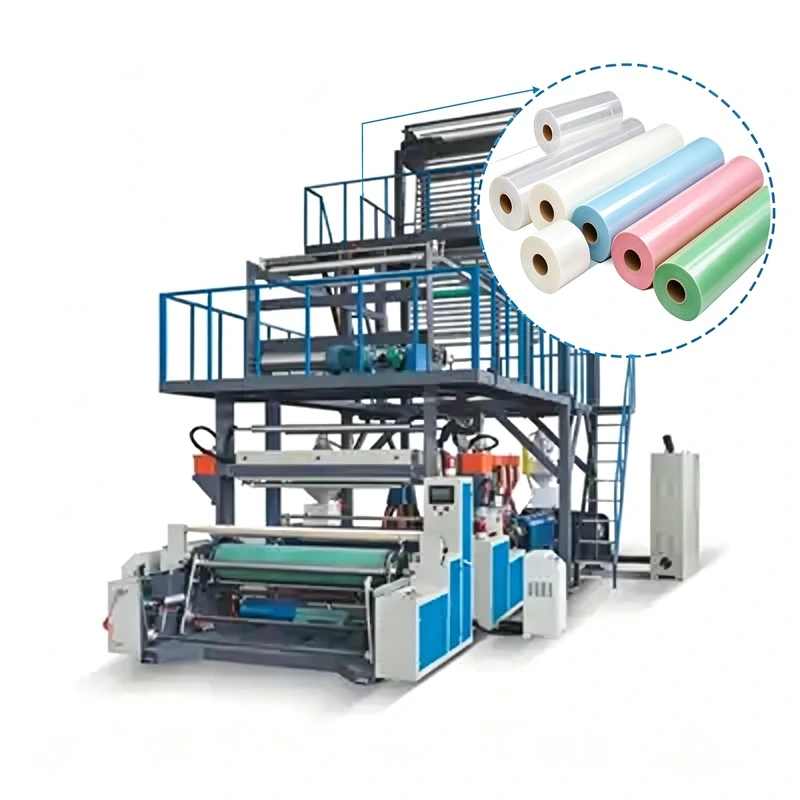
How Smart Control Systems Address Each Waste Source
Modern blown film lines incorporate a range of smart control technologies designed to minimize material loss at every stage of production.
1. PLC Monitoring Systems for Thickness Control
PLC (Programmable Logic Controller) monitoring systems provide real-time control of extrusion volume and thickness. This capability directly addresses thickness variation waste, which is often the largest single contributor to overall film scrap.
Traditional lines rely on manual adjustments and periodic gauge measurements. By the time an operator detects a thickness deviation, significant footage of off-spec film may have already been produced. PLC-based systems continuously monitor film thickness and automatically adjust extrusion parameters to maintain consistency.
Yongbang's blown film machines incorporate PLC monitoring that enables real-time thickness control. The system can detect deviations as small as 0.5μm through online thickness monitoring, allowing for immediate correction before significant waste accumulates.
Key benefit: Reducing thickness variation directly translates to less off-spec film and higher usable yield per pound of resin.
2. Variable Frequency Drive Systems for Energy and Process Stability
Variable Frequency Drive (VFD) systems reduce energy consumption by 15–20%. While energy savings are a primary benefit, VFD technology also contributes to waste reduction through improved process stability.
VFDs enable precise control of screw speed and motor torque, which directly affects melt uniformity. Inconsistent screw speed can cause surging—periodic variations in output that lead to thickness fluctuations and film defects. By maintaining steady screw rotation, VFDs help prevent the process instability that generates waste.
3. Double-Vent Air Ring Design for Uniform Cooling
The double-vent air ring ensures uniform cooling and consistent film thickness. Cooling uniformity is critical for film gauge control. If one side of the bubble cools faster than the other, the film will develop thickness variations that may render the entire roll unsaleable.
The air ring design directly determines film thickness uniformity in blown film production. A well-designed air ring system provides stable, consistent airflow across the entire bubble circumference, minimizing gauge variation and the associated waste.
4. IOT Monitoring for Predictive Maintenance
IOT monitoring enables 70% faster issue resolution. This capability reduces downtime waste by enabling predictive rather than reactive maintenance.
When equipment issues are detected early—before they cause bubble breaks or quality defects—operators can schedule maintenance during planned downtime rather than experiencing unexpected stoppages. Each unplanned stop generates startup waste when the line restarts, so reducing their frequency has a direct impact on material loss.
Waste Reduction Comparison: Traditional vs. Smart-Controlled Lines
The following table compares typical waste performance between traditional blown film lines and those equipped with smart control systems.
| Waste Source | Traditional Line | Smart-Controlled Line | Reduction Potential |
|---|---|---|---|
| Startup waste per event | 50–150 kg | 20–60 kg | 50–60% |
| Thickness variation waste | 2–5% of output | 0.5–1.5% of output | 60–75% |
| Edge trim waste | 5–10% of film width | 3–6% of film width | 20–40% |
| Downtime-related waste | 3–8 events/month | 1–3 events/month | 60–70% |
| Quality defect rate | 2–4% | 0.5–1.5% | 50–70% |
Note: Actual results vary by material, configuration, and operating conditions. These figures represent typical industry ranges and should be verified through site-specific testing.
The cumulative effect of these reductions can be substantial. A converter running 1,000 kg/hour of resin could potentially save 150–200 kg of material per production day through smart control implementation—material that would otherwise have been scrapped.
Checklist: Evaluating Your Blown Film Line for Waste Reduction Opportunities
Use this checklist to assess your current line's waste reduction capabilities:
- Thickness monitoring: Is thickness measured continuously with automated feedback control, or only periodically with manual adjustments?
- Screw drive: Is screw speed controlled by VFD with precise torque regulation, or by fixed-speed motor?
- Cooling system: Does the air ring provide stable, uniform airflow across the full bubble circumference?
- Process data: Is production data (temperature, pressure, thickness, output) logged and analyzable for trend identification?
- Predictive alerts: Does the control system notify operators of parameter drift before it causes defects?
- Grade changeover: Is there a standardized procedure with optimized parameters for each material grade to minimize startup waste?
- Edge trim recycling: Is edge trim collected and reintroduced into the process (where material properties allow)?
- Operator training: Are operators trained to interpret control system data and respond to deviations promptly?
Frequently Asked Questions
What percentage of resin input typically becomes waste in blown film production?
Typical film waste ranges from 3% to 8% of total resin consumption, depending on line configuration, material type, operator skill, and control system sophistication. Startup waste, thickness rejects, and edge trim are the primary contributors.
How does thickness variation specifically create waste?
Film that falls outside specified thickness tolerances cannot be sold to customers with tight specifications. Even if the film is otherwise defect-free, it must be reprocessed or scrapped. Thickness variation also creates uneven rolls that are difficult to convert in downstream bag-making or printing operations.
Can smart controls completely eliminate film waste?
No control system can eliminate 100% of film waste. Some waste—such as a minimum amount of edge trim and startup material—is inherent to the blown film process. However, smart controls can significantly reduce waste to the lowest practical level. Actual performance depends on operating conditions, material properties, and maintenance practices.
What is the role of the air ring in waste reduction?
The air ring controls bubble cooling. Uneven cooling creates thickness variation across the film width. A properly designed air ring—such as a dual-lip or double-vent design—provides stable, uniform airflow that minimizes gauge variation and the associated waste.
How does predictive maintenance reduce film waste?
Predictive maintenance detects equipment wear or parameter drift before it causes production issues. By addressing problems during planned maintenance rather than reacting to unexpected breakdowns, converters avoid the startup waste that follows every unplanned stoppage.
Is waste reduction through smart controls applicable to all blown film materials?
Smart controls benefit most blown film materials, including LDPE, HDPE, LLDPE, and biodegradable resins. However, the specific control parameters and waste reduction potential vary by material. Processors should verify performance with their specific material grades and production conditions.
Conclusion
Reducing film waste in blown film production requires a systematic approach that addresses each source of material loss. Smart control technologies—PLC monitoring, VFD systems, advanced air ring designs, and IOT connectivity—provide the tools to achieve meaningful reductions in startup waste, thickness rejects, edge trim, and downtime-related scrap.
The most effective waste reduction strategy combines appropriate control technology with proper operator training, standardized procedures, and regular maintenance. While no system can eliminate all waste, the cumulative impact of smart controls can significantly improve material utilization and reduce production costs.
Before investing in new control systems, evaluate your current waste sources, benchmark your performance against industry ranges, and identify the specific areas where improvement would deliver the greatest return. For a comprehensive overview of available film blowing machine configurations and control options, review the available equipment options.
Actual waste reduction results depend on material type, machine configuration, operating conditions, and maintenance practices. Buyers should confirm specific performance expectations with the supplier based on their production requirements.
 Brochure Download
 FAQ
FAQ