EN
EN Español
It’s 3:00 AM on a Tuesday, and a shift supervisor is staring at a control panel, watching the gauge profile drift again. The thickness of the LDPE film has crept from a tight ±4% variation to nearly ±8%. Rolls are piling up as hold stock, and the downstream converter is already threatening a rejection. The operator adjusts the air ring lip, tweaks the blower speed, and even tries a slightly higher melt temperature—still, the problem refuses to stabilize. The immediate instinct is often to blame raw material inconsistency or an aging extruder, but after the third such incident, a deeper question surfaces: Is the air ring really doing its job?
The challenge of maintaining uniform film thickness rarely begins with the extruder or the resin. In most cases, it originates just above the die, where the molten tube first meets the cooling airflow. The design of the air ring, its internal flow path, and how it integrates with the entire film production line dictates whether the bubble remains rock-steady or wobbles into a costly tolerance nightmare.
Why Film Thickness Refuses to Behave
To understand the problem, you have to look at what happens the moment the polymer melt exits the die gap. The hot tube must be inflated and cooled simultaneously. If the cooling air hits the melt unevenly—due to a poorly designed air ring chamber, incorrect lip gap, or unstable blower output—localized cold spots form immediately. These zones freeze earlier than their surroundings, creating thick-thin bands that spiral up the bubble and translate directly into gauge variation on the wound roll.
Traditional single-lip air rings, still common in older lines, deliver a single high-velocity stream of air that often strikes the melt too abruptly. This “knife-edge” airflow can set the frost line height in stone but offers almost no adjustability when conditions change. Many operators learn to live with the resulting gauge scatter, compensating with excessive film thickness just to stay above minimum specifications—silently sacrificing up to 8% in material give-away. According to ISO 4593, the standard for plastics film thickness measurement, a well-controlled process should hold variation within a narrow band, but that is only achievable when the cooling hardware is built for precision, not just for bulk airflow.
A dual-lip air ring changes the dynamic entirely. The lower lip provides a moderate, stabilizing air cushion that pre-cools the melt and fixes the bubble’s initial shape, while the upper lip delivers the main cooling blast further up the stalk. This staged cooling reduces the shock on the molten tube and dramatically lowers the chances of venturi-induced instability. The result is a more cylindrical bubble, a higher and more stable frost line, and gauge profiles that can be held consistently within ±3% even on high-output runs.
Turning Physics into Usable Gauge Control
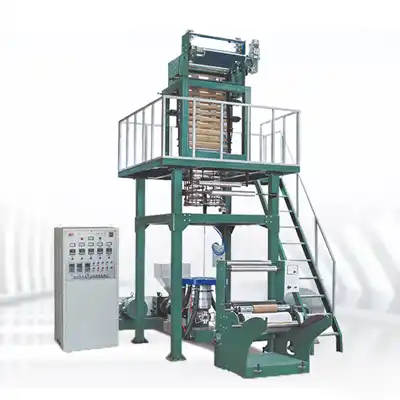
The real difference shows up in the numbers. In a typical film blowing machine, switching from an unoptimized single-lip ring to a properly engineered dual-lip design can reduce transverse direction thickness deviation by 30% to 50%. It’s not magic; it’s fluid dynamics. The trick is that a dual-lip ring creates a low-pressure zone just above the die that gently pulls the bubble outward while the stabilizing stream keeps it from fluttering. This allows the melt to stretch uniformly before the main cooling sets the dimensions. Without this stage, the bubble dances, and thickness maps become a permanent source of waste.
Of course, mechanical design alone can’t fix everything. Even the most precisely machined air ring benefits from integration with intelligent blowers and, where the line warrants it, an IBC (internal bubble cooling) system. But the foundation is always the airflow hardware. When processors invest in high-performance tubular film cooling systems, they’re not only buying metal; they’re buying predictable rheology and the removal of one of the most persistent variables in blown film extrusion.
Here’s what often gets overlooked: the best air ring designs incorporate adjustable lip gaps that can be fine-tuned without shutting down the line. This allows operators to adapt to different resins, melt flow indices, and ambient conditions on the fly. A plant in Southeast Asia, for example, switched from a fixed-gap ring to an adjustable dual-lip unit and documented a 12% reduction in trim waste within the first quarter—simply because they could dial in the airflow to match seasonal humidity changes that previously destabilized their bubble.
A Smarter Approach to Equipment Selection
When you’re facing persistent gauge issues, it helps to think beyond the air ring as a standalone component and view it as part of a broader extrusion system. The linkage between air ring, die geometry, and take-off speed is tight, and mismatches here almost always bleed into the final product. Modern film extrusion equipment for tight-tolerance packaging is designed with this systems perspective, ensuring that the cooling assembly isn’t just bolted on but engineered into the line’s overall gauge control strategy.
This kind of thinking is what separates a quick fix from a sustainable manufacturing solution. Companies that have built their reputation on ultra-thin stretch film or high-clarity shrink film consistently prioritize air ring design in their equipment selection criteria. They know that any percentage point lost to gauge variation multiplies across thousands of kilometers of film, turning a seemingly small defect into a massive cost burden.
If you’re exploring how to harden your process against thickness drift, it’s worth looking at manufacturers who have taken a first-principles approach to airflow optimization. Yongbang’s film extrusion platforms, for example, incorporate dual-lip air ring geometry that was refined through iterative computational fluid dynamics modeling and real-world field testing across multiple resin families.
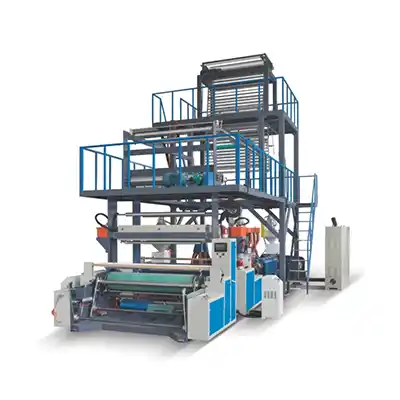
Rather than treat the air ring as an accessory, these systems integrate it with precisely matched blowers and optional closed-loop gauge control, so the hardware works with your feedback system instead of against it. For lines already operating a basic film blowing machine, even a retrofit to a properly specified dual-lip ring often pays for itself through material savings within a single production season.
The Path to Predictable Output
Thickness variation isn’t just a quality problem; it’s a profitability problem wrapped in a technical puzzle. The air ring sits at the heart of that puzzle. By shifting from a reactive adjustment mindset to a design-driven approach, film producers can turn one of their biggest headaches into a controlled, repeatable process variable. The next step isn’t buying a fancier gauge scanner or adding more tension control—it’s looking at the very first point where the melt becomes film and ensuring that point is treated with the engineering it deserves.
For operations targeting sub-±3% gauge consistency without overspending on resin, it makes sense to evaluate advanced tubular film cooling technologies that have proven their performance in real production environments. The right setup doesn’t just stabilize your bubble; it stabilizes your entire cost structure.
 Brochure Download
 FAQ
FAQ