EN
EN Español
It’s a familiar scene at a growing packaging plant: the morning production meeting reveals a backlog of thin-gauge HDPE sacks, glossy laminated reels, and a new contract for high-barrier food wrap. The shift supervisor points at the single-head line and asks, “Can we really squeeze all this out of one die without killing our delivery dates?” If that question echoes through your own shop floor, you’re standing exactly where many converters do—on the threshold between staying lean and scaling capacity. The choice between a single and a double head blown film system shapes everything from film quality to energy bills, yet the right answer isn’t on any spec sheet. It lies in how the two architectures intersect with your real-world product mix.
Before picking apart technical differences, it helps to frame the decision around the actual production flow rather than just equipment specs. Every converter’s goal is to match the extrusion setup to the film structures, throughput demands, and margin targets that pay the bills. Exploring various blown film production lines shows clearly that there is no universal “best” machine—only the best alignment with your order book and factory constraints.
How the Two Architectures Really Differ
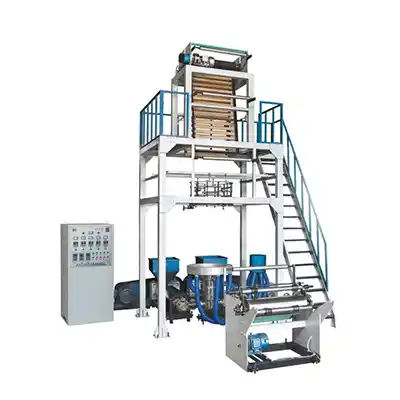
A single head system uses one die, whether it’s a monolayer spiral mandrel or a multi-manifold block feeding up to 11 layers. The bubble rises from one point, is stabilized by a single air ring, and creates one wide web or multiple slit reels. A double head system essentially puts two independent dies on the same floor, each with its own air ring, bubble cage, and collapsing frames, sharing utilities but operating as separate mini-lines. That fundamental difference cascades into every performance metric.
Where Output and Efficiency Diverge
If you run commodity films like garbage bags, carrier bags, or light shrink film, a single head can be optimized for extraordinary output—think 300–450 kg/h on a 3-layer industrial line with internal bubble cooling. But when your schedule switches between vastly different formulations every few hours, that same high-output line turns into a downtime liability. A double head system gives you the chance to run a heavy-gauge LDPE tube on one head while the other produces a thin LLDPE/stretch formulation simultaneously, keeping overall plant utilization high even while individual outputs are slightly lower. That matters because according to industry surveys by the European Plastics Converters Association, unscheduled downtime and changeover losses routinely eat 12–18% of potential production time in single-stream operations.
Film Structure Versus Floor Space
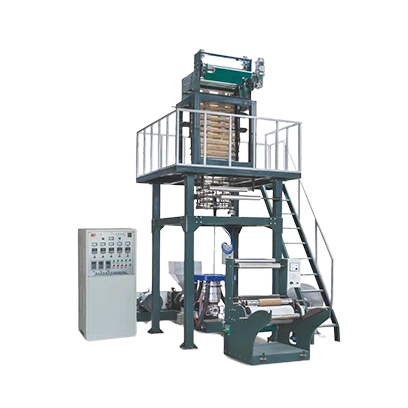
Many converters assume that a double head system automatically means more layers. In reality, both architectures can accommodate multi-layer. The trade-off sits elsewhere: a single head line delivering a 5-layer barrier film will use one compact tower, while achieving the same total output with two 3-layer double heads might produce more total kilograms but at the cost of larger floor space and a more complex winder setup. If your facility is tight on floor space, the energy density of a single head line becomes a strategic advantage. On the other hand, if your customers increasingly demand multiple specialty structures (for example, both high-clarity laminates and opaque silage film), the physical separation of two heads removes the contamination risk and purging delays that plague frequent material changes.
A Side-by-Side Look at the Trade-Offs
The table below consolidates the key differentiators in a way that speaks directly to day-to-day operations.
| Dimension | Single Head System | Double Head System |
| Typical film structures | Mono to 11-layer, optimized for one product at a time | Two parallel lines, each handling mono to 5-layer, often different formulations |
| Throughput ceiling | Very high per bubble (up to 500 kg/h with IBC) | Moderate per head, high combined output if both run continuously |
| Changeover flexibility | Lower; purging time hits high if materials vary wildly | High; one line can keep running while the other is changed over |
| Floor space | Compact tower design | Larger footprint, shared ancillaries |
| Energy consumption | Single main drive, one heating/cooling circuit | Two extruder groups, but can be offset by better overall utilization |
| Investment cost | Lower upfront, simpler installation | Higher upfront, but may offer faster ROI for diverse product portfolios |
For a versatile converter handling monthly fluctuations in resin type and film gauge, flexible blown film configurations have increasingly become the pivot point that determines whether the factory rides out seasonal peaks with profit or panic.
The Part Most Investment Analyses Miss
Payback calculations almost always center on kilograms-per-hour and electricity bills, but experienced plant managers watch a less obvious metric: scrap rate during startups and transitions. Every die scraped, air ring re-centered, and bubble re-established eats not just raw material but also operator attention. Data from internal trials at several Asian and European plants suggest that an optimized single head line can reach stable production within 8–12 minutes of a grade change, while a double head setup reduces the frequency of that restart by allowing dedicated heads for dedicated product families. If your factory produces more than five distinct film formulations daily, the double head paradigm often delivers 2–4% less edge trim and startup waste over a month—numbers that quietly transform margins.
Matching the System to Your Product Roadmap
Instead of asking “single or double,” ask three questions that usually predict the right fit:
-
Does your product mix change radically within a shift? If yes, lean toward double head.
-
Are your main raw materials chemically incompatible? Nylon/EVOH-rich barrier structures and purely polyolefin commodity films don’t like sharing a screw. The cleaning penalty can justify a second head.
-
Is floor space scarcer than labor? If so, high-throughput single head lines with quick-purge extruders may be your constraint satisfier.
Decision clarity rarely comes from a brochure. It comes from modelling a week of real orders through both scenarios and seeing which one leaves the fewest idle hours on the production dashboard. If you want to benchmark how different blown film architectures map to your specific order profile, you can explore modular single and dual head extrusion solutions designed to scale with shifting demand.
Where Expertise Meets Your Floor Plan
Yongbang has spent years engineering extrusion systems that translate these trade-off decisions into predictable outcomes. Instead of forcing you into a pre-packaged box, Yongbang’s approach starts with your intended film portfolio—layer counts, annual tonnage, resin types—and back-calculates the optimal configuration. Whether you end up with a high-output single head line or a split-duty double head system, the goal remains the same: film that meets spec without making compromise a habit. If you are ready to move from general comparisons to a layout that fits your actual production schedule, Yongbang’s tailored blown film systems are a practical starting point.
Disclaimer: The performance ranges and scrap rate figures mentioned in this article are based on typical industry observations and internal test data from installations processing standard polyolefin resins. Actual results vary depending on resin formulation, film gauge, ambient conditions, and operator skill. Always request a customized project study before making capital equipment decisions.
 Brochure Download
 FAQ
FAQ