EN
EN Español
Walk through any packaging converter, and you’ll hear the same frustrations: shrink film that lacks consistent gauge, mysterious tear propagation on high-speed wrappers, or the constant battle between downgauging targets and puncture resistance. For years, these pain points were accepted as the cost of doing business on conventional monolayer blown film setups. But the physics of single-layer extrusion places a hard ceiling on what you can achieve—one extruder, one set of material properties, and no room to isolate functions.
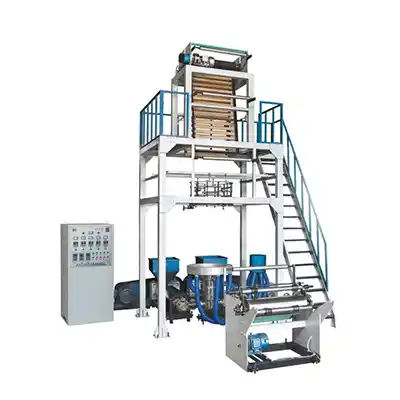
The breakthrough for many shrink film operations came when they started looking beyond the flat die and into three-layer co-extrusion configured in an ABA stack. This structural change does more than add layers; it uncouples surface performance from bulk economics. If you are evaluating how to modernize your shrink line, exploring multi-layer blown film solutions reveals possibilities that a monolayer line simply cannot replicate.
Why Shrink Film Demands a Layered Approach
Shrink film—whether used for collation packs, beverage multipacks, or industrial pallet wrap—must satisfy a difficult trio: high shrink force in both machine and transverse directions, controlled slip and anti-block surface properties, and the ability to thin down without sacrificing holding strength. In a monolayer process, every additive you load to improve shrink or slip necessarily weakens the melt strength or raises the raw material cost across the entire film profile.
An ABA blown film configuration decouples these demands. Two outer layers (A) are typically fed by one extruder, while a separate extruder supplies the core layer (B). This architecture lets the core carry the bulk of the film thickness, often using highly filled, recycled, or lower-cost polymers, while the thin A layers deliver the precise friction, seal initiation temperature, and optical clarity required by end users. In essence, an ABA blown film machine is designed to allocate performance where it matters and cost where it doesn’t—an impossible trade-off on a single-screw line.
Material Savings Meet Performance Gains
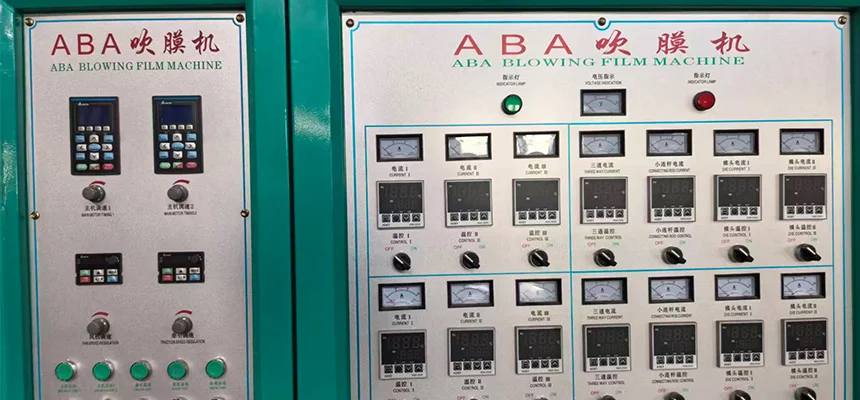
The financial attraction of ABA technology for shrink film is immediate: the core layer can accommodate high percentages of post-industrial reclaim, trim scrap, or even calcium carbonate-filled compounds without migrating to the surface. Since the A skins encapsulate the core, there’s no compromise on film clarity, gloss, or coefficient of friction. Operators regularly report that moving to an ABA structure cuts virgin resin consumption by 20–35%, depending on film grade, while maintaining or improving shrink performance.
But the benefits go deeper than material cost. By manipulating the ratio of the two extruders, processors can fine-tune the film’s thermal memory—how it “remembers” to shrink when reheated. The B layer can be formulated with a higher melt index resin that flows and orients aggressively during the bubble forming process, generating higher free shrink values under standard test conditions like ASTM D2732. The A skins, kept cooler and less drawn, provide the surface stability that prevents blocking and gives the film a wide operating window on packaging lines.
| Attribute | Monolayer Shrink Film | ABA Three-Layer Shrink Film |
|---|---|---|
| Recyclate usage | Limited to surface quality constraints | Core can accept >40% reclaim without surface defects |
| Gauge uniformity (2σ) | Typically ±8% to ±12% | Achievable ±3% to ±5% with proper die and air ring |
| Shrink force customization | Blended compromise | Tailored via core layer rheology |
| Film blocking tendency | Managed entirely by additives | Reduced by encapsulating low-melt-temp core |
| Oxygen/cost balance | Uniform barrier throughout | Barrier layer can be confined to core (if ABC conversion) |
(Data based on industry benchmarks and typical equipment performance; individual results may vary with resin and process conditions.)
Stability That Translates to Output
There’s an often-overlooked productivity dimension. Monolayer shrink lines pushing high outputs frequently battle bubble instability, especially when layer ratios drift or melt temperature varies. Because an ABA die receives material from two extruders operating at independently optimized temperature profiles, the combined melt curtain enters the die with better thermal homogeneity. This produces a more stable bubble, faster line speeds, and less scrap from wrinkles or gauge bands.
When investing in an ABA blown film machine, processors should also scrutinize the downstream collapsing and winding section. Shrink-grade films are notoriously prone to blocking at the nip if the bubble isn’t cooled symmetrically. A well-engineered system integrates a high-efficiency dual-lip air ring and internal bubble cooling (IBC) that maintain a consistent frost line, even when push-pull ratios are aggressively set to induce balanced orientation. If you’re comparing different configurations, reviewing the key specifications of a modern co-extrusion system helps you spot the features that directly impact shrink consistency—like oscillating haul-off units and gap-controlled collapsing frames.
Real-World Shrink Film Wins with ABA Technology
A mid-sized European collation shrink producer recently disclosed that, after switching from a 250 kg/h monolayer line to a 350 kg/h ABA three-layer system, their thickness tolerance narrowed from ±10% to ±4% while using 30% recycled core material. The resulting film qualified for a major retail chain’s sustainability program, opening a new revenue stream. This aligns with wider industry data: according to a 2023 AMI Consulting report on stretch and shrink film markets, multi-layer structures are projected to capture over 55% of shrink film capacity additions through 2027, driven precisely by the recyclate inclusion and lightweighting trends.
Another processor reported eliminating polymer processing aid (PPA) usage in the skins altogether by relying on the core layer’s metallocene-rich formulation to provide slip migration, reducing additive cost by over $12,000 per year per line. These aren’t isolated anecdotes; they reflect the fundamental material science of layer multiplication.
Key Considerations Before Upgrading
While the advantages are compelling, moving to an ABA setup isn’t just a bolt-on change. The die design must match your target layer ratio—typically, a 1:3:1 or 1:2:1 A:B:A split works for many shrink grades, but heavy recycle strategies may push the core to 60% or more. Extruder sizing should reflect the viscosity mismatch between skin and core resins so neither runs in an inefficient rpm range. And if you anticipate expanding into barrier shrink applications (e.g., for fresh meat with an EVOH core in an ABC configuration), choosing a platform that supports a future third extruder port pays dividends.
For operations ready to move from endless additive tweaks to a fundamentally different processing architecture, evaluating a specialized shrink film extrusion system designed for the exact demands of collation, display, and industrial shrink films can turn a quality headache into a competitive advantage.
Building a Shrink Film Future on ABA
The shift toward downgauged, recycle-rich, and high-performance shrink films isn’t a fleeting trend—it’s a structural change driven by brand-owner sustainability pledges and tighter retailer specifications. ABA blown film technology sits at the center of this transformation, offering a proven path to produce films that meet today’s performance and environmental targets without punishing your margins.
Whether you are retrofitting an aging line or planning a greenfield shrink film plant, the decision starts with understanding the layer architecture that matches your product roadmap. If you’d like to see how a purpose-built approach can elevate your shrink film quality while cutting material cost, Yongbang’s integrated blown film technology provides configurations tailored from the first screw to the final winder.
Disclaimer: This article contains general industry insights and does not constitute engineering advice. Equipment performance varies based on resin selection, ambient conditions, and specific machinery configuration. Always consult equipment manufacturers and conduct trials for your unique application.
 Brochure Download
 FAQ
FAQ