EN
EN Español
Every plant manager who has pushed post-industrial scrap back into the core layer knows the moment: the bubble begins to breathe erratically, then tiny specks appear in the film, and before the shift ends, a tear propagates from the edge and the whole web collapses. Recycled content is non-negotiable for margin, but the instability it introduces can make you feel like you are trading one problem for another.
Javier, a production supervisor at a mid-size packaging converter in León, described it plainly: “We were losing 11% of our output to wrinkles and gel-related pinholes every time we crossed 35% regrind in the middle. Our monolayer line simply could not isolate the defects.”
His experience is not unique. When you bury regrind in a single-layer blown film structure, every impurity, every viscosity shift, every degraded polymer chain sits in the same melt stream as your prime resin. The result is bubble instability, lower dart impact, and optical defects that print buyers will reject on sight. And yet, the answer is not to abandon recycled content—it is to rethink how the film is structured.
Why Recycled Cores Fail—and When They Don’t
The root cause sits in rheology. Post-industrial recycled LDPE and LLDPE carry a broader molecular weight distribution, higher gel counts, and traces of inks or adhesives that act as stress concentrators. When you blend them homogeneously with virgin resin, even 20% regrind can widen the melt temperature window by 8–12 °C, according to extrusion trials cited in TAPPI’s PLACE Flexible Packaging Symposium proceedings. The bubble neck height shifts, frost line moves, and suddenly your gauge profile degrades.
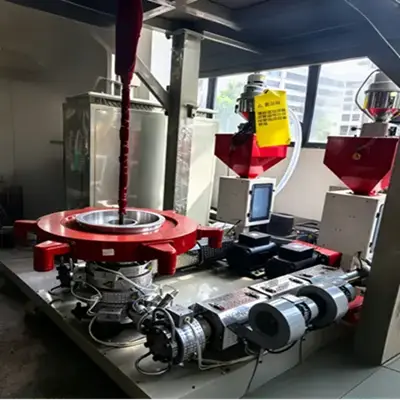
The insight that solves this is deceptively simple: separate the melt streams. By running a three-layer die where the core extruder handles the regrind and the inner/outer layers use virgin resin, you isolate the variability where it cannot touch the surface. Scratches, gels, and carbonized specks stay buried. The outer skins provide a pristine printable surface and seal integrity, while the core becomes a forgiving channel for up to 60–80% recycled material.
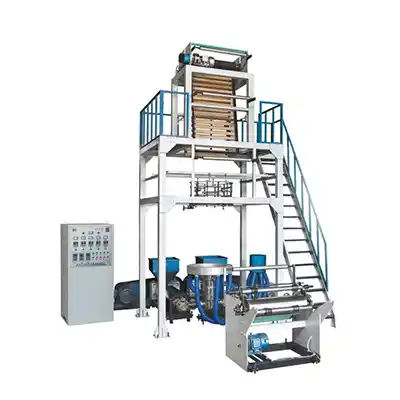
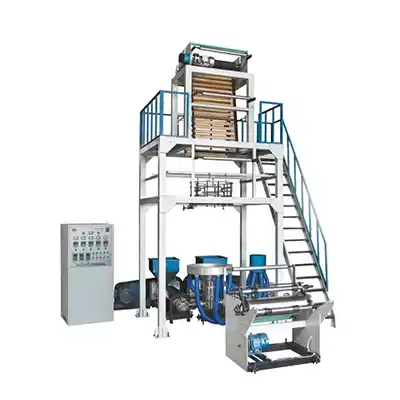
This is the principle behind multi-layer blown film lines designed specifically for high-regrind formulations. One such approach—the ABA configuration—uses two outer extruders feeding the same virgin resin and a larger central extruder for the recycled core. The mechanical simplicity keeps the footprint close to that of a monolayer line, but the process stability is orders of magnitude better. If you are dealing with fluctuating feedstock, exploring a dedicated cost-effective film production setup designed for recycled cores might fundamentally change your scrap economics.
What Changes on the Floor
Switching to a separated melt stream architecture alters more than the extruder layout. Operators see immediate differences in three areas:
1. Bubble Stability
Because the outer layers are formed from a consistent, high-integrity melt, the bubble’s load-bearing walls are decoupled from the core’s variation. A test run at an Indonesian blown film plant documented that standard deviation of layflat width dropped from ±4.2 mm on a mono-layer line to ±1.1 mm after moving to an ABA setup, even with 50% washed PCR in the core.
2. Defect Masking
Gels and black specks originating from recycled material remain encapsulated. The inner and outer skins—as thin as 15–20% of total thickness each—are enough to cover particles up to 200 µm. The film emerges visually clean, critical for brands that print high-resolution flexo graphics.
3. Mechanical Properties Retention
Dart drop and Elmendorf tear values depend disproportionately on the outer layers. By preserving virgin skin layers, you retain up to 92% of the virgin film’s dart impact strength while running high recycled loads, as measured by internal tests following ASTM D1709. The core carries the bulk and the cost saving; the skins carry the performance.
Common Pitfalls When Scaling Recycled Content
Even with the right equipment configuration, operators stumble into a few recurring traps:
-
Feeding inconsistency: Regrind with irregular particle size causes surging in the core extruder. A consistent grinding protocol and, where possible, a dual-diameter screw for the core extruder, dramatically improve melt stability.
-
Skin layer over-optimism: Trying to push skin layers below 10% invites micro-tears at the die lip. A floor of 12–15% per skin gives a safety margin.
-
Degassing neglect: Recycled resins carry volatiles. A vented core extruder or an upstream hot-air dryer prevents pinhole bursts that are often misattributed to formulation.
If your team is transitioning from a monolayer line, proper operator training on die gap adjustment and separate temperature profiling becomes the multiplier. We have seen shops overcome 90% of their recycled-film quality complaints just by aligning the core temperature profile with the MFI drift of their regrind batch. To dig deeper into how die design influences layer uniformity, you may want to view specific configurations that tackle these variables directly.
Beyond Troubleshooting: Building a Regrind-Ready Process
The long-term play is not just fixing today’s bubble instability—it is designing a production cell where recycled content becomes an asset rather than a compromise. This means:
-
Screw geometry: Barrier screws in the core extruder that can handle a wider range of bulk densities without pulsing.
-
Gauge control: An automatic air ring and segmented die lip that react to core-induced thickness variations in under 2 seconds.
-
Material traceability: Simple batch-logging of regrind source, wash history, and MFI, correlated with bubble camera snapshots for root-cause analysis.
One packaging group in Central America took this approach and, within six months, moved their average recycled content from 22% to 49% across their agricultural film portfolio—without a single customer complaint about aesthetics. Their secret was treating the recycled stream not as a contaminant but as a different raw material that deserved its own temperature, pressure, and screw-speed philosophy.
At this point, the ROI conversation shifts. The machine is no longer just a film extruder; it is a waste-to-margin engine. If your operation generates more than 200 tonnes of edge trim and start-up scrap per year, the payback on a purpose-built line often falls under 14 months—not counting the avoided landfill fees or the green packaging premiums buyers are willing to pay.
When Monolayer No Longer Makes Sense
For converters that produce mainly simple films—say, plain LDPE bags for the local market—monolayer lines still have a place. But the moment you add three variables—recycled content targets above 25%, a customer demanding print-grade surface, or film gauges below 40 µm—the monolayer equation breaks.
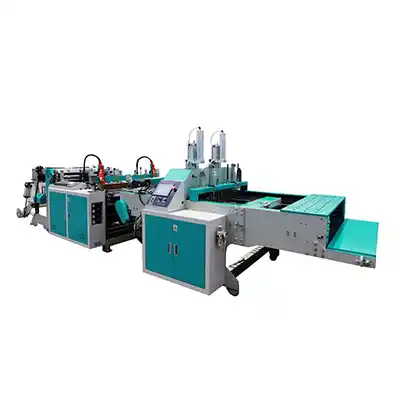
This is where the arithmetic gets compelling. An ABA blown film machine dedicated to recycled-core films can run a 30-micron film with 50% post-industrial regrind while maintaining a Class A surface finish. Monolayer lines forced into the same task typically sacrifice either speed (downrating output to control bubble turbulence) or quality (accepting a B-grade surface). Neither helps your profitability.
The packaging industry is also moving fast. Brand owners under Extended Producer Responsibility (EPR) frameworks are demanding verified recycled content. The technology to deliver that without compromising film performance exists today, and the early adopters are already locking in multi-year supply agreements with retailers who require third-party recycled content certification.
If you are evaluating your next step, it makes sense to first get a tailored assessment of what your current scrap stream could yield in a co-extrusion environment. Sometimes the answer is not a bigger extruder—it’s smarter layer arrangement.
A Smarter Route to Sustainable Film
What Javier’s team in León ultimately learned was that the recycled core layer problem is not really about the material—it is about how the machine treats it. When they commissioned a three-layer line designed to isolate recycled content, their 11% output loss shrank to 1.6% within the first month. The gel complaints stopped. And the regrind that was once a disposal cost became the most profitable input on their floor.
If you are looking for a more reliable way to convert recycled feedstock into high-quality blown film, Yongbang’s co-extrusion technology offers a path that respects both your margins and your customers’ specifications. The goal is not just to run regrind—it is to run it so well that nobody can tell the difference.
To explore how this approach fits your specific material mix and output targets, you can explore our solutions for high-recycled-content film production.
Disclaimer: This article references general industry data and anonymized user experiences. Performance figures may vary based on raw material quality, operating conditions, and specific machine configurations. Always conduct trials under your own production conditions.
 Brochure Download
 FAQ
FAQ