EN
EN Español
When a Southeast Asian snack brand recently switched its pillow-pack laminates from a 3-layer structure to a transparent 5-layer all-PE design, the shelf life of the fried shallots inside increased by six weeks — and the package became fully recyclable in existing PE streams. This is not an isolated story. Across the flexible packaging industry, the conversation has shifted decisively toward “more layers with less material,” and the technology sitting at the heart of this shift is making five-layer co-extrusion one of the most talked-about production strategies right now.
The reason isn’t simply “thinner is better.” It’s that five-layer structures offer a sweet spot in the cost-performance-sustainability triangle that three layers cannot touch and seven-to-nine layers often over-engineer. For packaging converters who have spent the last five years squeezed between brand owners’ 2025 recyclability pledges and volatile resin prices, this balance has become urgent. Many are now evaluating advanced multi-layer extrusion systems that can handle the precise layer ratios and disparate melt viscosities demanded by these new structures.
What’s fueling the shift: data beyond the anecdotes
According to a 2023 Smithers report, “The Future of High-Barrier Packaging to 2028,” the global market for multi-layer barrier films is projected to grow at a CAGR of 5.2%, with 5-layer structures accounting for the fastest segment expansion. The driving forces are clear: extended shelf life for food without aluminum foil, downgauging targets that require strength from multiple thin layers instead of one thick one, and design-for-recycling guidelines that push mono-material PE or PP structures — which inherently need extra functional layers to compensate for the missing barrier of PET or PA.
At the same time, resin producers have introduced grades specifically designed for co-extrusion tie layers and high-clarity skins. For example, advanced metallocene polyethylenes now allow a 5-layer film to achieve the same hot-tack and seal-through-contamination performance that once required a lamination. This materials evolution means that a converter with the right co-extrusion setup can replace two separate processes with one — a direct hit on conversion cost, energy use and lead time.
Why five is the new operational optimum
There is a practical, day-to-day shop-floor reason for the 5-layer wave as well: line utilization. Every added layer increases die complexity, startup waste and purging time when switching between recipes. Industry experience shows that moving from three to five layers typically adds only about 12–15% to die cost and start-up time, whereas a jump to seven or nine layers can double it. Five layers, therefore, sit at the inflection point where the converter gains the functional benefits of multi-layer construction — the ability to bury recycled content in a core layer, protect an expensive barrier resin between inexpensive skins, or create differential slip and seal properties — without the operational burden becoming unmanageable.
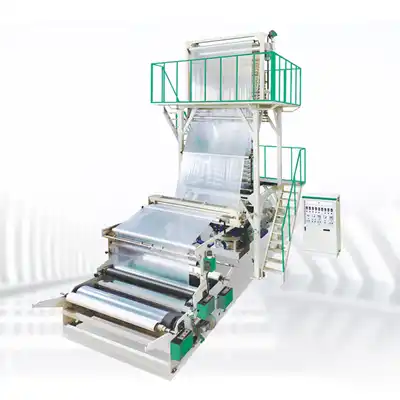
Modern die technology and control systems have further flattened this curve. Spiral mandrel dies with optimized flow channels now maintain <5% layer-ratio variation during speed changes, and real-time infrared gauge profiling feeds back to individual extruder drives. This precise gauge control and layer uniformity makes it possible to run downgauged films at high output without sacrificing tear resistance or optics.
What this means for the converter’s bottom line
When a film manufacturer can shift from a 120-micron 3-layer PET/PE laminate to a 90-micron 5-layer all-PE structure, the raw material saving per square meter is immediate — often in the 15–20% range. When that same structure also eliminates the lamination step and makes the finished package fully compatible with the CEFLEX “Design for a Circular Economy” guidelines, the commercial advantage with brand owners becomes even larger. Several European converters have publicly reported that 5-layer co-extrusion lines became the backbone of their mono-material PE transition, allowing them to keep orders from multinationals that had mandated fully recyclable flexible packaging by 2025.
Another, less-discussed benefit is flexibility. A well-designed optimized co-extrusion line configuration can run both symmetric structures (like A/B/C/B/A, typical for barrier films) and asymmetric structures (like A/B/C/D/E for heavy-duty shipping sacks with a filled core) without major changeover. This means a converter can serve the food industry in the morning and the industrial packaging sector in the afternoon. Such versatility becomes a real competitive lever in regions where order sizes are shrinking and SKU variety is exploding.
Bridging the knowledge gap with practical experience
While the value proposition is compelling, converters making the switch from monolayer or 3-layer lines often underestimate three operational areas:
-
Purging and material transition: Getting all five extruders and the die cleared simultaneously takes a structured procedure; otherwise, gel specks can persist for hours.
-
Layer ratio optimization: The cheapest resin doesn’t always belong in the core. Occasionally, placing a high-stiffness grade in a skin layer allows for greater overall downgauging.
-
Bubble stability with dissimilar melts: When a skin layer is LDPE and the core is EVOH, the bubble can oscillate if the air ring and IBC (internal bubble cooling) aren’t tuned for the thermal profile. Having machine-control presets based on resin families shortens the learning curve dramatically.
These insights come directly from decades of field data and operator feedback gathered from blown film lines running in diverse humidity and ambient temperature conditions — from tropical Southeast Asia to arid Middle Eastern climates. They underscore that the hardware itself is only half the equation; the embedded process knowledge and responsive support infrastructure are what determine whether a 5-layer investment hits its ROI target within 18 months or drags into a third year.
Taking the next step with confidence
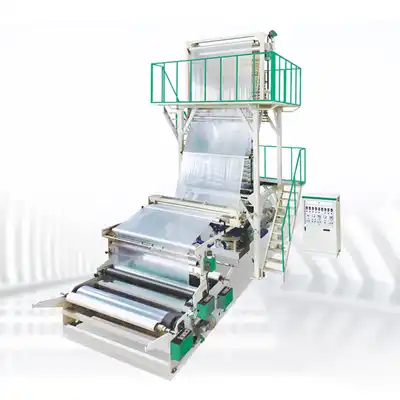
If the market data, material trends and shop-floor experience all point toward 5-layer co-extrusion as a strategic sweet spot, the remaining question for most converters is not whether to invest, but which partner can help them navigate the transition with the least risk. At Yongbang, our approach has been to embed decades of co-extrusion process understanding into every system we build — from the die geometry to the winder automation — so that the line arrives pre-configured for real-world recipes, not just theoretical throughput numbers. If you are ready to explore how a 5-layer platform can fit your product mix and cost structure, we invite you to review Yongbang’s five-layer co-extrusion solutions and reach out for a personalized technical consultation.
References & further reading:
-
Smithers, “The Future of High-Barrier Packaging to 2028,” 2023.
-
CEFLEX, “Designing for a Circular Economy – Flexible Packaging Guidelines,” 2022.
-
ISO 23559:2011, Plastics — Film and sheeting — Guidance on the measurement of gauge and thickness variation.
Note: Specific customer stories have been anonymized and generalized to protect confidentiality; the performance outcomes described are representative of field results observed across multiple installations.
 Brochure Download
 FAQ
FAQ