EN
EN Español
Every packaging producer faces the same pressure: film must be stronger, clearer, and cheaper—all at once. A monolayer line cannot deliver on all three. The ABA blown film structure offers a practical way out of this trade-off. By sandwiching a functional or lower-cost core between two identical surface layers, ABA technology allows processors to reduce material expense without sacrificing the surface properties that matter to end users. This article explains how the ABA structure achieves this balance, what performance trade-offs to expect, and how to evaluate whether it fits your production needs.
What the ABA Structure Actually Does
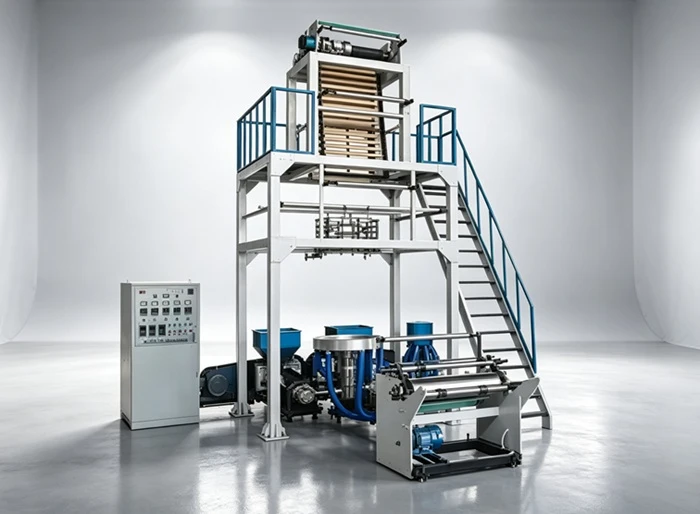
The ABA designation refers to a symmetric three-layer co-extrusion configuration: two identical outer "A" layers encapsulate a different "B" core layer. The outer layers are typically polyolefins like LDPE or LLDPE that deliver heat-sealability, gloss, and printability. The core layer is where the strategic gain lives—processors can load it with recycled material, calcium carbonate fillers, or functional resins like EVOH for barrier properties.
Because the A layers are identical, only two extruders are needed to produce three layers. This keeps the machine footprint and control system simpler than a full ABC three-layer setup, making ABA more accessible for mid-sized converters.
Where the Cost Savings Come From
The most immediate benefit of ABA technology is material cost reduction. By placing lower-cost material in the core layer—which typically accounts for 50–70% of total film thickness—processors can significantly reduce their reliance on expensive virgin resin. The core can accommodate high percentages of post-industrial reclaim, trim scrap, or calcium carbonate-filled compounds without migrating to the surface.
For shrink film applications, operators regularly report that moving to an ABA structure cuts virgin resin consumption by 20–35% while maintaining or improving shrink performance. In garbage bag production, the ABA structure allows LLDPE in the core for strength while using more cost-effective or recycled materials in the outer layers.
How Performance Is Maintained—or Improved
The cost savings would be meaningless if film quality suffered. In practice, ABA structures often deliver mechanical properties that match or exceed monolayer films of the same total gauge.
Impact strength. ABA films typically exhibit significantly higher impact resistance than monolayer films. The symmetric structure distributes stress more evenly across the film cross-section.
Bending stiffness. Placing a stiffer polymer in the core raises flexural modulus while keeping the outer layers ductile. This allows producers to achieve the stiffness required for applications like heavy-duty sacks without brittleness.
Optical clarity. Because filler or recycled content is completely encapsulated by the virgin outer layers, the film surface remains free of the gel-like defects that typically fog monolayer films loaded with post-consumer resin.
Anti-curling. The symmetric A-B-A build naturally resists curling—a common problem in asymmetric structures—improving handling during printing and converting.
Monolayer vs. ABA: A Direct Comparison
| Factor | Monolayer Film | ABA Three-Layer Film |
| Recycled content use | Limited; affects appearance and properties | Can be encapsulated in core layer |
| Impact resistance | Baseline | Significantly higher |
| Optical quality | Limited by regrind content | Surface remains clear |
| Material cost | All resin at full cost | Core layer uses lower-cost material |
| Curling tendency | Can occur | Minimized by symmetric structure |
| Downgauging potential | Limited | 5–10% thickness reduction possible |
| Equipment complexity | One extruder | Two extruders; moderate complexity |
Data based on industry benchmarks and typical equipment performance; individual results depend on material selection and operating conditions.
Where ABA Makes the Most Sense
ABA technology is not the right answer for every application. It delivers the greatest value when:
You need to incorporate recycled content. If sustainability requirements or cost pressures are pushing you toward higher regrind usage, ABA provides a way to hide recycled material in the core where it cannot affect surface quality.
You want to downgauge. The strength-to-weight profile of ABA films often allows processors to reduce total thickness by 5–10% without sacrificing puncture resistance.
You produce commodity packaging films. Garbage bags, shopping bags, T-shirt bags, and agricultural mulch films are all well-suited to ABA technology.
You need balanced properties without complexity. ABA requires only two extruders and offers simpler operation than ABC three-layer systems, making it a practical step up from monolayer.
When to Consider ABC or 5-Layer Instead
ABA has limitations. If your application requires three distinct functional layers—for example, a seal layer, a barrier layer, and a structural layer—an ABC asymmetric configuration may be necessary. If you need ultra-high barrier performance or complex functionality like anti-fog plus UV stabilization plus heat-sealability, a 5-layer structure may deliver better ROI. The decision should be driven by your actual product requirements, not by the appeal of more layers.
Key Questions to Ask Before Committing to ABA
-
What percentage of recycled material do I plan to run? The core extruder should be sized larger than the skin extruders if you plan to run 50–70% recycled content.
-
What is my required film width and thickness range? ABA machines are available in various configurations; verify that the machine can handle your specifications.
-
What materials will I process? Confirm that the machine is compatible with your resin types—HDPE, LDPE, LLDPE, biodegradable materials, or blends.
-
What level of automation do I need? From manual to fully automatic systems, the right level depends on your labor availability and production volume.
-
What technical support is available? Running recycled materials in the core can present challenges; supplier support for process optimization matters.
Common Misconceptions About ABA
"ABA is just a cheaper version of ABC." Not exactly. ABA is a different tool for a different job—symmetric structures for balanced properties and cost efficiency, versus asymmetric structures for specialized functional layering.
"Recycled core layers always cause quality issues." When the machine is properly configured and the layer ratios are controlled within tight tolerances, recycled core layers can be run successfully without surface defects. Even a 2% drift in core-layer thickness can affect quality, which is why precise temperature control is critical.
"More layers are always better." Extra layers add complexity, cost, and maintenance requirements. ABA often delivers 80% of the barrier performance of a 5-layer line at 30% lower equipment cost. The right layer count depends on what you actually need to produce.
Checklist: Is ABA Right for Your Production?
- You currently run monolayer film and want to reduce material cost
- You need to incorporate recycled content without compromising surface quality
- Your applications require balanced mechanical properties (strength, stiffness, clarity)
- You want to explore downgauging opportunities
- You produce commodity packaging films (bags, agricultural film, shrink film)
- You have operators who can manage moderate process complexity
- Your quality requirements do not demand asymmetric functional layering
If you checked five or more items, ABA technology is worth serious consideration.
FAQ
How much material cost can I save with ABA compared to monolayer?
The savings depend on the cost difference between your virgin resin and your core-layer material. Operators regularly report virgin resin consumption reductions of 20–35% when moving to ABA. Actual savings vary by material selection, layer ratio, and production volume.
What is the maximum percentage of recycled material I can put in the core layer?
With proper machine configuration, the core can accommodate up to 60–80% recycled material. The exact percentage depends on your recycled feedstock quality, screw design, and processing conditions. It is advisable to test your specific material with the supplier before committing.
Does ABA film curl less than monolayer film?
Yes. The symmetric A-B-A structure naturally resists curling, which is a common problem in asymmetric structures. This improves handling during printing, slitting, and converting operations.
Is ABA technology suitable for food packaging?
Yes, ABA films can be produced for food packaging applications. The outer A layers, which contact the food product, use virgin resin that meets food-contact regulations. The core layer can contain functional resins like EVOH for barrier properties. Verify that your specific configuration complies with relevant food-contact regulations.
How does ABA compare to ABC for barrier film production?
ABC allows three distinct functional layers—for example, a seal layer, a barrier layer, and a structural layer. ABA uses two identical outer layers and is better suited for applications requiring balanced properties and cost efficiency. For high-barrier applications with specific functional requirements, ABC may be the better choice.
What machine specifications matter most for running recycled cores?
Key specifications include: core extruder size relative to skin extruders, screw design for recycled material (longer compression zones, specialized mixing sections), robust barrel cooling systems, layer ratio flexibility, and precise temperature control. Yongbang's ABA machines feature up to 9 independent temperature zones with ±1°C control accuracy.
Conclusion
ABA blown film technology offers a practical path to reducing material costs while maintaining—or in some cases improving—film quality. The symmetric three-layer structure allows processors to encapsulate lower-cost or recycled material in the core, keeping the film surface clean and printable while delivering strength, stiffness, and anti-curling properties. The key is to match the machine configuration to your actual production requirements: core extruder sizing, layer ratio control, temperature precision, and material compatibility all matter.
Avoid the common mistake of assuming more layers are always better. ABA often delivers the optimal balance of cost and performance for commodity packaging films, and it requires less complexity than ABC or 5-layer systems. If your production involves garbage bags, shopping bags, agricultural film, or shrink film—and you want to reduce material cost without compromising quality—ABA technology is worth evaluating.
Before making a decision, review the available ABA configurations and discuss your specific material and production requirements with the supplier. The right configuration can make a measurable difference to your bottom line.
Explore ABA blown film machine configurations and technical specifications to find the setup that fits your production needs.
 Brochure Download
 FAQ
FAQ