EN
EN Español
If your co-extrusion line keeps shutting down due to bubble breaks, the problem is almost always rooted in one of three areas: insufficient melt strength, uneven cooling, or process parameter mismatch. Bubble rupture occurs when the molten material exiting the die is overstretched beyond its structural limits—meaning the melt strength of the extruded polymer cannot sustain the selected blow-up ratio (BUR). The good news is that most bubble instability issues can be diagnosed and resolved through systematic troubleshooting. This article walks through the common causes of frequent breaks in co-extrusion blown film and provides practical solutions to stabilize your production.
What Is Bubble Instability in Co-Extrusion?
Bubble instability is a broad term that encompasses multiple types of process disturbances affecting the inflated film bubble. In co-extrusion, the complexity increases because multiple polymer layers—each with different rheological properties—must expand and cool together as a single tubular structure.
The most severe manifestation is bubble rupture (frequent breaks), where the film structure fails catastrophically. Other forms include:
-
Bubble flutter/wobbling: Oscillation of the bubble below the frost line, caused by high air velocity from the air ring
-
Unstable frost line: The freeze line height fluctuates, indicating uneven cooling or melt temperature variation
-
Bubble breathing/pulsating: The bubble expands and contracts rhythmically, often due to extrusion surging or air ring fluctuations
Frequent breaks are the most disruptive form of bubble instability—and the one that demands immediate attention.
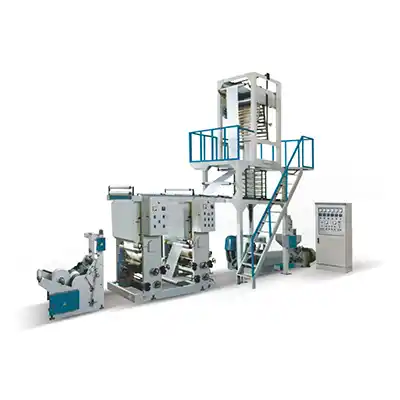
Root Causes of Frequent Bubble Breaks in Co-Extrusion
1. Insufficient Melt Strength
Melt strength is the most critical factor determining bubble stability. When the molten polymer lacks sufficient tensile strength to withstand the stretching forces during bubble expansion, rupture occurs.
Key factors affecting melt strength:
-
Resin selection: Different polymers have inherently different melt strengths. LDPE generally offers higher melt strength than LLDPE, which is why operators often blend 5–10% LDPE into LLDPE films to improve bubble stability
-
Molecular weight: Higher molecular weight resins typically provide better melt strength
-
Material degradation: Overheated or degraded polymer loses molecular weight and melt strength, making the bubble prone to breakage
-
Moisture contamination: Moisture in raw materials vaporizes at high temperatures, creating weak spots that reduce film strength locally
2. Improper Blow-Up Ratio (BUR)
The blow-up ratio is the ratio of the final bubble diameter to the die diameter. If the BUR exceeds what the melt strength can support, the bubble will rupture.
-
Excessive BUR overstretches the polymer beyond its limit
-
Insufficient BUR may cause the bubble to collapse or produce film with poor properties
For polyethylene films, the typical BUR range is 2.0–3.5, though this varies by material.
3. Cooling Air Issues
The air ring provides the primary cooling for the bubble, and its performance directly affects bubble stability.
Common cooling-related problems:
-
Uneven airflow: If air distribution around the air ring is not uniform, the bubble cools unevenly, leading to thickness variation and potential rupture
-
Excessive air velocity: High-velocity air can cause bubble flutter, which may escalate to rupture
-
Inadequate cooling: Insufficient cooling raises the frost line and reduces bubble stability
-
Air drafts: External air currents (from doors, HVAC systems, etc.) can destabilize the bubble
4. Melt Temperature Variations
Uneven melt temperature across the extrusion stream—or between layers in co-extrusion—can cause viscosity mismatches that destabilize the bubble.
-
Melt temperature variations as small as ±2°F are desirable; variations of 30°F or more can cause serious problems
-
In co-extrusion, viscosity mismatch between layers causes lower-viscosity polymers to migrate and encapsulate higher-viscosity ones, creating layer distribution non-uniformity
-
Temperature fluctuations may result from worn screws, failing heaters, or faulty thermocouples
5. Die and Hardware Issues
Problems with the die itself can cause bubble breaks:
-
Die blockage: Accumulation of degraded material in the die causes uneven flow
-
Non-concentric die: If the die pin is not centered, the bubble will be asymmetrical and prone to rupture
-
Die lip contamination: Carbon buildup or damage on die lips creates weak points in the film
Troubleshooting Checklist for Frequent Bubble Breaks
Use this systematic checklist to diagnose and resolve bubble break issues:
| Step | Check | Action |
|---|---|---|
| 1 | Resin quality | Check for moisture (dry if needed), verify MI and melt strength specs |
| 2 | Melt temperature | Verify temperatures across all zones; reduce if too high |
| 3 | Blow-up ratio | Calculate actual BUR; reduce if above material recommendation |
| 4 | Air ring | Check for uniform airflow; clean air ring; adjust air volume |
| 5 | Air drafts | Eliminate drafts from doors, AC, or nearby equipment |
| 6 | Die condition | Clean die lips; verify die pin is centered |
| 7 | Screw condition | Check for wear that may cause surging or poor melt quality |
| 8 | Screen pack | Replace if plugged; consider finer mesh for contaminated material |
| 9 | Extruder output | Check for surging or variable output; adjust feed or screw speed |
| 10 | Regrind usage | Reduce or eliminate regrind if it introduces degraded material |
Practical Solutions for Each Root Cause
Addressing Melt Strength Problems
Solution A — Adjust resin formulation
-
Add 5–10% LDPE to LLDPE or other linear polymers to increase melt strength
-
Select a resin with higher molecular weight for better melt strength
-
For biodegradable materials like PBAT, which inherently have low melt strength, consider a specialized screw design
Solution B — Optimize processing temperature
-
Lower extrusion temperature to improve melt viscosity and strength
-
For PLA, lower extrusion temperatures favor stable film formation
Solution C — Address material quality
-
Pre-dry raw materials to eliminate moisture
-
Filter contaminated material with finer screen mesh (120 mesh or higher recommended)
Optimizing Cooling Parameters
-
Reduce cooling air flow if flutter is present
-
Ensure air ring opening is uniform around the entire circumference
-
Check air ring alignment with the die center
-
Consider upgrading to a dual-lip air ring for better bubble stability
Adjusting Process Parameters
-
Reduce BUR to a level the melt strength can support
-
Lower melt temperature if the bubble is unstable
-
Increase haul-off speed gradually to avoid sudden stretching
-
Maintain stable extrusion output by checking screw and gearbox condition
Correcting Die and Hardware Issues
-
Clean die lips regularly to prevent carbon buildup
-
Verify die pin centering using a feeler gauge
-
Check die gap uniformity around the circumference
-
Replace worn screws that cause poor melt quality
Co-Extrusion vs. Single-Layer: Special Considerations
Co-extrusion introduces additional complexity to bubble stability because multiple polymers with different rheological properties must expand together.
Special considerations for co-extrusion:
| Issue | Why It Matters in Co-Extrusion |
|---|---|
| Layer viscosity mismatch | Lower-viscosity polymers migrate, causing non-uniform layer distribution |
| Interfacial instability | Viscoelastic behavior at layer boundaries can cause roughness, haze, or delamination |
| Temperature uniformity across layers | Each layer may require different optimal temperatures; balancing is critical |
| Material compatibility | Weak bonding between layers can lead to delamination or compromised barrier properties |
For co-extrusion lines, troubleshooting bubble breaks requires checking each extruder's melt temperature individually and verifying layer ratio consistency.
When to Seek Equipment Support
If you have systematically worked through the troubleshooting checklist and bubble breaks persist, the issue may lie with the equipment itself rather than process settings:
-
Worn extruder screws cannot deliver consistent melt quality
-
Outdated air ring design may not provide adequate or uniform cooling
-
Die design limitations may prevent achieving the desired BUR or layer distribution
-
Control system inaccuracies may cause temperature or output fluctuations
In these cases, reviewing equipment specifications or consulting with a machinery supplier can help identify whether an upgrade or replacement is needed. Review the available film blowing machine configurations to compare different system options.
FAQ
1. Why does my co-extrusion bubble keep breaking even with new resin?
New resin does not guarantee bubble stability if other parameters are off. Check your melt temperature (may be too high), blow-up ratio (may be excessive), and air ring settings (may be uneven). Also verify that the resin is properly dried—moisture is a common hidden cause.
2. What is the ideal blow-up ratio for stable bubble formation?
For polyethylene films, the typical BUR range is 2.0–3.5. The optimal BUR depends on the specific resin, film thickness, and application. If you are experiencing frequent breaks, try reducing your BUR incrementally until stability improves.
3. How does adding LDPE improve bubble stability?
LDPE has inherently higher melt strength than linear polymers like LLDPE. Adding 5–10% LDPE to a predominantly LLDPE formulation increases the overall melt strength of the blend, making the bubble more resistant to rupture during expansion.
4. Can ambient temperature affect bubble stability?
Yes. Higher ambient temperatures can make bubbles more unstable. External air drafts from doors, air conditioning, or nearby equipment can also destabilize the bubble. Maintaining a stable workshop environment with controlled temperature (±3°C) helps improve bubble stability.
5. What is the difference between bubble flutter and bubble rupture?
Bubble flutter is oscillation of the bubble below the frost line, caused by high air velocity from the air ring. It is a precursor to more serious problems. Bubble rupture is the complete structural failure of the film, where the bubble tears or bursts. Flutter should be addressed before it escalates to rupture.
6. How often should I clean the die and air ring?
Die lips should be checked and cleaned daily, especially when running materials prone to degradation or carbon buildup. The air ring should be cleaned weekly or whenever airflow appears uneven. Regular maintenance prevents the accumulation that causes uneven flow and bubble breaks.
Conclusion
Frequent bubble breaks in co-extrusion are rarely caused by a single factor. Most cases involve a combination of insufficient melt strength, improper BUR, cooling issues, and melt temperature variations. The key to solving the problem is systematic troubleshooting—checking each parameter one at a time rather than making multiple changes simultaneously.
Start with the fundamentals: verify your resin quality and drying, check melt temperatures across all zones, calculate your actual BUR, and inspect the air ring for uniform airflow. If the problem persists after working through the checklist, the equipment itself may need attention.
For production lines requiring more consistent bubble stability, exploring equipment with advanced cooling systems and precise process control can make a significant difference. Explore the film blowing machine options to see configurations designed for stable, high-output production.
Remember: bubble stability is the core of the blown film process. Getting it right means fewer interruptions, less waste, and more reliable output.
 Brochure Download
 FAQ
FAQ