EN
EN Español
In blown film extrusion, die gap and die pressure are two of the most critical parameters that directly determine film thickness, bubble stability, and overall product quality. The die gap—the annular opening through which molten polymer exits the die—typically ranges from 0.8 mm to 2.5 mm depending on the material and desired film specifications. Die pressure, on the other hand, is the resistance the melt encounters as it flows through the die, influenced by gap size, melt temperature, and polymer viscosity. Together, these parameters control the melt's velocity profile, swell ratio, and cooling behavior. This article explains what die gap and pressure are, how they interact, and what buyers and operators should know when selecting or operating a blown film line.
What Is Die Gap in Blown Film Extrusion?
The die gap is the distance between the inner and outer lips of the annular die through which the molten polymer exits to form the bubble. In most blown film dies, this gap is adjustable, allowing operators to fine-tune the extrusion process for different materials and film specifications.
The die gap directly influences:
-
Melt velocity at the die exit
-
Extrudate swell (the expansion of the melt as it leaves the die)
-
Film thickness and thickness uniformity
-
Bubble stability during the blowing process
A larger die gap reduces melt velocity and pressure, which can improve output but may compromise film clarity and mechanical properties. A smaller die gap increases shear rate and pressure, potentially enhancing melt homogeneity but also raising the risk of melt fracture and excessive die swell.
What Is Die Pressure and Why Does It Matter?
Die pressure is the back pressure generated as the molten polymer is forced through the narrow die gap. It is a direct indicator of the resistance the melt encounters in the die land and gap region.
Die pressure affects:
-
Melt homogeneity — higher pressure generally improves mixing and eliminates unmelted particles
-
Output stability — pressure fluctuations cause surging and gauge variation
-
Melt temperature — excessive pressure generates frictional heat, which can degrade sensitive polymers
-
Die swell — higher pressure increases the elastic recovery of the melt after exiting the die
For most polyethylene grades, typical die pressures range from 150 to 350 bar, depending on the screw design, melt temperature, and die geometry.
The Relationship Between Die Gap, Pressure, and Film Quality
The interplay between die gap and die pressure is governed by basic fluid dynamics. For a given polymer and output rate:
-
Wider die gap → lower pressure → lower melt velocity → less shear → lower swell ratio → potentially thicker film at same output
-
Narrower die gap → higher pressure → higher melt velocity → more shear → higher swell ratio → potentially thinner film at same output
However, the relationship is not linear. When the die gap is too narrow, the high shear rate can cause melt fracture—a surface defect that appears as roughness or "sharkskin" on the film surface. When the gap is too wide, the melt exits with insufficient velocity, leading to bubble instability and uneven thickness distribution.
Typical Die Gap Ranges by Material
| Material | Recommended Die Gap (mm) | Typical Die Pressure (bar) | Key Considerations |
|---|---|---|---|
| LDPE | 1.0 – 1.8 | 150 – 250 | Low shear sensitivity; wider gaps acceptable |
| HDPE | 0.8 – 1.2 | 200 – 350 | High melt strength; narrower gap for orientation |
| LLDPE | 1.2 – 2.0 | 180 – 280 | High viscosity; needs wider gap to reduce pressure |
| Biodegradable (PLA/PBAT) | 1.0 – 1.5 | 160 – 220 | Temperature-sensitive; avoid excessive shear |
Source: General industry ranges based on material properties. Actual values depend on specific screw design, melt temperature, and output rate. Buyers should confirm specifications with the equipment supplier.
How Die Gap Adjustment Affects Production
Adjusting the die gap is a routine but critical operation on a blown film line. Here are the practical effects of die gap changes:
1. Film Thickness
A smaller die gap produces a thinner melt layer at the die exit, which, combined with higher swell, can reduce final film thickness at a given blow-up ratio. Conversely, a larger gap produces a thicker melt layer, increasing final thickness.
2. Bubble Stability
The die gap affects the initial melt velocity. If the velocity is too low (wide gap), the bubble may flutter or become unstable. If too high (narrow gap), the melt may exhibit excessive draw resonance—a periodic variation in film thickness.
3. Output Rate
For a fixed screw speed, a narrower die gap increases back pressure, which can reduce output slightly. A wider gap reduces pressure and may allow higher output, but only if the cooling system can keep up.
4. Optical Properties
Higher shear from a narrow gap can improve melt homogeneity and reduce gels, but excessive shear can cause haze or loss of clarity—particularly critical for food packaging films.
Common Die Gap and Pressure Problems
| Problem | Possible Cause | Recommended Action |
|---|---|---|
| Gauge bands (thick/thin spots) | Uneven die gap around circumference | Check die lip concentricity; adjust gap uniformly |
| Melt fracture / sharkskin | Die gap too narrow for material | Increase gap or reduce output; raise melt temperature |
| Bubble instability / flutter | Die gap too wide; low melt velocity | Reduce gap incrementally; check air ring settings |
| Excessive die swell | Pressure too high | Increase gap or reduce screw speed |
| Surging output | Pressure fluctuations | Check screw design; verify melt temperature stability |
| Film haze | Excessive shear from narrow gap | Widen gap; lower melt temperature if possible |
Diagnosis should be verified through systematic testing. Actual performance depends on operating conditions.
What Buyers Should Know About Die Design
When evaluating a blown film machine, the die is one of the most important components to consider. Here is a practical checklist for buyers:
Die Gap Adjustability
-
Is the die gap manually adjustable or motorized?
-
Can adjustments be made while the line is running?
-
What is the adjustment range?
Die Material and Manufacturing
-
Is the die made from wear-resistant alloy steel?
-
What is the surface finish of the die lips? (Mirror finish is preferred)
-
Are the die components precision-machined? Yongbang uses 5-axis CNC technology with tolerance control of ±0.02mm for critical components.
Compatibility
-
Can the die handle the materials you plan to process?
-
Is the die compatible with your desired film width and thickness range?
Supplier Support
-
Does the supplier provide die gap setting guidelines for different materials?
-
Is training on die adjustment included?
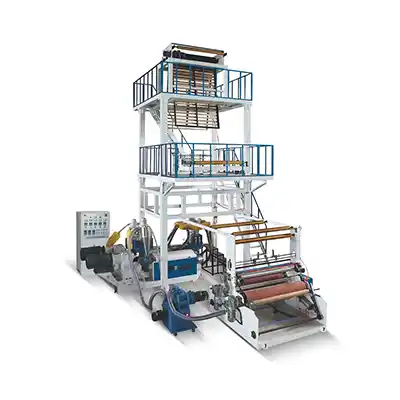
Review the available blown film machine configurations to see how different die designs and layer structures can match your production requirements.
FAQ
1. How often should the die gap be checked?
Die gap should be checked at every material change and at least once per shift during continuous production. Regular checks prevent gauge variation and ensure consistent film quality.
2. Can die gap be adjusted while the machine is running?
Some dies allow "on-the-fly" adjustments, but this depends on the die design. Manual adjustments typically require stopping the line. Motorized gap adjustment systems are available on some higher-end machines.
3. What is the difference between die gap and die land length?
Die gap is the opening width at the die exit. Die land length is the length of the parallel section before the exit. A longer land length increases residence time and pressure drop, improving melt homogenization but also raising pressure.
4. Why does die pressure fluctuate during production?
Pressure fluctuations can result from inconsistent feed rate, temperature variations in the barrel, screw wear, or contamination in the melt. Regular maintenance and proper screw design help minimize fluctuations.
5. How does die gap affect biodegradability of PLA films?
PLA and other biodegradable polymers are shear-sensitive. A die gap that is too narrow can cause excessive shear heating, leading to polymer degradation and loss of mechanical properties. A wider gap with lower shear is generally preferred for these materials.
6. Is a smaller die gap always better for film clarity?
Not necessarily. While higher shear from a smaller gap can improve melt homogeneity, excessive shear can cause melt fracture and haze. The optimal gap balances shear for homogenization while avoiding degradation.
Conclusion
Die gap and die pressure are not just numbers on a control panel—they are fundamental parameters that shape every aspect of the blown film process. A well-chosen die gap ensures stable bubble formation, consistent film thickness, and optimal mechanical and optical properties. Conversely, incorrect die gap settings can lead to gauge variation, melt defects, and production inefficiencies.
For buyers, understanding die gap and pressure is essential when comparing equipment options. Look for a supplier that offers precision-engineered dies, clear setup guidelines, and the flexibility to adjust for different materials. For operators, regular die gap checks and systematic adjustments are key to maintaining quality and maximizing output.
Review the available blown film machine configurations to see how different die designs and layer structures can match your production requirements.
 Brochure Download
 FAQ
FAQ