EN
EN Español
A thin, high-clarity LDPE film was running at full speed on a three-layer line when the operator noticed something familiar yet frustrating: the thickness profile on the oscillating gauge showed a consistent “hourglass” pattern, with gauge bands drifting up to 12% higher at two points around the bubble. The recipe hadn’t changed. The die gap was centered. So why did the profile refuse to flatten out?
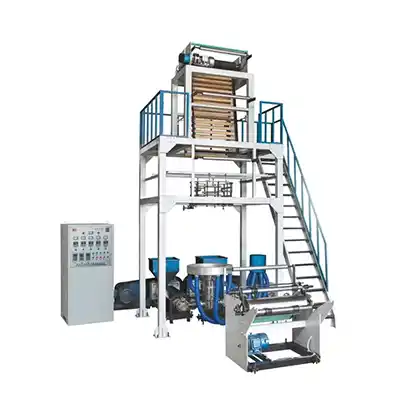
In many blown film troubleshooting sessions, all eyes go first to the die, the extruder output stability, or the IBC controls. But the silent, often overlooked variable is the air ring — the very first cooling interface the melt encounters after leaving the die lips. For anyone trying to tighten film thickness tolerances without just buying more control hardware, understanding air ring design is one of the highest-ROI levers available. If you’re looking for a deeper upgrade path, it’s also worth taking a closer look at how modern blown film lines integrate cooling technology from the air ring up to the haul-off — more on that later.
Why the Air Ring Becomes a Thickness-Deciding Factor
The moment the polymer melt exits the die, it starts to cool, crystallize, and solidify. The height and uniformity of the frost line — that visible boundary where the melt transitions from clear to hazy — are primarily governed by the air ring’s airflow distribution. When air velocity, volume, or temperature varies by even a few percent around the circumference, the frost line height becomes uneven. Because the melt is still stretching (being drawn upward) at that point, a locally higher frost line means more stretching and a thinner spot; a lower frost line means less stretching and a thicker band. Simply put: an asymmetric air ring produces an asymmetric frost line, which translates directly into gauge variation.
A 2022 process study from a German film institute (IKV, reported in Kunststoffe International) showed that for a standard 250-mm die running LLDPE, upgrading from a single-lip to a well-adjusted dual-lip air ring reduced 2-sigma thickness variation by roughly 40%, without any changes to the die or take-off settings. That’s a powerful testament to the cooling system’s role — and it explains why so many processors who struggle with film quality eventually turn their attention toward upgrading their line’s cooling and flow distribution capabilities.
The Physics Inside the Air Ring: What Design Differences Really Mean
Not all air rings are created equal, and the differences matter far more than a spec sheet suggests. Let’s break down the key design elements and how they shape film thickness.
1. Single-Lip vs. Dual-Lip Configuration
A single-lip air ring directs all cooling air through one annular slot, typically aimed at a fixed angle toward the bubble. It’s simple, but it offers no independent control of pre-cooling and main cooling. In contrast, a dual-lip design splits the airflow into a lower lip (which often acts as a stabilizing, pre-cooling stream) and an upper lip (the main cooling jet). This separation allows the lower stream to set the initial frost line location gently, while the upper stream does the heavy lifting. The result: greater stability of the bubble at high throughputs, and much better control of thickness variation in both MD (machine direction) and TD (transverse direction). Many modern lines designed for critical gauge applications, including those used in high-barrier flexible packaging, now use precisely machined dual-lip systems with adjustable lip gaps to handle a broad viscosity range.
2. Internal Flow Conditioning
Inside the air ring body, air doesn’t simply flow from the blower inlet to the lip — it must be distributed evenly around a 360° plenum. Poorly designed plenums create pressure gradients, vortices, and “hot spots” of high or low velocity. Leading designs use computational fluid dynamics (CFD)-optimized inlet geometries, perforated plates, or mesh screens to break up turbulence and deliver a uniform pressure profile to the lip exit. Some go further with multi-zone plenums, but even a well-designed single-plenum ring with proper baffling can outperform a poorly executed zoned design. The key is repeatable, predictable airflow at every radial point.
3. Manual vs. Motorized Adjustments
On many air rings, operators can adjust the lip gap or air distribution with manual screws. While cost-effective, this puts the burden on operator skill and makes consistent day-to-day performance harder to maintain. When the process changes — a different resin, a new layer ratio, a throughput increase — the air ring must be re-tuned. Lines with motorized upper lip adjustment and automatic profile control take manual variance out of the equation, but even then, the underlying mechanical design of the air ring remains the foundation. No control system can fully compensate for a fundamentally uneven flow field. This is why, in high-precision extrusion systems, the air ring and the overall cooling stack are considered inseparable engineering challenges, not afterthoughts.
Real-World Troubleshooting: When the Air Ring Is (and Isn’t) the Culprit
A flexible packaging converter in Southeast Asia ran a 5-layer barrier film for lamination. They were observing erratic TD gauge bands that shifted slowly over a production run. After verifying die bolt settings and confirming melt pump stability, the team mapped the bubble diameter just above the air ring using a non-contact laser gauge. The diameter was oscillating ±1.5 mm in sync with the gauge bands. Root cause? The air ring’s internal screens were partially clogged with fine dust from the plant environment, disrupting flow symmetry. A thorough cleaning of the plenum and screen brought thickness variation back within the targeted ±5%.
The lesson: even the best-designed air ring requires a maintenance discipline. Weekly checks of air filter elements, lip surfaces, and plenum cleanliness are as critical as screw and barrel maintenance. And if the air ring design itself makes cleaning difficult — requiring excessive disassembly, for instance — the maintenance gets deferred, and quality drifts.
This is the kind of real-world practicality that separates extruders that just “make film” from those that consistently hit spec. And it’s one of the reasons that, when production demands escalate, many processors look beyond standalone retrofits and start evaluating multi-layer co-extrusion systems engineered as a whole.
From Air Ring to Full-System Thinking: When an Upgrade Makes Sense
You can fine-tune the air ring on an older blown film line and see immediate, meaningful gains — especially if the core issue has been uneven cooling. But there comes a point where the surrounding infrastructure (die body uniformity, IBC cage design, collapsing frame geometry, and even the haul-off nip stability) becomes the limiting factor. At that threshold, chasing fractional improvements on the air ring alone can deliver diminishing returns.
Modern co-extrusion lines, particularly those built for ABA configurations where the skin layers and core layer serve very different rheological purposes, are designed with this system integration in mind. The air ring is no longer a generic component; it’s matched to the melt properties, the die diameter, and the expected output range. For example, processing a high-strength core with thin, low-melting skins in an ABA structure demands a cooling profile that simultaneously supports the softer skins while quenching the stiffer core layer quickly enough to avoid sag. That’s a cooling challenge a standard retrofitted air ring rarely handles well.
If your operation is moving toward higher outputs, thinner gauges, or demanding multi-layer structures, it may be time to explore how Yongbang’s ABA blown film solutions integrate air ring engineering from the earliest design stages. Yongbang’s approach embeds cooling performance into the entire line concept — from the die head through the air ring, IBC, and bubble stabilization — reducing the need for downstream compromise.
Practical Steps to Optimize Air Ring Performance Today
Not every improvement requires new capital. Here are five actionable steps you can implement on your current line to get better thickness control from your existing air ring:
-
Map the airflow: Use a simple anemometer or a smoke test (if safe for your environment) to check for obvious flow asymmetry around the circumference before your next maintenance window.
-
Standardize cleaning intervals: Establish a checklist and log for plenum and screen cleaning, not just lip surface cleaning. Document the effect on gauge variation to build a business case for more frequent service.
-
Verify alignment: Check that the air ring is concentric to the die and sits level. Even a 1–2 mm eccentricity can generate a slanted frost line.
-
Audit blower performance: Air ring pressure and volume are only as stable as the blower. Check drive belt tension and filter condition at the blower intake regularly.
-
Lock in operator training: Teach operators to recognize frost line asymmetry as a primary indicator of air flow problems, and empower them to flag it before bad rolls accumulate.
Making the Connection to Equipment Strategy
As you gain deeper control over your air ring and cooling process, you might start asking bigger questions: Could we run this structure faster if the air ring had a wider adjustment range? Would a line changeover from LDPE to HDPE benefit from a different lip geometry entirely? These are the kinds of questions that ultimately guide capital decisions.
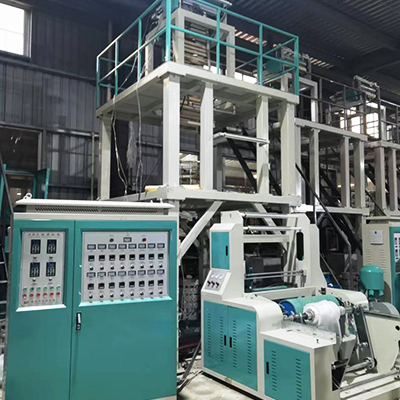
When the time comes to specify a new line, pay close attention to the air ring as a system, not just a component. Ask for CFD flow modeling data, field references processing resins similar to yours, and confirmation that the air ring’s cleaning and maintenance procedure is practical for a 24/7 production schedule. A well-engineered air ring inside a purpose-built blown film line won’t just improve your thickness profile — it will also reduce scrap, minimize start-up waste, and give your operators a far more stable process to manage.
If a future upgrade is on your radar, you may want to see how Yongbang configures its ABA blown film lines to address these exact challenges. The goal isn’t just to buy a machine — it’s to make thickness variation something you stop worrying about.
Disclaimer: The performance data and case examples in this article are based on general industry experience and publicly available research. Results may vary depending on resin type, machine configuration, and operating conditions. Always consult with your equipment supplier and conduct trials under your specific production conditions before making process or equipment changes.
 Brochure Download
 FAQ
FAQ