EN
EN Español
Last Tuesday, a packaging converter in Ohio watched his afternoon shift report come in: 15% below target, again. The line wasn’t down. Nothing was broken. It was just... slow. The operators were pushing the extruder as hard as they dared, but every time they tried to ramp up speed, bubble instability turned a clean layflat into a wrinkled reject. Sound familiar?
That quiet, creeping inefficiency is more expensive than a sudden breakdown. It hides in gauge variations, in micro-tears that appear only at the winder, in the two extra minutes it takes to thread the nip every shift change. Over a year, those small losses compound into something most costing models miss: lost capacity you already paid for.
The good news is that many of these bottlenecks can be eliminated without replacing your entire setup. Whether you’re running monolayer LDPE film for trash bags or complex coextruded barrier films, a handful of operational and technical adjustments can often unlock 10–20% more throughput. Let’s walk through them.
The Three Hidden Efficiency Killers on Your Line
Before we talk solutions, we have to name the real problems. In my years working with converters, three repeat offenders keep surfacing—and none of them show up clearly on a dashboard.
1. Bubble Instability as a Speed Ceiling
You can increase screw RPM all you want. If the bubble starts to sway, breathe, or oscillate, your operator will instinctively pull back speed. This is the most common output limiter we see, and it’s rarely a single-variable problem. Die gap, air ring design, melt temperature, and even the plant’s HVAC drafts all interact. One technician in Texas told me, “We thought the extruder was maxed out. Turned out, a chilled air duct was blowing directly onto the bubble from 12 feet away.” Fixing that airflow gave them an immediate 8% gain.
2. Gauge Variation Choking Downstream Productivity
Thicker film at the edges means the winder has to work harder, tensions become uneven, and roll quality suffers. To compensate, operators slow the whole line down. It’s a rational response to a system problem. Modern non-contacting gauge control can trim variation significantly, but even old lines benefit from a disciplined bubble tuning sequence: frost line height, blow-up ratio consistency, and air ring fine-adjustment. If you’re still relying solely on a manual micrometer every half hour, that’s where a lot of hidden speed is hiding.
3. Winding and Changeover Friction
The extruder might be capable of 200 kg/h, but if your surface winder struggles to build a straight roll above 120 kg/h, you’ve just capped yourself. Poor tension control, worn nip rolls, or a splicing system that requires three manual interventions per reel—all of this “friction” turns minutes into pounds of lost output. And because it happens at the end of the line, it rarely gets diagnosed as an efficiency problem. It gets labeled as “the way this material runs.”
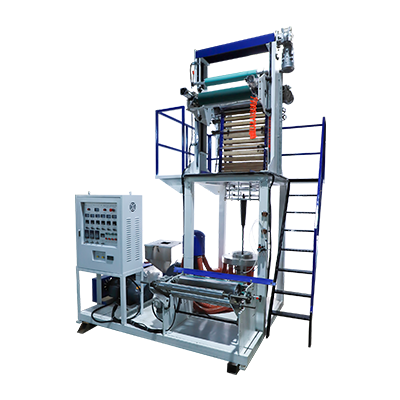
Tighten Up Without Tearing Down: Five Practical Steps
If you’re fighting one or all of the above, here’s a sequence that has worked for operations ranging from small job shops to multi-line plants. None of these steps requires a capital appropriation—though some may involve a modest investment in retrofits that pay back in weeks.
Step 1: Map the Actual Thermal Profile of Your Bubble
Don’t trust the setpoint. Use a handheld infrared thermometer or thermal camera to see what’s really happening from die exit to frost line. Cool spots on one side? You’ve got air ring asymmetry. Frost line too high? Your output rate is outpacing your cooling capacity. By correlating thermal data with bubble behavior, one plant found that a 3°C difference across the circumference was causing the gauge band they’d been fighting for six months. Correcting the air ring centering fixed it in a single shift.
Step 2: Reset Your Air Ring and IBC in Tandem
If you have internal bubble cooling, treat the IBC and external air ring as a single system, not two separate settings. A common pattern: operators increase IBC to lift throughput, then fight bubble instability with excessive air ring airflow, which disturbs the melt just above the die. Instead, start with external stabilization first. Get a stable neck, then introduce IBC gradually while monitoring bubble diameter at the frost line. This process alone has unlocked sustained output increases in the 12–15% range on several aging lines I’ve visited.
Step 3: Optimize Your Nip Section
Check nip roll alignment and pressure uniformity. Even a slight skew creates web wander that forces operators to slow down. Replace worn collapsing frame slats if they’re scoring the film. And if your threading process is manual and slow, consider adding a simple venturi threading system or even a well-placed rope guide. The math is compelling: if you save 90 seconds per changeover on a line doing eight changeovers a day, that’s over 70 hours of additional uptime per year.
Step 4: Separate Line Speed from Quality Anxiety
Give operators a runway to test limits without risk. For example, designate one hour per week as “speed window,” during which the shift lead is authorized to push the line 5% faster and observe. Record gauge, haze, dart drop, and visual defects. Often, the film stays in spec, and the crew learns that yesterday’s speed ceiling was really just a habit. This cultural shift, paired with data, is one of the cheapest efficiency levers you can pull.
Step 5: Address the Melt Early
If the extruder can’t deliver a homogeneous melt at the required rate, nothing downstream matters. Look at screw wear—even 2 mm of increased clearance in the metering section can reduce output and raise melt temperature. Barrier screws, properly sized for the specific resin blend, can make a notable difference. One Midwest processor swapped a 15-year-old general-purpose screw for a high-output barrier design and saw a sustained 18% rate increase on the same barrel, with better melt quality to boot.
When a Retrofit Makes More Sense Than a Fix
So far, we’ve focused on optimizing what you have. But there comes a point where incremental tweaks hit a wall—particularly if your product mix has shifted over the years and the original line design no longer matches. If you’re now running metallocene LLDPE on a line spec’d for fractional-melt LDPE, the cooling and die geometry were never right for the new resin. Or if your order mix demands frequent resin changes, a grooved-feed extruder with faster purging characteristics can slash changeover times from hours to minutes.
That’s when it’s worth exploring a purpose-built extrusion system designed for today’s materials and run rates. The market now offers modular, high-output film extrusion systems that can be precisely matched to your bag size, resin family, and throughput goals—reducing the compromises that eat away at efficiency. If you’d like to explore what a line matched to your actual production data could deliver, you can review specific configurations here. No gut-level guessing, just engineering.
Real Numbers from the Shop Floor
Let’s put some figures around this. A three-layer coextrusion line producing 80-micron heavy-duty shipping sacks was averaging 165 kg/h. The operators were reluctant to push further because of edge-curl issues at the winder. Root cause analysis revealed that the collapsing frame angle was too aggressive for the stiff outer layers. After adjusting the frame geometry and adding a secondary nip stabilizer, the line hit 192 kg/h—a 16% gain—without changing the extruder or die. Payback on the modification? Under four months, including a few shifts of tuning.
Another example: a plant running monolayer stretch film on an older line replaced a single-lip air ring with a dual-lip model and retrofitted non-contact IBC sensors. Output rose from 280 kg/h to 340 kg/h, and the gauge spread tightened from ±8% to ±4%. The improved roll quality allowed them to move one SKU from a premium complaint-prone contract to a new customer who valued consistency. This is the multiplier effect of efficiency: it’s not just more pounds. It’s more sellable pounds.
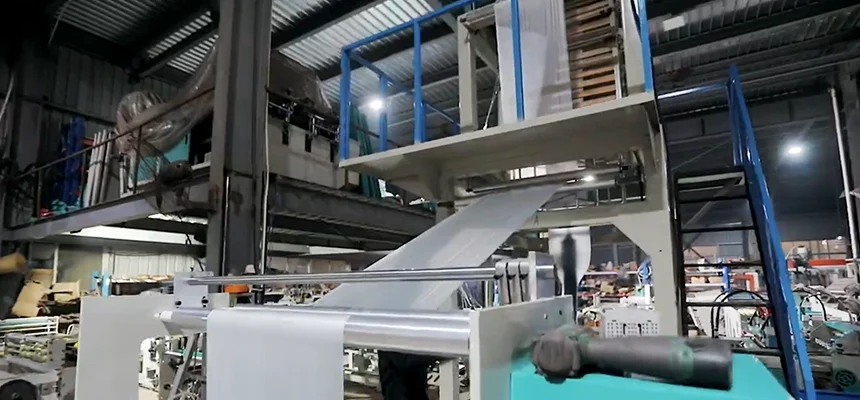
Building a Line-Side Efficiency Practice
If you take away only one idea, make it this: efficiency is not a project with an end date. It’s a practice. The plants that sustain high throughput are the ones where every shift supervisor can tell you what “normal” bubble shape looks like, where a weekly cross-functional huddle reviews speed-loss reasons, and where maintenance schedules are informed by actual melt-pressure data rather than a wall calendar.
That practice includes the hardware, obviously—the extruder, the die, the winder. But it also includes the unglamorous stuff: operator training on bubble tuning, a clear SOP for startup and shutdown, a logbook that captures air ring settings per resin grade. When these pieces are in place, even a mid-range line can outperform a flagship machine that’s been neglected.
For teams looking to make a larger jump—perhaps moving into multi-layer barrier films or scaling up for a big contract—the conversation naturally turns to equipment. Modern processing lines for flexible packaging films have evolved substantially, with features like automated gauge control, rapid-resin-change feed sections, and energy-optimized drives that directly address the three bottlenecks we outlined earlier. If your current setup is limiting growth, reviewing the latest specifications can help you build a clear business case before any capital request.
Don’t Let the “Invisible Downtime” Eat Your Margin
Slow output rarely declares itself. It’s not a seized gearbox or a blown heater band. It’s the line that runs at 85% of its real capability for three years, quietly turning potential profit into scrap and wasted energy. And because nobody is measuring what should have been produced, it never appears in the loss column.
The fixes we’ve discussed—thermal mapping, air ring tuning, nip optimization, melt-stream integrity—cost relatively little and can be initiated next shift. They don’t require a PhD in polymer science, just a disciplined methodology and a willingness to question long-held assumptions about what “full speed” really means.
If you’d like to benchmark your current output against what a well-matched modern system can achieve, Yongbang offers data-driven assessments based on your actual resin, product dimensions, and plant conditions. Click here to explore the capabilities of our high-output processing systems and connect with an engineer who can walk through the numbers with you. No high-pressure pitch—just a practical conversation about what’s possible when the machine and the material are finally in sync.
References & Further Reading
-
ISO 4593: Plastics – Film and sheeting – Determination of thickness by mechanical scanning
-
ASTM D1709: Standard Test Methods for Impact Resistance of Plastic Film by the Free-Falling Dart Method
-
Butler, T. I. (Ed.). Film Extrusion Manual. TAPPI Press.
-
Industry case studies and optimization data from Yongbang application engineering files (anonymized).
 Brochure Download
 FAQ
FAQ