EN
EN Español
Why does one brand of shredded cheese stay fresh for weeks while another clumps and dries out shortly after opening? The secret often lies not in the food itself, but in the invisible architecture of its packaging film. For converters, building that architecture means making a critical decision early on: selecting the right multi-layer extrusion configuration. The choice between a basic 3-layer ABA structure and a sophisticated 7- or 9-layer system impacts barrier properties, material costs, line efficiency, and ultimately, the product’s shelf life. But with so many options, how do you determine which configuration suits your specific food packaging applications best? This article breaks down the key configurations, compares their real-world performance, and provides a decision-making framework to help you avoid costly missteps.
The push for higher barrier performance, downgauging, and the use of recycled content has made co-extrusion the dominant technology in flexible food packaging. Achieving these goals reliably requires more than just mixing materials; it demands precision-engineered systems. Many converters find that upgrading to purpose-built advanced multi-layer blown film systems allows them to switch between recipes with minimal downtime, directly addressing the market’s demand for shorter runs and greater flexibility.
Layer Count and Structure: The Heart of the Decision
Before evaluating materials, you need to define the structural skeleton of the film. The three most common categories are 3-layer, 5-layer, and 7/9-layer configurations.
A standard 3-layer film blowing machine often runs an ABA configuration, where the middle layer (B) can contain cost-saving fillers, regrind, or a pigment masterbatch, sandwiched between identical skin layers (A) of virgin polyethylene. This setup is ideal for bread bags, light-duty produce bags, or general-purpose overwrap where moderate oxygen and moisture barriers suffice. It’s cost-effective and mechanically simple, but its ability to incorporate high-cost, high-barrier resins like EVOH is limited by layer symmetry.
When demanding gas barriers come into play—think modified atmosphere packaging (MAP) for fresh meat, or coffee aroma protection—the jump to 5-layer is unavoidable. The classic structure is A/B/C/B/A, where C represents a barrier core (EVOH, PA) and B stands for tie layers bonding the core to the polyolefin skins. This keeps the expensive barrier resin buried safely in the center, away from moisture that could degrade its performance. A 5-layer line provides the versatility to create asymmetrical films (A/B/C/D/E) for heavy-duty liquid packaging or retort pouches. For converters looking to future-proof their operations, the step from 3 to 5 layers opens the door to higher-margin, value-added products.
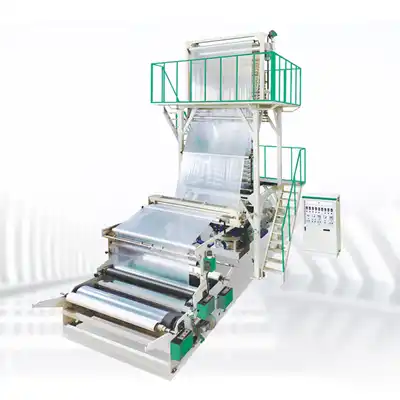
For ultra-high barrier requirements or when incorporating multiple functional layers—such as a combination of PA for toughness, EVOH for oxygen barrier, and tie resins—7 and 9-layer configurations provide unmatched flexibility. A typical 7-layer film for retortable food might run PP/tie/EVOH/tie/PP/tie/PP, allowing for thin engineering layers that maximize performance while minimizing cost. The ability to place a thin foil-like barrier between robust structural layers enables incredible downgauging without compromising strength.
Die Design and Layer Uniformity: Precision Matters
Configuration doesn’t end with layer count. The die technology distributing those layers determines whether your EVOH core is a flawless 3-micron shield or a wavy, inconsistent layer with gaping weak spots. Spiral mandrel and pancake dies for multi-layer systems must maintain exact concentricity and uniform polymer flow at varying throughputs. A deviation as small as 0.01 mm in layer distribution can cause seal failures or localized pinholes—disastrous for a vacuum-packed product.
A well-engineered film blowing machine integrates not just a precision die, but an optimized internal bubble cooling (IBC) system and auto-gauge control. According to a Smithers report on the future of high-barrier packaging, the global demand for transparent barrier films is growing at over 5% annually, driven by consumer preference for product visibility. Such clarity is only achievable if the die eliminates melt fracture and if cooling rates are uniform across the bubble circumference. When these mechanical factors align with a carefully chosen layer configuration, the improvement in water vapor transmission rate (WVTR) and oxygen transmission rate (OTR) can be dramatic.
For operations needing to pivot between a 3-layer bread bag and a 5-layer cheese shrink film on the same line, investing in a versatile co-extrusion blown film line with modular components is a prudent strategy. Quick-change die cartridges and adaptable extruder carriages shorten changeover times and expand your business's product range without requiring an entirely new system.
Material Synergies: Safety and Performance
Food contact regulations strictly govern material selection. In an A/B/A or A/B/C/B/A structure, the skin layers must be FDA-compliant for direct food contact, while buried barrier layers can utilize non-food-grade resins if migration is adequately blocked. Polyethylene (LLDPE, MLLDPE) remains the workhorse for sealability and moisture barrier. For oxygen-sensitive products like processed nuts or red meat, EVOH offers one of the lowest OTR values available, though it needs polyolefin protection from moisture. Polyamide (PA) contributes puncture resistance and a controlled shrink force, ideal for packaging bones-in cuts or sharp-edged dry goods.
A common mistake is over-engineering the barrier layer. A 12 µm EVOH core might provide a 100-year shelf life, but if the product’s target is 12 months, you are simply throwing money away. Industry guidelines such as ASTM F1249 and F2622 help model the required transmission rates. Matching the numerical barrier target to the layer configuration is an exercise in value engineering that pays for itself repeatedly over the life of the film.
Decision Guide: Which Configuration Delivers the Best ROI?
The “best” configuration isn’t the one with the most layers; it’s the one that consistently meets your product’s protection requirements at the lowest total system cost.
-
If your portfolio centers on fresh produce, toilet paper overwrap, or linear low-density stretch films, a 3-layer ABA line is your workhorse. The ability to load the middle layer with up to 40% recycled material offers immediate sustainability and cost advantages.
-
If your growth path includes cheese, processed meat, or modified atmosphere packaging, move directly to a 5-layer system. The cost uplift from 3 to 5 layers is justified by the immediate ability to process EVOH and PA, opening doors to clients in the high-value protein and dairy sector.
-
If your endgame is retort packaging, thermoformed lidding films, or ultra-thin high-barrier solutions for confectionery, a 7- or 9-layer configuration is necessary. These lines are a significant capital investment, but they carve out a competitive position that is difficult for commodity players to challenge.
Once you’ve made the strategic decision, the implementation matters. Look for partners who offer not just hardware, but process integration support. Specifically, we’ve seen processors successfully navigate the transition from mono-layer to 5-layer production by partnering with engineering teams that provide hands-on startup training, a factor that significantly reduces the learning curve and film waste. If you’re evaluating specific machine configurations for a new project, don’t hesitate to request a customized coextrusion proposal tailored to your target film widths and output targets.
Common Pitfalls and Calibration Realities
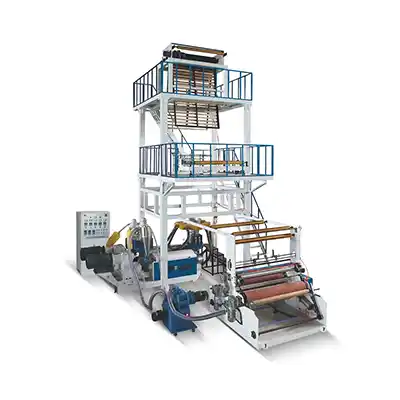
Even with the perfect configuration on paper, execution can stumble. A frequent oversight is focusing all engineering attention on the die and extruder, while neglecting downstream calibration. Inconsistent web tension at the primary nip or a misaligned collapsing frame can introduce wrinkles and gauge banding in a multi-layer tube, effectively destroying the barrier uniformity you worked to achieve. It is a system: the film blowing machine’s die, air ring, IBC, calibration basket, and winder must speak the same language.
Another pitfall is resin incompatibility. Pairing a highly fluid nylon with a low-melt-strength PE can cause flow instabilities. A robust screw design tailored to each extruder’s dedicated resin is not a luxury; it is a prerequisite for a stable bubble.
The Path to Better Packaging
Choosing a multi-layer extrusion configuration for food packaging is a balancing act of polymer science, mechanical precision, and market economics. The data clearly points to 5-layer structures as the sweet spot for a growing number of applications, offering a versatile canvas for barrier solutions while keeping cap-ex reasonable. Yet, the final decision must be grounded in your specific product’s shelf-life requirements and your plant’s operational skill set.
If you seek a partner that translates these technical nuances into reliable, day-to-day production capability, you might want to explore Yongbang’s co-extrusion solutions. The right configuration, supported by the right equipment and process knowledge, transforms packaging from a cost center into a strategic driver of brand trust and product freshness.
 Brochure Download
 FAQ
FAQ