EN
EN Español
Every flexible packaging converter has faced the same dilemma: a customer demands film that is simultaneously tough enough to resist punctures, transparent enough to showcase the product, and cheap enough to keep margins alive. Push gauge down and you lose strength. Add more resin and the cost inflates. For years, monolayer lines forced producers to choose between competing priorities. A three‑layer approach that sandwiches a functional core between two identical outer layers has changed the arithmetic — and it starts with understanding the architecture itself.
How the Three‑Layer Architecture Works
ABA blown film is a co‑extrusion structure where two identical “A” skins encapsulate a different “B” core. The skins are typically polyolefins like LDPE, LLDPE, or metallocene‑catalyzed grades that deliver heat‑sealability, gloss, and printability. The core is where the strategic gain lives. Processors might load it with HDPE for stiffness, polypropylene for heat resistance, a barrier resin like EVOH, or — increasingly — a calcium‑carbonate compound or carefully screened post‑industrial reclaim.
The mechanical logic is straightforward: critical surface properties are delivered by the outer layers, while the core contributes bulk, rigidity, or barrier at a fraction of the cost of an all‑virgin monolayer. Because the skin layers are identical, only two extruders are needed, which keeps the machine footprint and control system simpler than a full ABC three‑layer setup. Real‑world data from Plastics Technology’s processor surveys indicates that ABA structures routinely allow 20–30% core‑layer filler without sacrificing dart impact or haze — provided the layer ratios are maintained within tight tolerances.
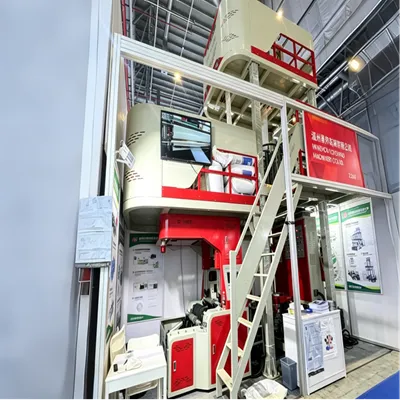
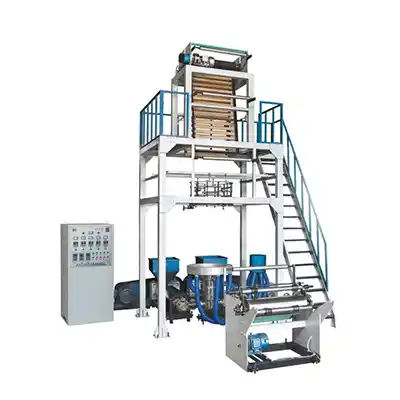
The challenge, however, lies in precision. Implementing this structure requires exact layer distribution control, which is a key capability of a modern ABA blown film machine. Even a 2% drift in core‑layer thickness can push haze beyond specification or create delamination during slitting. That’s why die design, extruder temperature profiling, and air‑ring dynamics are now treated as a single integrated discipline rather than isolated components.
Where ABA Outperforms Standard Structures
The benefits move well beyond cost substitution. From a material‑science perspective, the symmetrical A‑B‑A build brings several measurable advantages:
-
Bending stiffness without brittleness: Placing a stiffer polymer in the core raises flexural modulus while keeping the outer layers ductile. Tests following ASTM D882 have shown that an ABA film with HDPE core and LLDPE skins can exhibit a 30–40% higher modulus than a monolayer LLDPE film of the same total gauge.
-
Optical clarity retention: Because filler or recycled content is completely encapsulated, the film surface remains free of the gel-like defects that typically fog monolayer films loaded with post‑consumer resin.
-
Downgauging potential: The strength‑to‑weight profile often allows processors to reduce total thickness by 5–10% without sacrificing puncture resistance, a benefit that directly improves yield per kilogram.
-
Simplified resin logistics: Compared to ABC co‑extrusion, which requires three distinct resin types, ABA frequently runs on two, cutting inventory complexity and purging time between jobs.
An under‑recognized advantage is sustainability reporting. Major brand owners increasingly demand that packaging contain recycled content, yet they refuse to compromise on clarity or seal integrity. ABA technology provides an auditable way to embed recycled resin in a hidden core layer, turning what used to be a marketing headache into a quantifiable environmental claim. The American Chemistry Council’s 2025 Flexible Film Recycling report noted that such encapsulated‑recyclate designs are one of the fastest‑growing segments in blown film innovation.
Comparative Look: Monolayer vs. ABA vs. ABC
| Characteristic | Monolayer | ABA Co‑extrusion | ABC Co‑extrusion |
|---|---|---|---|
| Number of extruders | 1 | 2 | 3 |
| Core‑layer recyclate capability | No | Yes | Yes |
| Relative capital cost | Low | Medium | High |
| Operational complexity | Minimal | Moderate | High |
| Clarity with recycled content | Poor | Excellent | Very good |
| Gauge control precision | Standard | Demanding | Very demanding |
For the majority of converters who serve the consumer‑goods, agricultural, or heavy‑duty shipping sack markets, ABA occupies the optimum point on the cost‑versus‑performance curve. It delivers most of the downgauging and recycled‑content benefits of a full ABC line while avoiding the third extruder’s capital burden and ongoing energy consumption. Processors who have made the transition often comment that the learning curve is manageable, with break‑even periods on the incremental investment falling within 12–18 months.
Those numbers make a persuasive case, but only if the underlying hardware can maintain discipline at high throughput. Selecting a system that actively monitors melt pressure and automatically adjusts screw speed to hold layer ratios within ±1% is what separates consistent film from sporadic claims. For operations that are ready to move beyond the limitations of monolayer extrusion, tailored co‑extrusion configurations designed for high recycled‑content films can unlock precisely that repeatability.
Translating Structure into Machine Requirements
Understanding the structure is half the equation; the other half is specifying a production line that turns the theory into roll‑stock. An ABA blown film machine should be evaluated across four interrelated dimensions:
-
Die‑head engineering: Spiral mandrel or stacked plate designs? Spiral mandrels typically offer better mixing and faster purging for frequent resin changes, while stacked plates permit more complex layer‑thickness profiles. The critical specification is residence‑time distribution — anything over 45 seconds at temperature risks gel formation in the B layer.
-
Extruder geometry: Barrier‑flight screws are table stakes for the core extruder if you plan to run recycled or filled materials; they reduce melt‑temperature fluctuation by up to 8°C compared to conventional three‑zone screws. Independent barrel‑cooling zones per extruder are now considered essential rather than optional.
-
Air ring and IBC: Internal bubble cooling paired with a dual‑lip air ring can boost output by 15–20% on ABA lines, according to data from the Society of Plastics Engineers’ ANTEC conference proceedings. The key is ensuring the control algorithm does not oscillate when layer ratios shift — a fault that still plagues some entry‑level controllers.
-
Winding tension architecture: Because the two skin layers can have slightly different shrink rates, a center‑surface winder with closed‑loop tension trim prevents telescoping rolls, especially at diameters above 800 mm.
A useful sanity check before commissioning is to run a “core‑excursion test” — deliberately varying the B‑layer ratio from 20% to 50% while recording gauge deviation every 50 ms. If the system holds deviation below 3%, the control loops are well‑tuned. If not, investigate the melt‑pressure sensor refresh rate and the back‑pressure valve response.
From Blueprint to Roll‑Stock: A Real‑World Progression
A mid‑sized agricultural film producer in the Midwest recently shared their journey from monolayer to ABA (details anonymized). Their core business was silage wrap — a product that demands UV resistance, puncture toughness, and aggressive cost targets. By switching to an ABA structure with a calcium‑carbonate‑filled core and UV‑stabilized LLDPE skins, they achieved a 22% reduction in virgin resin consumption per ton of film while passing the same tear‑propagation tests they had used for a decade. More importantly, they were able to print a “Contains 30% Recycled Material” label on the core layer, a claim their dairy‑farm customers increasingly requested.
Such stories are becoming common, but they rely on equipment that can consistently deliver the designed layer architecture at commercial speeds. Yongbang has developed a range of co‑extrusion blown film systems specifically calibrated for this class of application — from compact 800 mm die‑diameter lines for specialty films to 2.5‑meter wide‑web configurations for high‑output commodity production. Their dual‑extruder platform incorporates barrier‑flight screws as standard, a selection of spiral‑mandrel dies optimized for rapid purging, and a control interface that visualizes layer‑ratio trends in real time. Interested readers can view the detailed technical specifications and configuration options to see whether the line aligns with their product mix.
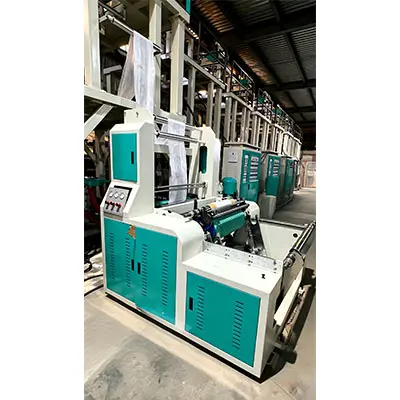
Ensuring Long‑Term Film Consistency
Even the best‑designed line will drift if preventive maintenance is not baked into the weekly rhythm. Focus on three areas:
-
Die‑lip cleaning frequency: ABA dies processing filled cores need a full lip‑clean cycle every 50–60 running hours. A 0.02 mm deposit on the lip face is enough to create visible die lines on the film.
-
Filter‑screen monitoring: Install a pressure transducer directly before and after the screen changer. A differential of more than 80 bar on the core extruder signals that gels are accumulating and that the screen‑life assumption needs revision.
-
Temperature profiling audits: Use an insertion probe to verify that barrel‑zone thermocouples have not drifted. A 5°C offset in the core extruder’s metering zone can shift the melt‑flow index enough to alter layer distribution.
Processors who maintain a simple “layer‑ratio log” — recording the core percentage, output rate, and haze value at the start of every shift — often spot trends weeks before a specification breach occurs. It’s a low‑tech discipline that pays disproportionate rewards.
Looking Ahead
ABA blown film is not a static technology. Trends like bio‑based polyethylene skins, water‑soluble core layers for detergent pouches, and fully recyclable all‑PE ABA laminates for mono‑material packaging are accelerating. The producers who will thrive are those who treat their production line not as a fixed asset but as a flexible platform for structure innovation. An investment in robust, well‑instrumented hardware today creates the headroom to take on those next‑generation films without a full rebuild.
Frequently Asked Questions
1. Can ABA blown film be used for direct food contact?
Yes, provided the skin layers are formulated with FDA‑ or EFSA‑compliant resins. The core layer is fully encapsulated, so non‑compliant recycled content can be used in the B layer without breaching food‑safety regulations, as long as the skin remains intact.
2. What is the typical gauge range of ABA blown film?
Most ABA lines produce film from 20 µm to 200 µm. Thinner gauges (below 15 µm) are possible but require exceptionally tight melt‑temperature control to avoid pinholing at the core‑to‑skin interface.
3. Is it possible to retrofit an existing monolayer line into an ABA configuration?
Generally no. ABA requires a multi‑layer die, at least two extruders, and a different control architecture. A purpose‑built ABA blown film machine is recommended. Retrofitting is rarely cost‑effective and often results in inferior layer distribution.
4. How does ABA co‑extrusion compare to adhesive lamination?
ABA produces a monolithic, non‑delaminating film in a single step, while lamination requires an adhesive and a secondary process. For many applications such as heavy‑duty sacks or carrier films, ABA is cheaper and generates less waste. Lamination remains preferable when combining materials with extreme melt‑flow incompatibility.
5. What are the common failure modes in ABA film production?
Interlayer delamination caused by inadequate melt strength in the core, visible flow lines from die‑lip buildup, and haze spikes due to core‑layer breakthrough are the top three. All can be mitigated by die‑temperature uniformity and frequent lip inspections.
6. How much recycled content can realistically be incorporated in the B layer?
Many processors run 30–50% post‑industrial reclaim without measurable performance loss. With careful filtration and melt‑flow matching, post‑consumer content levels up to 25% are commercially viable, though they demand more frequent screen changes.
Disclaimer: This article provides general guidance based on publicly available industry data (including ASTM D882, Plastics Technology surveys, and ANTEC proceedings). Equipment specifications and performance figures should be verified with the manufacturer for individual production scenarios.
 Brochure Download
 FAQ
FAQ