EN
EN Español
If you are evaluating blown film equipment, the question is not whether multi-layer co-extrusion is "better" than mono-layer—it is whether the additional layers solve a problem you actually have. Mono-layer lines produce reliable single-polymer films at lower capital cost and with simpler operation. Multi-layer co-extrusion adds capability but also adds complexity. The right choice depends entirely on your film specifications, production volume, material strategy, and customer requirements.
This article compares mono-layer and multi-layer blown film configurations across the factors that matter most to production decision-makers: cost, quality, flexibility, and operational demands.
What Is a Mono-Layer Blown Film Line?
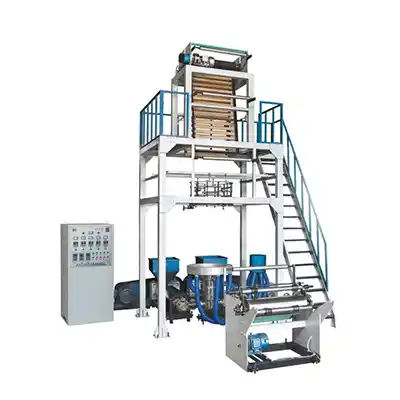
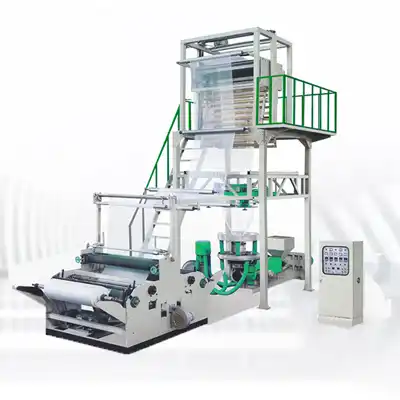
A mono-layer blown film line uses a single extruder to melt and push one polymer through a die, forming a bubble that collapses into a film of uniform composition. The entire film is made from the same material—whether LDPE, HDPE, LLDPE, or a blended compound.
Typical applications for mono-layer film:
-
T-shirt bags and grocery sacks
-
Protective films and dust covers
-
Light-duty packaging and liners
-
Agricultural films (basic grades)
-
Shopping bags and garbage bags
Key characteristics:
-
One extruder, one die, one material stream
-
Simpler temperature control and process management
-
Lower equipment investment
-
Easier maintenance and operator training
-
Output typically ranges from 60–100 kg/hr depending on screw diameter
What Is a Multi-Layer Co-Extrusion Line?
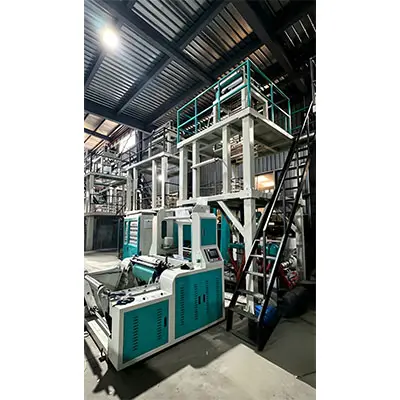
A multi-layer co-extrusion line combines two or more extruders feeding into a single die, where multiple polymer streams are layered together before exiting as a composite bubble. Each layer can serve a distinct function: barrier, stiffness, sealability, appearance, or cost reduction.
Yongbang's multi-layer offering includes ABA three-layer co-extrusion configurations, which use two extruders to produce a symmetrical A/B/A structure. The outer "A" layers deliver surface properties like gloss and printability, while the inner "B" layer can contain recycled material, fillers, or functional resins.
Typical applications for multi-layer film:
-
Food packaging requiring barrier properties
-
Shrink films and heavy-duty sacks
-
Industrial packaging with strength requirements
-
Films incorporating recycled content
-
High-clarity laminates and specialty structures
Key characteristics:
-
Two or more extruders; more complex control systems
-
Ability to combine different materials in one film
-
Higher capital investment
-
Greater operational expertise required
-
Can achieve properties unattainable with single-layer films
Explore high-performance co-extrusion lines for multi-layer options.
Mono-Layer vs Multi-Layer: A Direct Comparison
The table below summarizes the key differences between mono-layer and multi-layer blown film configurations across decision-relevant criteria:
| Factor | Mono-Layer Line | Multi-Layer Co-Extrusion Line |
| Number of extruders | One | Two or more (ABA uses two) |
| Capital investment | Lower | Higher |
| Operational complexity | Simple; easy to train operators | More complex; requires skilled technicians |
| Material flexibility | One polymer or blend per run | Different materials in different layers |
| Film property range | Limited to single-material capabilities | Broad; can combine barrier, strength, sealability |
| Recycled content use | Limited; may affect appearance and properties | Can be encapsulated in core layer |
| Downgauging potential | Limited | 5–10% thickness reduction possible |
| Changeover time | Faster | Slower; more purging required |
| Maintenance | Simpler; fewer components | More components; more potential failure points |
| Output per line | 60–100 kg/hr typical | Varies by configuration; ABA lines often higher |
When Does Mono-Layer Make Sense?
A mono-layer blown film machine is often the right choice when:
1. Your film does not require multi-material properties
If you are producing standard packaging films—T-shirt bags, protective covers, basic shopping bags—a single polymer is sufficient. Adding layers would increase cost without improving the product.
2. You are starting production or expanding capacity on a budget
Mono-layer lines require lower capital investment and simpler infrastructure. They are easier to finance and faster to commission.
3. Your operation has limited technical resources
Mono-layer lines are easier to operate and maintain. Operators can be trained quickly, and troubleshooting is more straightforward.
4. Your production runs are long and material changes are infrequent
Mono-layer lines excel at running the same material for extended periods. If your product mix is stable, the simplicity of a mono-layer line is an advantage.
5. You are producing films where appearance requirements are moderate
For applications where optical quality is not critical, mono-layer film performs adequately without the cost of additional layers.
When Does Multi-Layer Make Sense?
A multi-layer co-extrusion line becomes valuable when:
1. Your film requires properties that no single polymer can provide
If you need a film that is simultaneously sealable, printable, stiff, and resistant to moisture or oxygen, multi-layer construction allows each layer to contribute a distinct function.
2. You want to incorporate recycled content without compromising appearance
Multi-layer structures can hide recycled or lower-grade material in the core layer, keeping the surface layers virgin and visually clean. This is increasingly important for sustainability reporting and brand requirements.
3. You need to reduce gauge while maintaining performance
Multi-layer films can achieve the same mechanical properties at thinner gauges than mono-layer films. This translates to more yield per kilogram of resin.
4. Your customers demand consistent, high-quality optics
The ability to keep functional or recycled materials away from the surface preserves clarity and gloss.
5. You are targeting higher-margin, value-added markets
Food packaging, medical films, shrink films, and industrial barrier films typically require multi-layer structures and command premium pricing.
The ABA Configuration: A Practical Middle Ground
For many converters considering their first multi-layer line, the ABA three-layer configuration offers a practical entry point.
ABA uses two extruders to create a three-layer film with identical outer layers and a functional core. The core can contain:
-
Recycled or regrind material
-
Calcium carbonate fillers for cost reduction
-
HDPE for stiffness
-
Pigment masterbatch
Because the outer layers are identical, the control system is simpler than a full ABC three-layer setup. This makes ABA a more accessible step up from mono-layer production.
What ABA solves:
-
Cost pressure: fillers and recycled content in the core reduce material cost
-
Sustainability: recycled material can be used without affecting surface quality
-
Stiffness: HDPE or PP in the core improves rigidity
-
Appearance: surface remains clean and printable
What ABA does not solve:
-
Asymmetric structures (different materials on each side)
-
Extreme barrier requirements (EVOH requires protection from moisture)
-
Films requiring more than three distinct functional layers
Decision Checklist: Mono or Multi-Layer?
Use this checklist to evaluate which configuration fits your production requirements:
| Question | Mono-Layer | Multi-Layer |
| Do you produce basic packaging films (bags, liners, covers)? | ✓ | |
| Do you produce food packaging with barrier requirements? | ✓ | |
| Is recycled content a customer requirement? | ✓ | |
| Do you have in-house technical expertise for complex processes? | ✓ | |
| Are you targeting premium, high-margin film markets? | ✓ | |
| Is capital cost your primary constraint? | ✓ | |
| Do you need to reduce material consumption through downgauging? | ✓ | |
| Is your product mix stable with few material changes? | ✓ | |
| Do you run frequent short batches of different formulations? | ✓ |
Common Misconceptions About Multi-Layer Lines
Misconception 1: "More layers always mean better film."
Not necessarily. Each additional layer adds equipment cost, operational complexity, and purging time. If your application does not require the properties that additional layers provide, the added cost does not translate to added value.
Misconception 2: "Multi-layer lines are too complex for our operation."
ABA three-layer configurations are less complex than full ABC systems. Many converters find the transition manageable with proper training and support. That said, the jump from mono-layer to any multi-layer configuration requires a genuine operational commitment.
Misconception 3: "Mono-layer lines are obsolete."
Mono-layer lines remain the workhorse for a vast range of packaging applications. They are not obsolete—they are purpose-built for applications where single-polymer films meet the requirement.
Misconception 4: "Multi-layer always costs more to operate."
While multi-layer lines have higher capital costs and more components, they can reduce material costs through the use of fillers, recycled content, and downgauging. The total cost of ownership depends on your specific material strategy and production volume.
Frequently Asked Questions
Q: Can a mono-layer line produce the same film quality as a multi-layer line?
No. Mono-layer lines produce films of uniform composition. Multi-layer lines can combine different materials in one film, achieving properties—such as barrier protection combined with sealability—that are impossible with a single polymer. However, for applications where single-polymer film is sufficient, mono-layer quality is entirely adequate.
Q: How much more does a multi-layer line cost than a mono-layer line?
Equipment cost varies significantly by configuration, extruder count, die design, and control system sophistication. Buyers should confirm specific pricing with suppliers based on their required specifications and production targets. Generally, multi-layer lines represent a higher capital investment but may offer material cost savings over time.
Q: Can I upgrade a mono-layer line to multi-layer later?
Typically no. The fundamental architecture—number of extruders, die design, control system—differs between mono-layer and multi-layer lines. Upgrading generally requires replacing major components or the entire line. It is more practical to plan for multi-layer from the outset if you anticipate needing those capabilities.
Q: What materials can be used in ABA multi-layer blown film?
ABA configurations commonly use LDPE, LLDPE, or HDPE for the outer "A" layers. The core "B" layer can contain recycled material, calcium carbonate fillers, HDPE for stiffness, or other functional resins. Material selection depends on the required film properties and cost targets.
Q: How does layer count affect film performance?
Generally, more layers allow more functional separation—each layer can be optimized for a specific property (barrier, seal, structure, appearance). However, each additional layer adds equipment and operational complexity. The optimal layer count depends on your specific application requirements.
Q: Is ABA considered true multi-layer co-extrusion?
Yes. ABA is a three-layer co-extrusion configuration that uses two extruders to produce a symmetrical A/B/A structure. It is a practical and widely used multi-layer solution, particularly for converters looking to incorporate recycled content or reduce material costs.
Explore ABA blown film solutions for more details.
Conclusion
The choice between mono-layer and multi-layer blown film is not about which technology is "better"—it is about which configuration fits your production requirements, material strategy, and business objectives.
Choose mono-layer if:
-
Your film applications are satisfied by single-polymer films
-
Capital cost and operational simplicity are primary concerns
-
You do not need barrier properties, recycled content encapsulation, or downgauging
Choose multi-layer if:
-
Your film requires properties no single polymer can provide
-
You need to incorporate recycled content while maintaining surface quality
-
You are targeting higher-margin, value-added markets
-
You have the technical resources to manage more complex operations
For many converters, the ABA three-layer configuration offers a practical bridge—adding capability without the full complexity of ABC or five-layer systems.
If you are still evaluating which configuration fits your production needs, reviewing the available mono-layer configurations can help clarify your options. Discuss your specific film specifications, material requirements, and production targets with equipment suppliers to make an informed decision.
 Brochure Download
 FAQ
FAQ