EN
EN Español
Thickness variation is the silent profit killer in blown film production. A deviation of just a few microns can lead to excessive scrap, customer complaints about roll quality, and wasted resin that directly eats into margins. While many troubleshooting guides focus on die gaps and melt temperatures, the first point of contact between the molten polymer and the outside world—the air ring—often holds the key to exceptional gauge uniformity. In every modern film blowing machine, the air ring does far more than simply cool the bubble; it shapes the very profile of the film leaving the die.
Understanding how air ring design affects your final product is not just an academic exercise. It is a practical pathway to higher output with less material. This article breaks down the mechanisms, explores optimization strategies, and points toward equipment choices that make a measurable difference.
Why the Cooling Zone Defines Your Film Profile
The moment the melt exits the die lip, it enters a critical transition zone. The air ring’s job is to deliver a stable, high-velocity stream of chilled air that locks in molecular orientation while the bubble is still malleable. This process, known as the Venturi effect in dual-lip designs, creates a partial vacuum that holds the bubble against a guiding cone, stabilizing the frost line height.
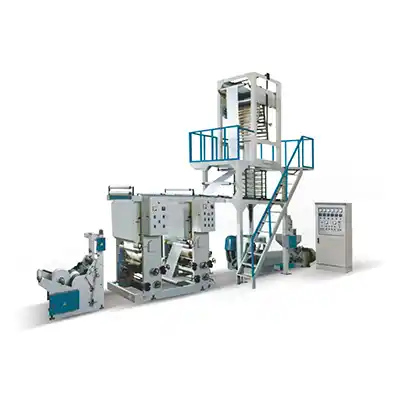
Single-lip air rings direct air at a single angle onto the bubble, which can be sufficient for low-output, narrow die applications. Dual-lip systems, however, introduce a secondary air stream that shapes the bubble more precisely. The lower lip provides initial high-volume cooling and stabilization, while the upper lip fine-tunes the final gauge. This dual control is particularly effective for high-stalk bubbles and materials like HDPE, where melt strength demands gentle handling. Operators who transition from a single-lip to a properly adjusted dual-lip often see gauge bands—those rhythmic thick-and-thin spots—diminish significantly within the first few production runs.
How Aerodynamics Translate into Gauge Uniformity
Film thickness is a direct reflection of the air flow’s uniformity around the bubble’s circumference. Even minor turbulence, dirt buildup on the air ring lips, or asymmetrical chamber pressures will leave a fingerprint on the film. For instance, a partially clogged air ring outlet might cause a localized thin spot because that area of the bubble is being quenched too quickly and drawn down more than its surroundings.
The ideal air ring creates a laminar flow that hits the bubble at a consistent angle—typically between 45° and 60° relative to the vertical axis—along the entire 360° perimeter. To maintain this, processors should routinely verify that the air ring is perfectly centered on the die. According to guidelines aligned with ASTM D6988-21, the standard guide for thickness determination, a concentricity check using feeler gauges is a fundamental yet often overlooked maintenance task. Upgrading to a high-precision air ring with advanced film cooling systems can resolve many of these root-cause issues by ensuring better factory-aligned concentricity and chamber balance.
Balancing Cooling Rate and Production Speed
A common misconception is that more cooling always means better gauge. In reality, overcooling the bubble too aggressively at the air ring can freeze in surface imperfections and increase haze, especially for clarity-sensitive films. The objective is to extract heat as quickly as possible while still allowing the bubble to stretch uniformly. This is where the air ring’s lip geometry and gap settings become a tactical decision.
For processors who need to push output without sacrificing quality, a modular approach often yields the best results. Many lines can benefit from modular cooling upgrades for blown film that adapt the air flow profile to specific resin characteristics. For example, running metallocene LLDPE requires a more stable bubble with lower-velocity cooling to avoid bubble flutter, a challenge that a purpose-configured air ring handles smoothly.
Internal Bubble Cooling: The Next Level of Control
For higher throughput applications, internal bubble cooling (IBC) works in tandem with the external air ring. While the external ring stabilizes and cools the outside surface, an IBC system circulates chilled air inside the bubble. The synergy between these two systems allows for frost line heights that are both lower and exceptionally stable, directly narrowing the gauge distribution. One study published in the Journal of Plastic Film & Sheeting demonstrated that integrating IBC with an optimized dual-lip air ring reduced gauge variation by up to 40% compared to external cooling alone.
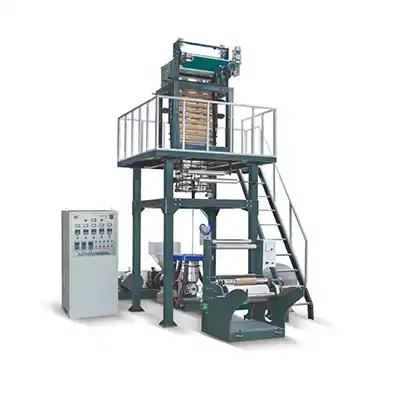
However, IBC control adds complexity. The internal air pressure must be dynamically balanced with the external air ring’s velocity to maintain bubble diameter. When evaluating a complete blown film line, operators should consider whether the supplier offers integrated control panels that synchronize both cooling loops. This reduces the risk of gauge errors introduced by manual adjustments.
Where Equipment Design Shapes the Outcome
We have worked with numerous processors who initially attributed their thickness issues to inconsistent resin blends, only to discover that the air ring chamber design was creating micro-pressure differentials. One processor, after switching to a line that featured a CFD-optimized air ring assembly, reported a 12% reduction in resin consumption per ton of finished film—simply due to tighter gauge control allowing them to target the lower end of the spec window. These real-world gains highlight why the air ring deserves as much engineering attention as the screw or the die.
This is where Yongbang’s approach to blown film extrusion technology makes a practical difference. Yongbang builds complete extrusion systems where the air ring is not an aftermarket accessory, but a core component engineered to work seamlessly with the die geometry and downstream tower configuration. Their design philosophy emphasizes uniform airflow distribution through polished internal channels and fine-pitch adjustment rings that hold settings run after run. For operations seeking to eliminate the last 5% of gauge variation, explore Yongbang’s extrusion solutions to understand how an integrated system can change your quality baseline.
Beyond the hardware itself, the support around equipment selection matters. A mis-specified air ring can hamper even the most advanced line. That is why engaging in a detailed application review often uncovers gains that a simple part swap cannot achieve. If you are reviewing your current operation and want a data-driven perspective, request a technical consultation to walk through your specific film structure, output goals, and gauge requirements.
Getting the air ring right is one of the highest-return adjustments you can make on a film blowing machine. It directly reduces raw material cost per roll, improves converting efficiency for your customers, and extends the life of downstream rollers by eliminating gauge bands that cause uneven wear. A well-designed air ring paired with a stable die and properly tuned IBC system transforms the blown film process from a craft into a repeatable, lean manufacturing operation.
Disclaimer: This article provides general guidance on air ring technology. Always refer to your equipment manufacturer’s documentation and process-specific safety guidelines when making adjustments. Performance outcomes may vary based on resin, ambient conditions, and line configuration.
 Brochure Download
 FAQ
FAQ