EN
EN Español
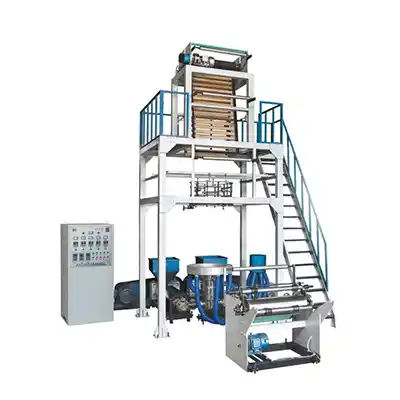
What you really need is this answer: Forget about memorizing all the specifications and parameters.These are the machine’s heart, lungs, and nervous system. Think of it like buying a truck – you need to know the engine power, load capacity, and fuel efficiency, not just the number of cup holders. For a film blowing line, the critical specs revolve around the extruder, die, cooling system, and haul-off. Getting these right with a partner like YongBang means you’re not just buying hardware; you’re investing in a predictable, profitable stream of plastic film.

The Extruder is More Than Just a Screw
Everyone talks about screw diameter. “We have a 90mm blown film extruder!” It sounds impressive, but it’s a bit like shouting “I have a 5-liter engine!” without mentioning if it’s in a sports car or a tractor. The real story is in the details.
First, the L/D Ratio – the Length-to-Diameter ratio of the screw. A longer screw (like a 33:1 or 35:1 L/D) isn’t just for show. It provides more residence time, allowing for better melting, mixing, and homogenization of the polymer, especially when you’re working with recycled content or complex multi-layer structures. I recall visiting a plant struggling with gels and unmelted particles in their polyethylene film. They had a “powerful” extruder, but with a short 28:1 L/D. Upgrading to a YongBang line with a 34:1 barrel was the fix – the extra length acted like a longer, quieter cooking zone, smoothing everything out.
Then there’s drive power. It’s measured in kilowatts (kW) and must be matched to the screw. Under-power it, and the screw stalls under load, killing your output. Over-power it, and you’re wasting capital and electricity. A 90mm screw typically needs a robust 200-250kW DC or AC vector drive for serious, stable production. YongBang engineers don’t just pair numbers from a chart; they simulate the torque requirements based on your most challenging polymer resin recipe.
The die head is where the molten plastic forms the bubble
The die is where your molten plastic becomes a bubble. Its design is pure artistry backed by physics. Two specs are king here: die diameter and gap.
Die diameter (e.g., 400mm, 500mm) primarily dictates your maximum layflat width. A simple rule: Layflat Width = Bubble Circumference / 2, and Circumference = π x Die Diameter x BUR (Blow Up Ratio). So, a 400mm die running at a BUR of 2.5 can produce a bubble with a circumference of about 3.14 meters, giving a layflat of roughly 1570mm. If you need 2000mm layflat bags, you’ll need a larger die or push the BUR higher, which brings other challenges.
The die gap is the precision slit the plastic flows through. A narrower gap (like 1.2mm) increases backpressure, improving melt quality but requiring more motor power. A wider gap (2.0mm) is gentler, good for heat-sensitive materials. The key is uniformity. A die that’s been machined to micron-level precision, like those from YongBang, ensures the gap is consistent all the way around. I’ve seen films with +/- 15% thickness variation from a poor-quality die turn into a rock-solid +/- 3% with a properly engineered one. That’s not just better quality; that’s raw material savings hitting your bottom line directly.
Bubble Cooling and Stabilization System
This is where so many lines fail, and datasheets are painfully silent. You can have the best extruder and die, but if you can’t freeze the bubble shape consistently, you get junk. The cooling system is the unsung hero.
Look at the IBC (Internal Bubble Cooling) system. It’s not a checkbox feature; it’s a necessity for modern, high-output lines. IBC allows you to control the bubble from the inside, dramatically improving cooling efficiency and stability. A report from the European Plastics Converters Association noted that IBC systems can increase output by 20-30% for the same die size by pulling heat away faster. The spec to ask about? Airflow volume and control precision. A wimpy fan won’t cut it. YongBang systems use variable-frequency drives on high-volume fans, with real-time pressure sensors that auto-adjust to keep the bubble perfectly still.
Then, examine the external cooling ring. Is it a single-lip or dual-lip? Dual-lip rings create a more stable air curtain, pinning the bubble early and providing a second cooling zone. The material matters too—aluminum is standard, but copper cooling rings, which YongBang offers for high-clarity applications, have far superior thermal conductivity, pulling heat away from the film like a champ.
Traction and Winding Specifications to Prevent Failures
The haul-off unit and turret winder are where your beautiful bubble gets turned into a sellable roll. Here, specs about power and speed are useless without talking about control and synchronization.
Haul-off nip roll width must exceed your maximum layflat. But more critical is the drive system. Is it a simple AC motor or a servo-driven system? For high-precision films (like laminations or printing substrates), servo-driven haul-offs paired with digital draw ratio control are non-negotiable. They maintain absolute tension and speed consistency, which directly impacts film gauge variation. A study by the Chinese Plastics Processing Industry Association found that over 40% of gauge variation in the machine direction (MD) can be traced back to haul-off speed instability.
Winding is an art form. The key spec is turret capacity—the maximum roll diameter and weight it can handle. But the magic is in the winding programs (constant torque, taper tension, gap winding). A good YongBang winder doesn’t just make a roll; it makes a perfect, hard, non-telescoping roll ready for the printing press or bag machine. Nothing frustrates a customer more than a soft, uneven roll that jams their high-speed equipment on the first revolution.
YongBang's Philosophy of Customized Co-extrusion Film Production Lines
Anyone can sell you a standard machine. The real test comes when your needs aren’t standard. This is where a YongBang coextrusion film line shows its true colors. Let’s say you want to make a high-barrier film with 5 layers: Nylon/Regrind/Tie/EVOH/Tie/LLDPE. The specs now intertwine.
You need multiple extruders (likely a 70mm for the nylon, a 90mm for the LLDPE, etc.), each with the correct L/D and power for their specific polymer. You need a state-of-the-art coextrusion die with modular feedblock technology to layer those melts without intermingling. You need even more sophisticated IBC to handle the complex cooling needs of different materials. YongBang doesn’t just bolt these parts together. Their engineering team uses flow simulation software to model the entire melt path before a single part is machined, ensuring layer uniformity and preventing the expensive trial-and-error that plagues lesser projects. This isn’t just a machine; it’s a custom-built film production ecosystem.
Conclusion
Choosing an AB Blown Film Machine is ultimately about trust. Trust that the numbers on the page translate to performance on your floor. It’s about finding a partner who understands that you’re not buying kilowatts and millimeters—you’re buying reliability, quality, and a return on investment.
Don’t navigate the complex world of film blowing equipment specs alone. Let the engineers at YongBang turn your production goals into a tailored technical reality. Visit the YongBang Blown Film Line product page to see our range, or better yet, contact our technical team directly for a confidential consultation.
 Brochure Download
 FAQ
FAQ